Showing posts with label plays. Show all posts

Sunday, June 24, 2012

Six Sentence Sunday: Con-Eire

Thanks, Linda Parsons.
The blog has moved: this is the last post that will be here apart from a housekeeping kind of post tomorrow. Everything's been moved over to the website for your ease and comfort. We'll play over there from now on.

It's Six Sentence Sunday again: they're going to be wrapping things up come January. It's a lot of work to coordinate something that keeps growing in leaps and bounds. I'm grateful for the new readers it brought me.

This week I offer a few sentences from my play Con-Eire which gives a behind-the-scenes glimpse at the workings of a spec fic convention. Having helped with quite a few of them, I have seen the enormous effort that goes into running them and the often capricious behaviour of 'big names' who have forgotten the fact that the people who run these are not paid and work only for the love of the stories, art, programmes and films that they love.

We catch up with the various members of the Con Com after news that their guest of honour, Very Famous Writer, has threatened to pull out because he discovered that the artist GoH is Very Famous Artist, with whom he has "history" as they say. But the complications multiply: we had a staged reading of this at Trinoc*coN which was a hoot, if I do say so myself. It was helped mightily by a very game cast and a whole lot of giggles.

 
MAEVE
Well, everything’s very hush hush—which is to say, nobody is too sure—but Minor Writer claimed that Very Famous Artist may be delving into her past for the next romance.
CONNOR
I feel like we need a scorecard.
DECLAN
Artists have to be free!
CONNOR
They always say that, but none of them gets anything done unless somebody else is taking care of the bills.
DEIRDRE
ANYway—
MAEVE
Well, that’s all I know: Someone from the past...
If you think you might like it, you can pick it up as an ebook at Amazon:


Tuesday, April 03, 2012

Tuesday's Overlooked A/V: Beckett's Film

Beckett is funny: people seem to often overlook that fact. Productions of Waiting for Godot that get that fact tend to be much better than those with dour seriousness. You put his craggy mug up there and suddenly it's art with a capital Arrrr! Slapstick is a fundamental element of his work however, so no surprise that he worshipped Buster Keaton. Yes, Keaton by 1965 suffered the effects of his dissolution, but it suits the haggard bemusement of his character in this short film. Beckett himself referred to Film as "an interesting failure"; considering how many dull successes fill the theatres at present, that seems infinitely preferable.


Even newly anointed big-stuff-with-a-show-at-the-Tate-Mod Damien Hirst has done Beckett.

As always, check Sweet Freedom for the round up of other gems. If you watch this on t'Tube you'll see a bunch of other videos featuring both Beckett and Keaton; indulge yourself. Another great resource for arty indulgences, if you don't already know about it, is UbuWeb.

Monday, April 02, 2012

Flash Fiction Challenge: Zoo Story

Patti Abbott has challenged folks again on the topic of the zoo: here's mine with apologies to Edward Albee and William Shakespeare and Bruce Robinson as well. So there.
 
Zoo Story

"So, this is the place."

"This? Why?"

"I thought it would be dramatic."

"Dramatic? Why? Wolf howls make it dramatic?"

"Not exactly. That scene was filmed here."

"What scene?"

"From the movie, you know the one."

"No. You mean…no. Which one?"

"The funny one, with those two guys and the drinking and—it's very funny. You liked it."

"It's not coming to mind."

"But there's that scene where he quotes from Shakespeare."

"Who does?"

"Whatsisname…Grant."

"Cary Grant?"

"No, not Cary Grant. The other one."

"Hugh Grant?"

"No, whatsit—Richard! Richard A. Grant."

"Don't know him."

"You do! He was in that movie and in lots of other ones. Tall bloke, gaunt looking, theatrical. He was in the Spice Girls movie."

"What did he play?"

"I don't remember. Anyway that's not the point."

"What is the point?"

"He was giving that speech from Shakespeare, right here, by the wolves."

"What speech?"

"Oh, you know the one."

"Obviously I don't. 'Wherefore art thou, Romeo?'"

"No, not that one. The one with 'quintessence of dirt' in it. Oh, you know, it's a famous one. Macbeth maybe."

"No, not ringing any bells."

"About the nature of man…"

"All the world's a stage?"

"No, not that. Oh, you know it—I can't remember now. It was raining down and he was reciting it to the wolves."

"Why to the wolves?"

"Because they were there. His friend had gone."

"What was his friend's name? Maybe that will remind me."

"I can't remember his name. I'm not sure the friend ever gets named."

"In the whole movie? No one ever says, 'Hey whatsyername, answer that phone' or something like that?"

"No. I mean, I'm pretty sure. The film's from his point of view. They go see the uncle and he gives them the cottage and they go on holiday."

"Oh, yeah, I kind of remember that one."

"Anyway he has that speech—"

"He does? Or the other one?"

"The other one, all right. But he gives that speech at the end of the movie and his only audience is the wolves and it's very significant."

"Why?"

"Well, because he goes on to be a great actor and you can see it in that moment. It's the beginning of better things."

"Oh."

"So I thought it would be appropriate—"

"What's the speech again?"

"It's about man's place in the world, the sky above, the ground below and how grand it all is. Quintessence of dirt."

"What does that mean anyway?"

"Like the epitome of dirt, I guess."

"Wouldn't that be a bad thing though?"

"No, not really—I think you're missing the point. It's poetry like."

"But it must mean something. If you're the epitome of dirt, you're still dirt."

"But don't you see—I mean, it's Shakespeare. Poetry."

"Ironic, you mean?"

"Well, not necessarily ironic but poetic. What's the word? Metaphor."

"Metaphor? That's when you compare things?"

"Sort of."

"So, what? The wolves respond to metaphor? Oi, wolves! Metaphorse for me."

"You're thinking metamorphoses. That's changing."

"Evolving. What would wolves evolve into?"

"Don't change the subject."

"What was the subject? This stupid movie?"

"It's not the movie, it's the speech."

"What about it anyway? You can't even remember what Shakespeare it's from."

"The play isn't important."

"The play's the thing—isn't that Shakespeare too?"

"Probably. But what I was saying—"

"Every famous quote comes from Shakespeare, doesn't it? Why is that?"

"I don't know. But the speech—"

"All the world's a stage, the play's the thing, the face that launched a thousand ships…"

"Yeah, but what I wanted to say—"

"Are they all from Hamlet? No some must be from comedies. Wait, Hamlet—that's the one. It comes from there."

"What does?"

"Your speech."

"Right, that's it. I'm sure it is. And the reason I—"

"Lots of good ones come from that play—isn't it bad luck to say the name? 'Bare bodkin': we always had a giggle at that one in school."

"Look, I wanted to say—"

"And there's a joke about privates, too. Miss, we'd say, could you read that part again, we didn't understand it. Hilarious!"

"Never mind that. I was talking about—"

"Do you suppose writers do that on purpose? Put in jokes like that?"

"I don't know. I don't care."

"What was that?"

"What?"

"That little box you threw into the pen."

"Nothing."

"Look, that wolf is trying to eat it. What is it?"

"Nothing. Never mind. Let's go have a drink."

"You're funny today."

"Yeah. Maybe Shakespeare wrote me."

"Ha, that's funny. So what was that box?"

"Nothing. Nothing at all."

Friday, March 30, 2012

Friday's Forgotten Books: The Life of Christina of Markyate

I don't think there's much chance of overlap with this week's choice. The life of a twelfth century recluse: it doesn't scream popular appeal, I suppose. But it should! A fascinating story and an early biography of a woman in a time when few but kings and saints got their stories told (fortunately at least someone important considered Christina close enough to the latter). I have begun writing a play about Christina's life in hopes of making it known to a broader audience, but as with so many things, it has had to wait in the queue for a bit. I have actually been spending these months in Ireland completing long delayed projects and jettisoning ones that are no longer relevant to my path.

Of course my brain insists on constantly coming up with new ideas, so it's a rather hopeless cause. If I had all the time in the world, it still wouldn't be enough.

Christina is born in Huntingdon to noble Anglo-Saxon parents, Autti and Beatrix. The story is a dove flew over to Christina's mother from the monastery and nestled in her sleeve and stayed there a week while she was pregnant, demonstrating of course that the child was touched by the Holy Spirit. You'd think after such a clear sign, her parents would resign themselves to offering her to the church, but no.

They get her engaged to a rich young man despite her protests that she'd like to devote her life to quiet contemplation. While we tend to think of the church as a repressive organisation in the current age, for women in the Middle Ages it offered one of the few opportunities for independence and a little authority (assuming you weren't born to a royal family or likely to be married into one). So they married her against her will, but she refused to consummate the marriage. So the bishop tried to rape her to make her more compliant; in a hilarious scene, she's divinely assisted to resist him.

She ends up running away to live dressed as a man with a monk: talk about a modern gal! Eventually she's allowed to take up the life of a recluse as she wished, but there are always problems. Christina's peerless conduct evokes envy in others and she has to frequently chastise her superiors because those men would rather wheel and deal wealth than praise god. So it's a busy life, fighting off demons and receiving prognostications from the Holy Spirit -- and only a few recognised her for what she was:

Hence, some of them called her a dreamer, others a seducer of souls, others more moderately, just a worldly-wise business woman...others who could think nothing better to say spread the rumour that she was attracted to the abbot by earthly love.

It's a wonderful capsule of twelfth century life; it's a familiar tale of the difficulties of being an exceptional woman. The Talbot edition has a terrific introduction, but can be a bit pricey unless you find a used copy. There's a more inexpensive edition of her life available now:


Drop by Patti Abbott's blog for the round up of other FFBs.

Thursday, March 08, 2012

Women's Day, Con-Eire & BitchBuzz


Happy International Women's Day! A day to celebrate and a day to chastise because there's a long way to go yet and I'm getting more than a little impatient at fighting the same battles I have fought since childhood. There has been progress, I remind myself, but there's a long way to go until NO ONE gets dismissed or disrespected on account of gender. This is for all of us.

Of course, I celebrate the day in my usual way: a new publication. Well, not exactly new -- Con-Eire has been available in an expensive print edition which kind of missed the point of it being a fun and light-hearted thing. Now it's available for your Kindle or ebook reader for just $1.99.

Having just come back from a terrific con experience (which may have seemed anything but until it began), I had a lot of fun and chuckles while editing and updating this, including removing a couple of references to MySpace (!?) and some other tech innovations. Wow, so much has changed in just a few short years. But the over all issues remain the same for any event of this kind. I'm really proud that Lee Martindale (who also took a role in the premiere performance) gave me such a lovely blurb.

"From the bowels of back-of-house, from the deepest, darkest, most secret chambers of arcane ConComm knowledge, comes a screamingly funny glimpse into what’s behind the curtain at a science fiction convention. Fairy-dusted hilarity served with a side order of giggles."

It reminds me of the good old days of Trinoc*coN and there's a new dedication to Susan and Mildred (and Birdie and Ron) in it, with the hope that the next Three Mothers reunion won't be too far away. In the meantime, it's back to work including cleaning for the arrival of the Queen of Everything and Marko this weekend. Hurrah!


One of the things that simplified the process of making an ebook of Con-Eire was the wonderful new open source platform called Booktype. I was so delighted with it, I wrote about it in my column today for BitchBuzz.  I was really glad to find that:
 
"Booktype has been developed by the folks at Sourcefabric who have an ambition to foster independent journalism around the world by creating software to facilitate its development for print, digital and on air delivery."

Friday, October 14, 2011

Friday's Forgotten Books: Three Plays by Mae West

You think you know Mae West, don't you? The slightly risqué performer with the voluptuous curves: who asked Cary Grant to come up and see her, told Beulah to peel her a grape? What you may not know is how much she cleaned up her act for the movies. Three Plays includes Sex, The Drag and The Pleasure Man. West's plays are hilarious, full of street cant and scorching satires on the sexual and gender mores of her time. The first of the three landed her in jail for "corrupting the morals of youth" where she dined with the warden and his wife, and told reporters she only wore silk underwear. The press loved her and she got a lot of attention, but her next play which dealt frankly with homosexuality got tryouts in the provinces (Connecticut and New Jersey) but was kept off Broadway by the "Society for the Prevention of Vice" (an early morality group). Her next play The Pleasure Man, about the backstage shenanigans of vaudevillian Lothario featured an enormous cast of actors, acrobats, female impersonators and dancers -- all of whom were arrested on two of the three performances that took place. West and her cohorts were acquitted after the jury split their decision. One suspects it might have gone something like this wonderful scene from I'm No Angel:


See the full round up of overlooked books at Patti Abbott's blog.

Tuesday, August 30, 2011

Lumottu (Enchanted)

Tonight my play LUMOTTU will get a reading at the Arts Society of Kingston's Playwrights' Lab New Play Readings at 6:30 PM

ARTS SOCIETY OF KINGSTON

97 Broadway
Kingston NY 12401


Arja lives with one foot in this world and the other in the mythic world of ancient Finland. Her family has moved to the new world, but the old world’s magic clings to their lives — and deaths.


Yes, it is utter madness to schedule it now; it was originally scheduled for the end of May when I decided I was much too busy with teaching and getting ready to go to England to do a reading as well (as I have to be director/producer).

>_<

Well, you know; if my life weren't utter madness, how would I know it was my life? With luck I've got Kipper sorted, the flood waters have receded enough for me to get to the storage facility (yes, really) and I can enjoy the performance for what it is (a chance to hear what the play sounds like outside my head) without being consumed by anxiety and madness.

With further luck, news on an ebook version of Unikirja soon, too!

Come to Kingston, mon, if you can and if not, wish me luck or more boxes or a safe passage. Or just buy one of my books (and while you're at it, leave me a review! That's even more essential whether it's Amazon, B&N, Goodreads or Library Thing).


Thursday, August 25, 2011

Counting the Days

...until the packing is done. Then I remember how few days there are and gulp, because there's still so much to do.

On a more positive note: my play Lumottu ("Enchanted") from Unikirja gets a reading next Tuesday in Kingston at the Arts Society, 6:30 pm. If you can show up, do! It will be fun to hear what it sounds like outside my head. Finnish immigrants in the early 20th century find the magic of the old country follows them.


Yes, made my bed and I'm lying in it (although not much: keep waking up too early). Resisting the urge to set things on fire and run away. I don't know how, but it will get done. I can't wait to be in the pleasant green paradise of Galway with music all around me.

Wednesday, August 17, 2011

Mary of Nijmeghen

Mary -- or Mariken van Nieumeghen as it is in the original -- is a play that shows up in the early sixteenth century. My students read it this week and (among other things) we talked about how one might adapt it to a modern movie and came up with a really good plan. They're convinced I just use the class to brainstorm writing projects.

Who? Me?!

But they did enjoy learning a lot of new curses (eg. "profligate strumpet"). It's a Faustian tale -- although it predates the "original" Faust -- in which a young woman sells her soul to the devil in a moment of weakness and confusion. He doesn't tempt her with life everlasting, love or riches, but with learning.
The Devil: If you would give your love to me, I would teach you the arts as no one else could: the seven liberal arts, rhetoric, music, logic, grammar, geometry, arithmetic and alchemy [<--substitutes a false one here, it should be astronomy], all of which are most important arts. There is no woman upon earth so proficient in them as I shall make you.
The seven disciplines were the backbone of the original university as founded in the Middle Ages. I like to remind my female students that they would not have been welcome there. Fascinating that this is the temptation for her, though wealth and riches come eventually. She finally repents when she sees a play (how po-mo) but it's a delight to see the joy and frustration of the writer (believed to be Anna Bijns) come through in the scene in which drunken revelers demand a demonstration of Mary's rhetorical skill:
O rhetoric, o true and lovely art, I who have always esteemed thee above all, I lament with grief that there are those who hate you and despise you. This is a grief to those who love you. Fie upon those who count you merely folly. Fie upon them who do so, for I wholly despise them. But for those who support you, life is full of hurt and sorrow. Ignorant men are the destruction of art.

They say in the proverb that through art grows the heart, but I say that it is a lying fable, for should some great artist appear, those who are unskilled and know not the first thing about art will make their opinion prevail everywhere, and artists will be reduced to beggary. Always it is the flatterer who is preferred, and always artists suffer such harm, and ignorant men are the destruction of art.

Fie upon all crude, coarse common minds, trying to measure art by your standards: everyone should pay honour to pure art, art which is the ruler of many a pleasant land. Honour be to all who are the promoters of art, fie upon the ignorant who reject art, for this is why I proclaim the rule that ignorant men are the destruction of art.

Prince, I will devote myself to art, and do everything in my power to acquire it. But it is to all lovers of art a sorrow that ignorant men pay so little honour to art.

Clearly it will always be so, but it's comforting to know that despite the efforts of ignorant men, art continues to thrive even in the midst of our suffering. Translation by Eric Colledge in this excellent collection.


Friday, July 29, 2011

Friday's Forgotten Books: Between the Angels and the Apes

Not so much "forgotten" as -- what? Aborted? Headed off at the pass? The initial news was wonderful: Alan Moore writing an opera on John Dee with Gorillaz! What's not to love? It sounded like a match made in an alchemical lab somewhere with the potential of turning into gold. There was just one problem: Gorillaz couldn't be bothered to come up with some artwork for Moore's magazine Dodgem Logic despite having the issue held for them several times.

Really? Is it so hard to give a little quid pro quo? Apparently, so that was that.

Well, if you're Alan Moore, you just get on with the billion other projects you have going and publish what you have in Strange Attractor, and if you're Damon Albarn, you make your own opera on Dee anyway.

The lovely thing about Between the Angels and the Apes is how the notes reveal (once again) Moore's structural approach to composition. Consider the opening section of the outline:

If we're to create an approximately ninety-minute piece on the subject of Greatest Dead Englishman John Dee, then a solid and conventional place to start structurally would be a classic three-act construction with sections of a half-hour each. This also seems to fit nicely with the triangular Greek delta symbol (which is how Dee identifies himself in the facsimile notes presented in A True and Faithful Relation of What Passed for Many Yeers between Dr John Dee and Some Spirits [Meric Casaubon, 1659] and is also the elemental symbol for fire, which is in turn the element that represents the highest spiritual component of the magician or, indeed, the ordinary human being).

Moore further breaks down each section into subsections with flashbacks and the opening and closing scene of the dying Dee in Mortlake with his daughter. It almost seems as if Moore comes up with the idea of breaking the fourth wall as he writes, suggesting that the magician can sense the audience as "spirits of futurity" watching him from the time to come. His take on Queen Elizabeth is that she's a kind of Faerie Queen and he suspects "that Dee's devotion to Elizabeth was at least partly erotically inspired" so imagines her  as more "otherworldly and erotic" than traditionally envisioned. It's a fascinating look at a show that will doubtless never be. Yes, it includes some of the text as well as the notes for the piece, although it remains unfinished.

You can buy this issue of the journal, which also includes Moore Bumper Book of Magic collaborator Steve Moore, no relation, but subject of his performance piece, Unearthing.

Find this week's round up of Forgotten Books over at Sweet Freedom, next week back at Patti's.

Last week's FFB included Todd's write up of our comic Jane Quiet for which he's given me and Elena the best pull quote ever:

Laity might be the literary child of Angela Carter and Peter Cook and Italo Calvino, and Steier the artistic child of Trina Robbins and Gahan Wilson and Jules Feiffer, and not a little dash of Joan Aiken.

Yes, I plan to employ that one.

Wednesday, July 20, 2011

NT Live: The Cherry Orchard

"Who cares about Chekhov anyway? A bunch of old women moaning about ducks flying home to Moscow."

 ~ Withnail [Richard E. Grant] in Withnail & I

I am always grateful to the Spectrum 8 for hosting the NT Live performances; I'm also grateful that enough people in the Capital region attend them to make it lucrative. Keep up the good work! I need the lifeline.

After sneaking off for a matinee of Harry Potter in the afternoon (bad girl! should have been working -- yes, it was fun), I headed back to the theater for the evening's broadcast. Strange to realise that this was in the Olivier Theatre: I was expecting the Lyttelton, where the production of The White Guard had been. Chekhov's been getting a lot more attention lately, so perhaps this is to be expected. The sets by Bunny Christie were as evocative as those for The White Guard and there was a brief behind-the-scenes featurette where she spoke about the design.

There was a fabulous cast (of course) headed by Zoë Wannamaker as Ranyevskaya, Charity Wakefield and Claudie Blakely as her daughters -- each coping with the dissolution of their familiar lives in different ways -- Conleth Hill as the merchant Lopakhin, who probably makes the most changes within the course of the drama and Mark Bonnar as the nascent revolutionary, Trofimov (who's name I cannot hear without thinking of Monty Python).

Everyone was terrific: Tim McMullan and Gerald Kyd provided a light touch of comic relief to break up the wistful sadness of Ranyevskaya and her family. The timing was perfect. The costuming, too, was exquisite --

-- and yet I'm just not won over to Chekhov. Maybe I'm just a Philistine or part of that audience "weaned on cinematic jump-cuts who like their irony on a plate." Or I just don't like Chekhov. I have tried before and still I'm more fond of the Gumby version than any other. At least it's brief. I can understand the impact of Chekhov's realism -- and landy, we've had a huge trend in that direction ever since -- but while I can see how it would be wonderful to act in his plays, I don't much enjoy watching them. I do like dark humour, but maybe just of a different kind (Finnish, not Russian). Or maybe I just need the right production. This one was superbly skillful, so I'm not sure what it would take.

Sunday, June 12, 2011

Running to Catch Up

That's a misleading title as I plan for this to be a very lazy Sunday. I may wander out to a museum this afternoon and get myself a Sunday roast dinner, but that's about as far as my ambitions run at present. I often have the thought of how little time I have in London this trip nipping at my thoughts, but that only makes it more grand to luxuriate in idleness. I have been busy nonetheless and it will take a while for me to get caught up on writing about all my adventures. Among  things done:

I got a poem published (yes, me!). Some print copies of Chronogram should have arrived by the time I return, but you can read "Lullaby" online (albeit in a rather unexpectedly awkward layout).

I played a theremin!

I visited the wax head of Jeremy Bentham!

I saw a giant fox!

I've been to plays, museums and galleries!

Pubs!

Hanging out with friends and laughing -- and a whole lot more. I love this city, and the truth about London is that you never know what might lie around any corner. Such as naked people on bikes...

Tuesday, May 31, 2011

Utter Madness

What was I thinking? That I could somehow manage to do all the last minute things I need to do before getting on that airplane tomorrow and go down to Kingston for a reading of my play Lumottu?

HA HA HA HA HA HA!

So, yes, the play reading has been re-scheduled for August 30th. Yes, right before I head off to Ireland, but things will have to be sorted long before that. Um, I hope.

I must be mad; yes, it's the only explanation. I am up early to pack, finish things that need to be done, run errands and then actually teach today, too! My mantra continues to be, "Somehow it will all get done, somehow..."

Not sure exactly how that will happen, but things are bound to get done if you stare at them long enough, right? What? It takes more than staring? I'm doing this all wrong then. Thank goodness I have help: thank you, Catherine, and thank you, Peg! I think there was something else I meant to mention in this post, but for the life of me I can't recall what.

Sunday, May 15, 2011

Con-Eire: Now Available as an Ebook

Con-Eire: a comedy for voices

Download: $1.83

"RADIO PLAY" SCRIPT is ideal for live performances at cons!

It’s three days before the start of CON-EIRE, the best Irish-themed science fiction and fantasy con in the tri-state area, when a phone call sets the entire Convention Committee into panic mode. Is Big Name Writer going to pull out at the last minute? What does Very Famous Artist have to do with that decision? And what do the Fairies have to say about all this? Follow the hilarious mishaps as the committee members work desperately to salvage months of planning and hard work, all of which are about to be undone by a well-known prima donna.

You can also "like" the page to share with friends on Facebook or pass it along on Twitter, Reddit, Digg or even (gasp!) MySpace. It's great for reading impromptu at cons: we had so much fun doing it at Trinoc*coN! Yes, just another plank in my plan for World Domination.

Tuesday, April 19, 2011

Converting Monks with Slides in San Antonio

I was hoping to have time to write up the NT Live Frankensteins I saw for Tuesday's Overlooked A/V but I'm still working on my presentation for PCA, so it's unlikely to happen. I did upload a version of my speech with the Powerpoint slides embedded (very hastily, so it's a bit clunky) so they will make a little more sense in context.

Converting Monks Into Friars With Slides

Wednesday, April 13, 2011

Euro Punks Exhibit

Wednesday already?! Eek! Madness -- this entire week has been, will be, is. Yesterday after the Glass Ceiling talk organized by the Women's Initiative, I jumped in the car and headed down to Kingston for a reading of a new play at the Arts Society of Kingston. The play was on the life of Margaret Fuller and has a lot of potential: the audience offered a lot of good feedback. I hope I'll get a lot of the same on my play.

Two panic moments after the play: first, being horrified to find that my car was missing, afraid it had been towed. No, I had simply walked two blocks past where it was. Can we say distracted? Driving to Bertie's for dinner I had an owl fly right over my hood on the backroads, which initially made me gasp in alarm and then think, "wow, how cool was that?" Great dinner (of course) and then back home again (after midnight).

Finishing the slides for the talk; tomorrow is polishing both. Out with friends Thursday night, on my way to Iowa Friday. Phew! And then next week is PCA. I can relax for a day on the 25th. >_< At last, here's the photos from the Euro Punks Exhibit at the Villa Medici in Rome. A lot of them are awful, but I was snapping away hastily, having fun. At least you get a flavour of the exhibit. If you want to see better pictures, take a look at the catalogue. I know a certain punk rock DJ who might let you take a look at his copy...

Tuesday, April 12, 2011

April Fools Broad Pod

Okay, well not so much April fools as April fun! The April Broad Pod is up -- that's the podcast from Broad Universe, the organization that supports women in speculative fiction and has a wealth of fabulous people including me! Go on, give it a listen.


Today I'm participating in a talk on "The Glass Ceiling" on campus, put together by the young go-getters of the Women's Initiative. Then I'm running down to Kingston for another play reading at the Arts Society of Kingston. It will give me a chance to chat more with the folks there about my own reading of Lumottu, which will be on May 31st (save the date!).

It's Tuesday, so don't forget to check out this week's Overlooked A/V over at Todd's blog.

Rush, rush, rush! The theme of the week. Here's my first word cloud for the talk: still tweaking to do.

Wednesday, March 30, 2011

Reading: Lumottu

I am very pleased to announce that my play Lumottu will receive a fully cast reading at the Arts Society of Kingston on May 31st. Casting will commence soon. As they make clear on the website, "These are workshops rather than productions, whose focus is on process, not product. It is the hope of the Lab that playwrights will listen to all feedback without defending or explaining their work, then sift through the feedback at their leisure. In the end, only the playwright can decide what feedback to use or lose."

The name of the play is the Finnish word for "enchanted" and it explores the power of myth for people in difficult situations. Here's the description they're using for mailings:

Arja lives with one foot in this world and the other in the mythic world of ancient Finland. Her family has moved to the new world, but the old world’s magic clings to their lives — and deaths.

Sound intriguing? I hope so. This play first jumped from my head Athena-like when I was on the boat in Lake Saimaa heading out to see the ancient rock paintings. I saw it as a performance: a woman dressed as Louhi with her eagle wings behind a girl who was telling the story. It's wonderful to have this one step closer to realising that image.


Much unexpected fun last night: John Crowley was reading at the UAlbany Art Museum. Who knew? Thanks, Christopher for mentioning it in time for me to get there. And we all went out to The Point afterward which was delightful as always. In addition to the super-duper volume of Little Big, he and his wife worked on a new Helen Keller documentary that will be part of American Masters this fall.

Monday, February 07, 2011

Review: Magus

Carey Harrison's play Magus offers a melange of people and times, jumping back and forth between the early twentieth century and the late sixteenth. Kafka, Shakespeare and Cervantes all meet in a vision conjured by the madness of Kafka's sister Ottla, overseen by the multi-skilled consultant to Queen Elizabeth, John Dee, who invites the audience into the vision. Dee's quest for life eternal seems to have been answered as he speaks to the audience in the present time before stepping back to the sixteenth century, then moving forward to appear as Sigmund Freud for Kafka. I love the idea of Dee having lived on and taken up new personas like Freud, but Harrison didn't really develop that angle and I think it's a missed opportunity. Harrison's magus is kindly and warm-hearted but yearning for that eternal life -- seemingly only for himself, though. His wife is barely in his thoughts (or the play, a shame for the lovely Naomi Hard), though there is an allusion to the wife-swapping alleged between Dee and his partner Edward Kelley (played with nervous malevolence by Phillip Levine). Kelley's only interest is gold and he has a bottomless and urgent hunger for it that makes him willing to countenance tricking his partner and plotting the murder of that troublesome young Shakespeare.

The invention of this meeting between Shakespeare (Rudi Azank) and Cervantes (Richard Bennett) had all kinds of potential for explosion, but nothing much happened with it. You set the bar high when you include historical figures of such talent. Surely even as a callow youth Shakespeare had wit and insight, but in the play he's just a kind of laddish troublemaker, though Azank made sure he was charming. Bennett had even less to do with Cervantes.

George Konrad's Kafka centered around a heartfelt sorrow for his sister's madness. Although Ottla's vision formed the play, her role was peripheral. Nonetheless Brittany Sokolowski managed to infuse a fragile quality to her performance that made her brother's obsessive worry understandable. But again, Kafka wasn't especially Kafka-like despite his transformation scene. The sudden injection of realism through Ottla's trip to the deathcamp Auschwitz gave me the feeling that everything including the kitchen sink was being thrown in.

I don't want to sound too negative: after all I'd take a play with ambitions that don't quite work over a less ambitious play any day of the week. Harrison himself offered a warm and engaging Dee. The care that went into the production was obvious. The costuming was quite good and the sets simple but effective (loved the satyr!). David Temple's beautiful classical guitar music offered both dramatic ambiance and reverie.   

This was my first visit to the Center for Performing Arts at Rhinebeck; it's a interesting space and I'm glad they're willing to branch out from the usual repertory staples to do an unusual and ambitious project like this play. Well done!

Friday, November 26, 2010

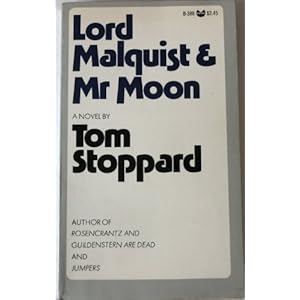
Friday's Forgotten Books: Lord Malquist & Mr Moon

Although a bit late in the day (just got home this afternoon and had to spend some time soothing Kipper's complaints about being abandoned for a whole day and a half), I wanted to try to get back in the habit of writing up a "forgotten" book for Patti's round-up of titles.

"Let it be said of me that I was born appalled, lived disaffected, and died in the height of fashion."

Lord Malquist and Mr Moon is (to date) Tom Stoppard's only novel. Of course he's one of the most celebrated playwrights in the world, but this novel seems to often be forgotten in discussions of his work. Not quite out of print (there's a trade paperback edition from Grove that came out about five years ago), it's seems to have a very low profile. The novel came out in 1966 just before Rosencrantz & Guildenstern are Dead and Stoppard's first real success, although he had been writing short dramatic works for both stage and radio (the collection of his radio plays appears to actually be out of print and is also a wonderful book to pick up). 

In this novel, the Czech-born British knight (by way of Singapore and India) indulges in some of the same obsessions that fill his plays -- peculiarities of class and station, misunderstandings, confusions, sexual entanglements, surreal slapstick humor and an actual ticking bomb. It's by turns hilarious and insightful and always brilliantly timed. So I'm just going to give a few random quotes to give you the flavor of the story that mixes up the would-be Boswell Mr Moon and the haughty noble (as well as his wife, a cowboy, a lion and more):

"I find crowds extraordinarily lacking," said the ninth earl. "Taken as a whole they have no sense of form or colour. I long to impose some aesthetic discipline on them, rearrange them into art. It would give a point to their existence."

It was all a question of preparing one's material. There was no point in beginning to write before one's material had been prepared. Moon, who had experimented on a number of variations of a first sentence, felt this quite strongly. He found that the vastness of his chosen field reassuring rather than daunting but it did cramp his style; he could not put down a word without suspecting that it might be the wrong one and that if he held back for another day the intermediate experience would provide the right one. There was no end to that, and Moon fearfully glimpsed himself as a pure writer who after a lifetime of absolutely no output whatever, would prepare on his deathbed the single sentence that was the distillation of everything he had saved up, and die before he was able to utter it.

"I got dizzy," he explained.
"I should think you did -- what were you doing?"
"Nothing," said Moon. "I was trying to face one way or the other and I got confused and fell over."
Let that be my epitaph.

For Style is an aesthetic, inbred and disengaged, and in such precarious times these are virtues. We all have an enormous capacity for inflicting harm, and hereto the only moral issue has been the choice of the most deserving recipient..."

"You see, he understood that substance is ephemeral, but style is eternal."

"Be poetic, dear boy, be poetic and take your text from d'Aurevilley -- La verité m'ennuie."

"Idealism is the thin edge of madness -- console yourself, dear boy, with the thought that if life is the pursuit of perfection then imperfection is the nature of life."

As in his plays, Stoppard enjoys creating characters whose opinions oppose diametrically and then setting them at each other. The hapless Moon manages to be both pathetic and hopeful, the imperious earl both infuriating and amusing. Sex has its allure but always seems just out of reach. The randomness of life (as deliberately arranged by the writer) creates mad moments of black humor. I'd love to see Stoppard write another novel, but he seems happy with plays (not that I mind). Nonetheless, it would be fun.