Showing posts with label reviews. Show all posts

Saturday, June 16, 2012

Review: Dotter of her Father's Eyes

I've talked about this book so much, I assumed I had already reviewed it somewhere, but no. Bloomsday seems the right day to do so at last. I considered spending Bloomsday in Dublin -- being in Ireland after all -- but when I thought about the six hours I'd have to spend traveling back and forth, I thought Galway's the perfect place to spend the day writing. I will go on my own wander about town later.

Mary and Bryan Talbot's Dotter of her Father's Eyes offers the very finest graphic storytelling: a compelling and complex narrative that relies on the magic interplay of words and pictures. It's a book full of visual delights: the design shows such attention to detail, from the end papers to the three intertwining narratives rendered in different but complementary styles. If you've read other works by Bryan, that's precisely what you've come to expect.

I was going to say I hadn't been familiar with Mary's writing before this, but of course it turns out I had, as she's written quite a lot on gender, language and consumer culture. I just hadn't connected the Talbot names! This is Mary's story of her childhood, of remembering her childhood and how she's sees it through the prism of Lucia Joyce's life because her father, James Atherton, was a prominent Joycean.

Lucia's life is a heartbreaking one; there are parallels between their lives -- headstrong daughters butting heads with their famous (and equally willful) fathers. But the contrasts are perhaps more important and show why Talbot achieves success and happiness while Lucia ends so tragically. Part of the difference is time: women's lives have improved despite the continuing madness of retrograde morons. Part too is due to finding a true partner: the book itself shows the beauty of that relationship, but the story brings it to life. Ultimately, the power of creation -- and the horrifying effects of having that human need crushed -- offers the most powerful beacon.

Exquisite art: there's such beauty here, but the most harrowing images seared my brain: Robin's birth and Lucia's "dance" in the sanatorium. It's an incredibly moving story with a lot of sorrow, but ultimately reaffirming. You'll treasure it.

Buy it by clicking the picture below. Visit Mary's site and Bryan's too.


Friday, May 25, 2012

Friday's Forgotten Books: Lyrics and A Hard Road to Nowhere


A bit of a cheat: a music two-fer. One is old, but the other's new; nonetheless, given the difficulty of finding your audience in the ocean of new publications out there, it deserves a boost to the signal.

The Fall: Lyrics by Mark E. Smith

The lynchpin of my current writing career: what, you think I exaggerate? With stories like "It's a Curse" and "Bill is Dead" and "Mandrake Anthrax" and "Grotesque" and "Just Waiting"? I do occasionally have stories not inspired by Smith's lyrics but they're getting to be in the minority. The Fall's lyrics are like Zen koans mashed up with the ramblings of a mad meth drinker with overstuffed carrier bags.

My garden is made of stone
There's a computer centre over the road
I saw a monster on the roof
Its colours glowed on the roof

All the songs in this collection will forever be coloured by reading the German translations out loud on the tube going back from Kentish Town to Stockwell while giggling madly after that first hypnotic show. Magic.

John Hodgson's A Hard Road to Nowhere: The Blitzkrieg Bop Story captures that story from the other side of the equation; the intoxicating, maddening, frustrating and elating process of forging music in the fluctuating organism that is a band -- or rather a series of bands that finally create a centre of gravity that becomes Blitzkrieg Bop. Obviously blown away by The Ramones at a crucial age, Hodgson and his fellow bandmates find a wellspring of inspiration as the first eruptions of punk arrive in the remote northeast of England. The third person narrative occasionally feels a bit awkward but it provides a way to highlight the pages ripped from Hodgson's journals of the period, which capture the youthful highs and lows with vivid authenticity.

Cheap as chips: get it now -- and be sure to bookmark Hodgson's Soundcloud page for the music to accompany it. A wide variety of songs, old and new and updated. Good stuff.

See also my review of Val McDermid's The Distant Echo over at A Knife & A Quill.

Not sure if the FFB will be at Patti's or at Todd's -- check both, they're bound to be worth it.

Thursday, May 24, 2012

Crime Pop and Burning Bridges

I've got a piece over on A Knife & A Quill on pop music with crime (no, not criminally bad pop music, although I do make mention of The Buoys' "Timothy" alas):

I was listening to Skydaddies’ “Murder in the Park”, a fine Beatlesesque — no, really more Rutlesesque! Not because it’s a parody, but because it knows how it’s being Beatlesesque, if you know what I mean — tune about a girl who takes pictures of a murder in a park and it struck me that there’s a good amount of crime music in unexpected places. Not in rap songs about poppin’ caps in someone’s arse or thrash metal about KILLING! but in more unusual places...

And do listen to Skydaddies (kind of a preview of tomorrow's book as well):

SKYDADDIES - Murder In The Park (2012 edit)

I had a guest post over at Fiona's: she's asked the Burning Bridges folks to suggest what they'd like to set fire to -- sort of an impromptu Room 101. Drop by and suggest more things to burn because
I am the god of hellfire and I bring you:


Monday, May 21, 2012

Postcards, Bridges, a Knife and a Quill

I model the latest SL Johnson design with lighting by Garbo
I have got so far as narrowing down the entries in the First Annual Postcard Fiction Contest to a pool of final contenders (yes, Ale! Your card arrived). Agonizing to make the final choice! I may need a glass of wine for this. Alas, I have none. I suppose that could be remedied, but I have so much to do today.

I will force myself to make a choice by Wednesday and keep rereading them in the meantime. A huge thank you to everyone who entered. I may indeed make this an annual event. It was about this time last year that I got the call saying I was going to Ireland. It has to have been the fastest year on record, whew.

Not that it felt like it when I was packing and clearing out my old flat. The horror, the horror. But wherever I may be, I will stop around this time and think of the adventure about to unfold and feel very happy:
“If it could only be like this always – always summer, always alone, the fruit always ripe and Aloysius in a good temper...”
― Evelyn Waugh, Brideshead Revisited 
 No time to spare for wistful thoughts: much too busy! One of the latest projects: a book trailer for Burning Bridges: A Renegade Anthology. Yes, if you're reading this you likely already know the story -- and that you have no excuse for not getting it! Free on Smashwords, 99¢ on Amazon and all that going to literacy. Don't make me come over there! No, really -- because I'm staying over here. The trailer tells the story of the assembly of our renegade band. Check it out and give it a like and get the book already!


One more important bit of news: I'm writing reviews over at A Knife and A Quill, a site for dark fiction, as you might guess from the name. Lots of horror and crime fiction covered over there. So if you have an interest, drop by and read some reviews, interviews and features. If you're an author think about submitting something for review by the team. Yes, this is in addition to writing for The Girl's Guide to Surviving the Apocalypse and the occasional piece for Un:Bound. Why do you think I'm so busy? My quill is always scratching away.

Writers, who can resist a quill? I remember comparing quill tattoos with Sarah Pinborough at P-Con. Writing: it's in the blood, it's in the flesh.

Thursday, May 03, 2012

Reviews: Guerilla Blues & Beowulf

Guerrilla Blues
Alessandra Bava


People tend to think writers give their friends good reviews because they're pals; the truth is you become friends with people who write stories or poems that inspire you to be better, to do more, to aim for dizzying heights. My jester -- the poet of Rome -- Alessandra's new collection offers wonderful evidence of that. Inspired by poets and revolutionaries the poems converse with everyone from Che Guevara and Simone Weil to Artaud, the Beats, Akhmatova and Pasolini. All are people who burned with inspiration and a revolutionary zeal.

That's the fire that burns through these verses. This dual language edition shows how Bava shines with incendiary passion in both Italian and English. Setting aside the incredible skill that speaks to (composing poetry in one's childhood tongue proves challenging enough, but to practise the art in another tongue --) the inherent desire to find as wide an audience as possible. In Bava's hand poetry is not a detached art of the drawing room, but a call to the barriers and a shout in the streets.

Burn writing to the stake &
immolate yourself in the form of
Poetry. Then, like Phoenixes,
rise in the form of Action.
Every line forms a potential molotov, from the titular poem's description of "Tattered books / of flesh as bomb / shrapnel / bleeding truth" and the ringing lines of "Sons of Disobedience" with its lines of fury, flesh and teeth. "This is No Chimera" speaks to the forces of acquiescence and conformity that press upon us all, maintaining that "The only requirement / is to believe in / hazardous deeds" lest we turn into Gregor Samsa-like bugs as "Wake Up!" warns, too.

It's all part of her "Rules of Poetry" (which also gives the name to her blog) which include "be fearless" as well as "demand respect" but most of all "kill indifference" because in the end

demand attention:
the poet is You.

Beowulf
adapted by Joshua Gray
illustrated by Sean Yates

As a medievalist, I always despair of people's dismissal of the time especially early works like this epic poem. Most people -- if they're exposed to it at all -- get it in school, taught very badly by someone who likewise knows nothing about the poem and its context. I wish I had a dime for every student who expressed surprise at the poem being nothing like they encountered in high school (hmmm, maybe I do...). So I'm always pleased to see attempts to introduce readers to the poem in new ways. Gray and Yates' volume attempts to bring the old story to new, young readers with bold illustrations and a simplified story.

The illustrations capture a dark mood of adventure; they're sufficiently gruesome though only suggestively so -- safe for parents, inviting for younger readers. Gray's text reduces the story to a speedy series of adventures in the conquering of the three monsters with efficiency and some flair. Hrothgar's "sermon" gets boiled down to its essentials: don't let pride rule, when you're king you're responsible for more than just your fame. The publicity materials refer to this as a "verse adaptation" but it reads like prose, but the language is lively enough to be engaging.

There are some contextual errors that made me give very Biggs-ian head snaps: wet suit?! Surely even a child completely ignorant of the time period would know that a wet suit is a very modern invention. A sword does not go into a "holster" and Heorot is not a "castle" in any way. None of these anomalies are quite as egregious as the mistakes in Cigale's introduction conflating time periods, clearly unfamiliar with the difference between a scop and a bard, and missing the cadence of half-lines. But he highlights one lynchpin of this adaptation: the eternal bond between fathers and sons and "all men", which is apparently the aim of all storytelling.

Because there are, of course, no women in this telling of the story (monsters excepting).

I feel like banging my head against the wall again. Why is it the 11th century monks who wrote this story down in England can have more regard for the importance of women than 21st century (seemingly) secular men? It's not as insulting as the Zemeckis film, where women are reduced to powerless concubines, but I'm mystified by this need to completely remove women from the story in order to glorify men. Is that really the message to give your sons? That they somehow exist outside the world of women and girls? I hope not.


Wednesday, April 18, 2012

Writer Wednesday: Reviews

PLAGUE TOWN
DANA FREDSTI

Ashley Parker makes a winning heroine: she's a bit older than her fellow students and while she's got the classic California co-ed looks, it's her intelligence and integrity that you'll remember. Fredsti's writing is always full of good humour and arch observations, but it's also chock full of action and really gruesome horror. The alternation in narrative between zombie hunters and zombie sufferers gives a chance to recognise the human price of the plague, something that doesn't come across in a lot of more depersonalised tales. At times the in-jokes come a little heavy, but the story cracks right along with both intense and grisly action, but also complicated interactions between characters you will root for. Looking forward to the sequels!

THE LANGUAGE OF DYING
SARAH PINBOROUGH

In this intense novella we see an already damaged family dealing with the impending death of their father. Our narrator is the beleaguered middle child and daddy's girl, who seems to be the rock holding everything together -- until the cracks in her façade begin to show. Interactions with her siblings bring out the comfort of that shared experience, but also the strains of their lives together. As her father's life ebbs, she drifts into remembering the very worst times in her life and a memory of something that may or may not have happened -- and something that waits outside the house. In his introduction, Graham Joyce calls it 'fractured realism' and it fits. A strong exploration of the dark spectre we must all find a way to deal with sooner or later.

SNAPSHOTS
PAUL D. BRAZILL

As indicated on the tin, twenty-one short sharp tales of crime, despair and bizarrely comic misadventures. Not so much the world of the rich and famous as of the spent and fumbling, observed through a bleary eye of cynicism gilded with a mordant sense of humour that will have you laughing even as you wince. If there's a fault here, it's that they read too quickly. It would be a treat to see Brazill tackle something lengthier.

[Apologies for the wonky formatting; the mobile Blogger app leaves a lot to be desired.]

Thursday, December 01, 2011

News, a Wish and BitchBuzz

Criminy: it's December! How the time has flown by this semester, even though I haven't been in class. My sympathies to my colleagues knee-deep in exams and grading. I know how it feels -- and couldn't be happier that I am not.

Sorry! But it's true.

NEWS: 

It's a Curse: Drunk on the Moon, Book 7 by moi should be about tomorrow from Trestle Press. Thanks again to Mr B for inviting me to have fun playing with his werewolf PI, Roman Dalton. I hope I did him justice -- it sure was fun :-) I will have a book trailer up soon: just waiting on the cover art.

I'll be on the G-ZONE blog radio show, AKA Gelati's Scoop tomorrow night to talk about It's a Curse. You can listen live and call in, or listen to it later online. I'll be on about 4.30 pm Eastern time, which is about 9.30 pm here.

I'm interviewed in the latest Broadly Speaking from Broad Universe which is about mentors and teachers in literature, so I talk about Owl Stretching and Pelzmantel a bit and my own teaching experiences a little bit.

Next Tuesday is my talk at the Moore Institute at NUIG. I keep thinking about trying to add a Guy Fawkes mask to their logo just for a lark, but I lack the requisite skills.

My column for BitchBuzz this week is on gifts that won't steal your soul. Give something genuine if you're gift-giving this holiday season.

WISH:

It's my birthday month, so I want to ask you for a gift. Nothing expensive -- all it costs is a little of your time. I don't need stuff: I spent some harried weeks this summer trying to get rid of a lot of my stuff. What I would really like is some attention: not for me, for my books. My wish is for any who have the time to "like" my books on Amazon, Goodreads, Shelfari, LibraryThing etc. and offer them reviews. They need not be elaborate; they need not be glowing. But books without reviews seem chancier to potential readers. No one wants to be the first to do something; they want to see that others have trod the path before them and it's safe. So if you have a few spare moments, can you help out a fellow American who's (okay, not really) down on her luck?


Friday, November 04, 2011

Know-vember: Adele

Thanks to the lovely Adele (@hagerat) for being the first volunteer! Adele runs UnBound (your home for reviews and news on spec fic works) and has awesome skills at kickboxing and baking (a religion has been founded around her baked goods -- that's how tasty they are). And look: she's just as cute as can be swathed in a sloth!


1. What's the first thing you do upon waking in the morning?

Hit snooze. Then turn off my alarm, pet ginger cat who is usually sleeping on the bed and looking huffy about the noise, check email and twitter on my iphone (addict) then crawl out of bed. 

2. What's a song you might be persuaded to dance to?

Country music makes me want to dance. Shanghia Cigarettes by Caitlin Rose is a good one. But I only dance in the house with all the curtains closed. 

3. Where in the world do you live?

East Midlands, UK, in a little village. 

4. What's a great night out for you?

My nights out tend to consist of kickboxing training, which is how I like it. I can have my arm twisted for food and a film. 

5. What's a great night in?

Book, cat, movie, laptop. Life is good.

6. If you were offered an all expenses paid trip anywhere in the world, where would you go?

New Zealand I think, it appeals. Although a long lazy tour of Europe would be fun too. 

7. What book do you wish everyone would read so you could talk about it?

The Office of Lost and Found by Vincent Holland-Keen coz it's mad as Badgers. 

8. What movie makes you cry?

Nothing recently although i used to sob every time at the Muppets Christmas Carol. I've toughened up since then. 

9. What makes you laugh?

Most things, I'm easily amused. 

10. Are there fairies at the bottom of your garden?

No. They moved out because of the Cats, there is a Dragon though. 

Thank you, Adele! You're the tops!

Thursday, October 20, 2011

BitchBuzz: Björk's Biophilia

I suppose it comes as no surprise that I love the new Björk album, but wow! What a wonderful little package. The vision of it amazes me: the mash-up of science and myth that makes both magical. I will not rest until I've seen one of the shows. Currently she's playing in Iceland, but I will keep a weather eye out for news that she's heading my way.

Music Review: Björk's 'Biophilia'

By K.A. Laity


"Best way to start a-new is to fail miserably…" - Björk, "Moon"

A new Björk album (can we still use that word, album? Does it still convey the idea of a release even if it comes in digital form as well as tangible?) always offers a chance to see what the unpredictable Icelandic artist has in her brain pan lately. Her music delights and her ambitions grow.

Biophilia, however, isn't just an album. As her press releases explained, it's "a studio album, apps, a new website, custom-made musical instruments, live shows and educational workshops" as well as a documentary film about the whole process. The apps will give each song its own game, lyrics, animation and even academic essays on the science behind each of them, too.

She debuted Biophilia at the Manchester International Festival, stunning audiences with her wild costumes and fascinatingly complex instruments like the pendulum harps and a musical Tesla coil as well as a large Icelandic women's choir. Björk intends to spend three years touring with an elaborate stage show as well as an accompanying educational program, bringing music training to local schools. Doubtless this will be a welcome gift to schools who've made cuts in those essential programs...

Read the whole review over at BBHQ: I swoon quite shamelessly. Seems to be a thing with me lately. Bumping into things as well. Wonder what it could be. The lyrics for this  album are full of wonderfully quotable bon mots. I like the pull quote above because it reminds me of Beckett's "Fail again. Fail better," which is the sense of the song, too.

I'm off to London tonight. If I can manage it, I will try out the Android app for Blogger and sent a post or two while I'm on the road. Two Alan Moore performances! Don't curse me too much, PĂĄdraig! Leaving behind picturesque Galway for the Big Smoke: it will be a change.


Wednesday, July 13, 2011

Publication: Dracula X

My latest publication is another humorous piece, this time in Defenestration Magazine. It may look a trifle familiar to folks on the Horror in Film and Literature list:

“Review: Dracula X” 

I was a little worried about seeing this as I had not see the first nine installments, but my video store rental clerk (last store in the entire region with actual videocassettes!) assured me that this one stands on its own merits. I didn’t check the box to see if this was a foreign film, albeit dubbed into English, but I suspect that might account for some of the oddities. The film starts in media res, with Dracula already attacking an unidentified woman—erm, well when I say “attacking” the vampire is not going for the traditional neck, but rather explicitly biting away in her nether regions instead. Well, she doesn’t seem to be feeling any pain. The lighting is particularly bad, perhaps because they seem to be in some kind of cave.  Obviously this is not going to be an entirely faithful adaptation. Perhaps it was meant to be a low budget approximation of the castle...

As always, you can read the rest at Defenestration Magazine. Check out their other posts: there's a lot of good silliness there. Silly suits me lately. I suppose it's part of the stress. I'm off to Readercon tomorrow which I hope will be fun and not just a further cause for stress. There are some things I rather wish I had got done before now, but so it goes. Somehow it will all work out, right?

Tuesday, June 14, 2011

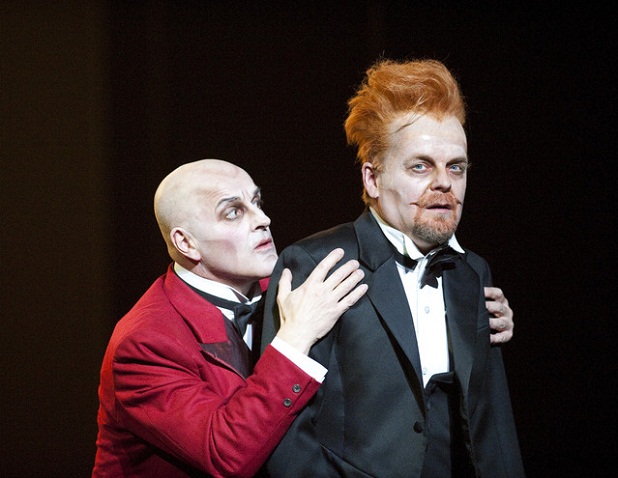
Review: Terry Gilliam's The Damnation of Faust

I had a lot of trepidation about the ENO production of Berlioz's The Damnation of Faust; not because Gilliam hadn't done opera before, which seemed to put some people off—after all what better to do with an over-sized imagination than put it to use in the heightened spectacle of opera?—but because of the trailer and the thought, "Oh, not Nazis again." The ultimate banality of evil is that it can be used without controversy or effect. Apart from bizarre extremists of various stripes, most people are are board with the whole Nazis=bad, so I imagined some ham-handed club about to be wielded over the audience.

But yeah, I got my ticket anyway. It was bound to be spectacle, right?

Gilliam did not disappoint. The production literally starts with a bang that clearly startled many in the audience. Enter Christopher Purves as Mephistopheles with a few of his lost souls, announcing himself as our infernal compere for the evening. His hellfires seem to always be ready to lick at the feet of the players, ever present. As our shock-headed Faust, Peter Hoare enters the pastoral opening his work literally on his back as he ignores the courting couples in the forest in search of solitude to return to his calculations and contemplation, but the spirit of the spring invades, including a Krampus and Holda as if it were almost a mythic spring. How can he resist?

Mephistopheles persuades Faust out of his cell at last; the cell looks not like a monkish scholar's room, but a holding cell in an asylum. Coupled with Faust's later appearance in a straight-jacket, it may be a way to cast doubt on the veracity of all that occurs, but it's not really important.

I have to admit, the Nazi motif worked perfectly; after all, Berlioz's opera unfolds against a backdrop of war. The slight relocation in time suits. We see the rise of the fascist movement gradually as Faust's own story unspools. In the tavern scene a few brown shirts stand out, but as the scene unfolds we see them gradually muscle through the crowd and gradually more chorus members remove their jackets to reveal brown shirts and uniforms underneath, until the majority of the tavern crowd has joined up. It works.

It works too that Marguerite is a Jew that Faust first sees singing the role of Brunhilde in the Ring wearing a blonde wig. Mephistopheles' careful maneuvering of Faust into her room occurs on a setting that I knew at once would turn into Kristallnacht, but Gilliam kept the audience waiting for it then in the midst of the scene, rolls back time restoring all the broken windows and returning people to their homes to replay the scenes slightly differently with more direct interference from the demon. You begin to suspect that all the mayhem in the land has been his doing.

I find Berlioz's opera a lugubrious affair and I much prefer Marlowe's Faust to Goethe's sappy romantic, but Gilliam had the story cracking along with the most amazing visuals that combined good old fashioned stage craft, projections, puppetry and a good bit of flash and explosion. The mad race to "save" Marguerite was a fantastic hell journey, the final damnation an incredible glorious release of the hellfire, and so many moments were simply cleverly apt and nimble. It was a great way to employ Gilliam's tendency to excess without the impression that anything was superfluous.

Of course the cast was superb: Purves' Mephisto had the right combination of oiliness and menacing bombast. Hoare's Faust managed to convey the emotional wrenching of his character without ever tipping over into bathos. Christine Rice's Marguerite offered up a silky heroine with a voice anyone might fall for. The role is so small yet so important; Marguerite really has to knock your socks off in her opening song and then break your heart soon after. Rice was amazing; when Marguerite sang her breaking heart on the way to the gas chambers, there were a lot of wet cheeks in the audience. The whole orchestra and chorus were superb of course; the practically filled the stage at the curtain.

The good news is that there was a crew from the BBC (and a huge group of folk attending as well) so perhaps there will be the opportunity to see some of this even if you couldn't be there for the final performance. Gilliam looked giddy as he joined the cast on stage for the final bows. And why not? Well done, indeed.

Tuesday, April 05, 2011

Review: Vision: From the Life of Hildegard of Bingen

See all of Tuesday's Overlooked Films (and other media) over at Todd Mason's blog.


There's a short BBC film on the life of Hildegard von Bingen that I show to my classes starring the fantastic Patricia Routledge as the visionary healer. Despite its creaky low-budget ambience I prefer it to this one despite its beauties. But I'm all for more films (and plays and books) about one of the many influential women of the Middle Ages. Despite what my students have sometimes told me, there are not only women in medieval times (yes, I have had students say that "there were no women in Anglo-Saxon England" which makes one wonder how there were any men...) but a surprising number were well known at the time not just in retrospect.

Hildegard is one and this film conveys some of the reasons why. Her visions hold center stage here, which is a shame because her music should share that stage. The music is there, but it's as if filmmaker Margarethe von Trotta assumes you already know about the music from the start. Eventually -- and rather gloriously -- the music gets it moment, embodied in a very pagan-looking production of the Ordo Virtutum which releases the nuns from their habits and wimples to look absolutely golden with grace.

But a lot of the film seems unable to see Hildegard's piety except from an anachronistic modernity. There's the gruesome revelation of her spiritual mother's cilice upon her death, where the metal prongs have to be peeled away from her rotting flesh. Hildegard's combativeness against the masculine discipline seems to be the simple misogyny of individuals rather than the more complicated hierarchical world that evolves from a patriarchal structure; after all, Hildegard proves able to negotiate that imposing edifice with skill and insight, circumventing control with targeted appeals to the right ears. The importance of an authoritative endorsement of her work at the Synod of Trier and her correspondence with popes and leaders demonstrates the significant power this "humble vessel" attained.

Of course modern filmmakers can only see the relationships between the women, especially Hildegard's connection to her acolyte Richardis, as a barely concealed sexual attraction, which trivialises the depth and complexity of the lives of women in cloistered world. Hildegard's faith gave her authority and power; it infused her life and her outlook. The visions -- which von Trotta's film suggests are as often put on for show as for genuine insight -- were amazingly complex works that crystalised complex notions into a single multifaceted image. She turned a medical condition that plagued her into a gift that allowed her to interpret and explain in an unprecedented way: true genius.

Nonetheless, there is much to enjoy in the film. Barbara Sukowa makes an arresting Hildegard and the film provides a gorgeous view of medieval life that isn't all leeches and mud. The gardens in particular are lovely: Hildegard as a healer (and the author of Physica and Causae et Curae) also gets short shrift in the film, though we do see her teaching the novices herbs. The film has a leisurely pace, so don't go expecting action/adventure. A good introduction for folks who know nothing about this remarkable woman: with luck, it will inspire you to look further.

Saturday, April 02, 2011

BitchBuzz: Exploding on the Internet

So, yeah -- it's a bit late. The column I usually send in on Wednesday to appear on Thursday was there, unsent, Thursday late. I would say I can't believe I did that, but it's all too believable with the hectic way things are. I take it as a reminder to slow down and pay attention. Never a bad idea.

Rebecca Black, Fame, & Exploding in Public

By K.A. Laity

"Fame is a bee. / It has a song / It has a sting / Ah, too, it has a wing." - Emily Dickinson

There have been a couple of instructive internet memes this past week: Rebecca Black and The Greek Seaman. The former is a 13-year-old with well-to-do parents who paid for a professionally recorded music video, the latter a novice writer who attacked a reviewer who did not like her book. The two are seemingly unrelated but for the internet sensation they became, but if we dig a little further we will find some unsettling parallels.

You may count yourself lucky if you didn't get a friend on Facebook linking to "The Worst Music Video Ever" and asking for you to watch it and agree. First, it's not the worst ever (there is so much competition, but a rough internet agreement seems to have settled on Armi &Danni's "I Wanna Love you Tender"). Further, it's surely not any more (or less) annoying that Justin Bieber or a host of other teen sensations. I quizzed my students on why they thought Black was so much worse than any other but they simply shrugged and put it down to fatigue with Autotuned pop music. A valid point, but I think that's a tipping point we reached some time ago...

Read the rest at BBHQ.

Tuesday, March 29, 2011

Tuesday's Overlooked Films: The Tempest

First a quick link: I am the featured writer interview in the latest Text Novel newsletter: "The world is my bison." :-) TextNovel is one of the places that The Mangrove Legacy appeared before its publication and of course, the new serial Airships and Alchemy can be found there as well as on the serial blog. And if you want to know how to pronounce the word, see here.

Be sure to see the round up of all the overlooked films over at Todd's blog.

I love Julie Taymor's vision: she has an imagination that sings and flies and creates some amazing works. How, you ask, how could her film of Shakespeare's wondrous Tempest, the most magical of all his plays, fail?

Simple: bad CGI.

Unconvincing, twee and hokey CGI. Cringe-worthy! Today's audiences expect better graphics. We don't need to see Ben Wishaw's (digitally unsexed) Ariel duplicate like a badly loading JPEG. Almost none of the CGI is good: worse, almost none of it is necessary.

Because the rest of the film is wonderful. Helen Mirren makes a glorious Prospera. Every minute the camera focuses on her becomes completely captivating. Glorious: it's the only word that works. Sally Potter offers another stunning wardrobe -- I want ALL of Helen Mirren's clothes (especially the one above). There's a great cast: how can you go wrong with Tom Conti, David Straitharn, Chris Cooper, Alfred Molina, Alan Cumming? Even Russell Brand didn't annoy me much; after all Trinculo is a fool. Felicity Jones makes for an irresistible Miranda and Reeve Carney provides an adequate Ferdinand (a lousy part: there's little for him to do in any version of the play) looking golden and mooning after Miranda. Djimon Hounsou gives us a Caliban of the earth, who seems to have sprung from its depths like a mudman, his Butoh-inspired movement making him visually Other as much as his strange exterior and race. Wishaw embodies Ariel with some CGI enhancement, which I think doesn't give him enough credit for the way his acting as Ariel must shift gender and aspect so often. When clothed in black wings as the harpy, he's magnificent.

So forget the bad CGI: see this film anyway. It's worth it for Mirren alone, and there is so much more besides. Peg and I were talking about this on the way back; maybe Taymor just doesn't care about the CGI being good. But audiences now want it to look seamless. We saw this at Upstate Films in Rhinebeck which was a terrific theatre except for the fact that they turned up the house lights the second the credits began. The credits in this film are a piece of the story: Portishead's Beth Gibbons sings Prospera's final speech with Elliot Goldenthal's music and it's quite wonderful.

Monday, February 14, 2011

Review: Another Year & Fela!

In the middle of watching Mike Leigh's Another Year, I realised why I usually dislike mimetic films. The reality they purport to capture has nothing to do with their glossy interiors and shiny surfaces. Actors -- especially Hollywood actors -- do not look like they do in real life without the flattering lighting, makeup and carefully adjusted wardrobe. They do not look like us. Give me fantastical films that heighten reality or offer a completely new world! I'll buy the artifice. But tell me it's a "grittily realistic" slice o' life where a beautiful star gains a few pounds or wears glasses -- no, I don't care.

Which is why Leigh's films are such a delight. While British films in general seem to be increasingly permeated by plasticity like Hollywood, Leigh continues to cast people who look like human beings who have lived. We believe in Tom and Gerri (Kim Broadbent and Ruth Sheen), the long term couple who potter around their daily lives with seemingly little drama except that provided by others. The film opens with Gerri trying to reach a prospective therapy patient, played with heartbreaking, shattered, vulnerability by Imelda Staunton, then Tom the geologist at work on the latest intrusion of London clay currently filling the Victorian plumbing of the capital city. But the central image of the film as it moves through the four seasons is their garden at the allotment. Much of the pleasure and tenderness of their lives is spent there, speaking little but tending, always keeping an eye on things.

Obviously it's a metaphor for their marriage, but more so for their approach to relationships as a whole. They prod their son for news about his life, but never intrusively and he shows himself to have learned from their example. They put up with Gerri's colleague Mary, the neediest woman on the planet, but not without tag-teaming to deal with her fatiguing ways. They tut over their various friends' miseries and offer genuine help, but they're not willing to be dragged down by them either. Their friends like Mary, Ken and Tom's brother Ronnie find themselves miserable and confused, mostly because they're so self-centered. They don't tend their relationships, they don't concern themselves with anything outside themselves. When Mary, desperate for a relationship, finally has a small moment of connection, she can't really capitalise on it, because she doesn't really know how to connect. The pace of the film is leisurely, but you will enjoy the time spent with Tom and Gerri.

Fela! was the most recent of the National Theatre broadcasts at the Spectrum. Bill T. Jones' vision of the Afrobeat pioneer and self-styled Nigerian revolutionary Fela Kuti pulsates with rhythm and dance of course! Even if you know nothing about Kuti (I really only knew his big international hit, "Zombie") you will be enraptured by the music -- it's simply irresistible. I was particularly captivated by the beginning of the second half which started with a bunch of kalimbas being played. My colleague Dave Rice once opined that if everyone were issued their own thumb piano the world would be a more peaceful place: I agree. The rising and falling fortunes of the singer (Sahr Ngaujah) were tied to the death of his mother Funmilayo (Melanie Marshall) who had fought against the corrupt government and was eventually murdered. The play manages to introduce the audience to Afrobeat, to tell Kuti's story without pulling punches (he was no angel!) and uplift the audience despite a whole lot of tragedy. I found the journey to the orishas in the second half simply mesmerising. It was a treat for the whole cast -- and audience, too -- to have director/choreographer Jones join them on stage for the encore, shirtless and looking awfully youthful (and muscular) at sixty as they all danced more. With the interval, the show came to nearly three hours, yet it never dragged. Energizing!

Friday, February 11, 2011

Friday's Forgotten Books: Three Men in a Boat

This might be an odd choice for "forgotten": after all it's a classic, at least as acknowledged by humorists. But I find that the "in print" edition listed on Amazon (that gauge of what's available) is actually a CreateSpace edition, though there's a Tor edition from 2001. I am pleased to see that the version illustrated by comedian Vic Reeves has been scheduled for release here in May.

 Jerome asserts that the strength of this narrative is its root in the truth. "There were four of us," he begins, "George, and William Samuel Harris and myself, and Montmorency. We were sitting in my room, smoling, and talking about how bad we were -- bad from a medical point of view I mean, of course." After discussing various symptoms and ailments (like the Beowulf poet, Jerome's digressions from the stated purpose prove infinitely entertaining), they hit upon the idea of a a trip up the river as a perfect solution.

It hardly seems the sort of genius stroke it proves to be. The novel follows that meandering path of the Thames with a gentle but persistent humor that sneaks up on the reader. You find yourself laughing out loud at the oddest things. And between the comic moments, Jerome slips in moments of poignancy and even history with painless deftness. Sometimes they all combine at once, as when he describes the effect of a hearty meal on the cranky boaters.
It is very strange, this domination of our intellect by our digestive organs. We cannot work, we cannot think, unless our stomach wills so. It dictates our emotions, our passions. After eggs and bacon, it says: 'Work!' After beefsteak and porter, it says: 'Sleep!' After a cup of tea (two spoonfuls for each cup, and don't let it stand for more than three minutes), it says to the brain: 'Now, rise, and show your strength. Be eloquent, and deep,  and tender; see with a clear eye, into Nature and into life; spread your white wings of quivering thought, and soar, a godlike spirit, over the whirling world beneath you, up through the long lanes of flaming stars to the gates of eternity!'
The book has been a favourite of many. It spawned Connie Willis' To Say Nothing of the Dog (the subtitle of Jerome's tome). Not gut-busting humor, but an inviting story you would be glad to encounter at any time. Like the friend you're glad to see, especially when you don't have time, but gladly neglect your duties to idle away the afternoon. When you find someone who's read it, you need only smile and say "the cheese!" and the two of you will be old friends.

Perhaps the best film version is the one that has a script by Tom Stoppard: Michael Palin has said he counts it among the finest work he has done and remains quite proud of having been in it with Tim Curry (as J) and Stephen Moore (George). Stoppard's script captures the heart of the book, but the biggest laughs end up falling in different places due to the switch from verbal to visual. It only makes sense, after all.

You can find the complete list of FFBs at Patti Abbott's blog.

I have more reviews to write: Fela! the National Theatre broadcast from this week and Mike Leigh's Another Year which I saw yesterday afternoon when I ought to have been working. To say nothing of the hot chocolate I drank while lounging in the café after the film...

Monday, February 07, 2011

Review: Magus

Carey Harrison's play Magus offers a melange of people and times, jumping back and forth between the early twentieth century and the late sixteenth. Kafka, Shakespeare and Cervantes all meet in a vision conjured by the madness of Kafka's sister Ottla, overseen by the multi-skilled consultant to Queen Elizabeth, John Dee, who invites the audience into the vision. Dee's quest for life eternal seems to have been answered as he speaks to the audience in the present time before stepping back to the sixteenth century, then moving forward to appear as Sigmund Freud for Kafka. I love the idea of Dee having lived on and taken up new personas like Freud, but Harrison didn't really develop that angle and I think it's a missed opportunity. Harrison's magus is kindly and warm-hearted but yearning for that eternal life -- seemingly only for himself, though. His wife is barely in his thoughts (or the play, a shame for the lovely Naomi Hard), though there is an allusion to the wife-swapping alleged between Dee and his partner Edward Kelley (played with nervous malevolence by Phillip Levine). Kelley's only interest is gold and he has a bottomless and urgent hunger for it that makes him willing to countenance tricking his partner and plotting the murder of that troublesome young Shakespeare.

The invention of this meeting between Shakespeare (Rudi Azank) and Cervantes (Richard Bennett) had all kinds of potential for explosion, but nothing much happened with it. You set the bar high when you include historical figures of such talent. Surely even as a callow youth Shakespeare had wit and insight, but in the play he's just a kind of laddish troublemaker, though Azank made sure he was charming. Bennett had even less to do with Cervantes.

George Konrad's Kafka centered around a heartfelt sorrow for his sister's madness. Although Ottla's vision formed the play, her role was peripheral. Nonetheless Brittany Sokolowski managed to infuse a fragile quality to her performance that made her brother's obsessive worry understandable. But again, Kafka wasn't especially Kafka-like despite his transformation scene. The sudden injection of realism through Ottla's trip to the deathcamp Auschwitz gave me the feeling that everything including the kitchen sink was being thrown in.

I don't want to sound too negative: after all I'd take a play with ambitions that don't quite work over a less ambitious play any day of the week. Harrison himself offered a warm and engaging Dee. The care that went into the production was obvious. The costuming was quite good and the sets simple but effective (loved the satyr!). David Temple's beautiful classical guitar music offered both dramatic ambiance and reverie.   

This was my first visit to the Center for Performing Arts at Rhinebeck; it's a interesting space and I'm glad they're willing to branch out from the usual repertory staples to do an unusual and ambitious project like this play. Well done!

Wednesday, December 29, 2010

Reviews: Harry Nilsson/King's Speech/True Grit

I have no doubt about the finest film I saw last year this past year: hands down, it was Winter's Bone. I've heard people carp about how "accurate" it was, especially people who felt it portrayed their part of the world unflatteringly. I don't know -- there's plenty of areas like that, even here in upstate New York. And if "accuracy" is going to be some kind of gauge for best picture of the year, there's an awful lot of statues to be handed back. All the trailers I saw before True Grit today claimed to be "based on a true story" which always makes me groan. The truth is no basis for a story: too messy. But let me save that rant for another time.

Who is Harry Nilsson? (And Why Is Everybody Talkin' About Him) offers an insightful look at the brilliant singer songwriter and his life. The film benefits from the ailing Nilsson's decision to try to record a kind of autobiography, the found tapes proving a real treasure trove of commentary that makes the late singer a very vivid part of the film. It helps too that his family including his third wife, Una, with whom he had six children and seemed to be as happy as he found possible, were also cooperating. The tragedy of course is that someone so talented was also so troubled. Paul Williams' description of Nilsson as a great big bunny with real sharp teeth captures that succinctly. He had many hits, collaborated with the Beatles and the Pythons, but wasn't able to shake the ghosts that haunted him, from the father who abandoned him to the friends near to him who died like Keith Moon and John Lennon. As a bonus there are so many extras, too -- as if they couldn't bear to part with any of the footage shot, including Eric Idle's tribute song. They talk to all kinds of people who worked with him from Richard Perry to Van Dyke Parks and with his wives and kids. Excellent: I highly recommend it.

The King's Speech has already received laurels a-plenty which has a lot to do with its cast: they are indeed splendid, including many fine actors in tiny roles who get a couple of lines each (like Claire Bloom, alas). Like so many films now, the background is left enigmatic (well, you know the history, fill in the details yourself, I guess) and only the central actors received development. That really only means Rush and Firth: Helena Bonham Carter is reduced to appearing with corgis and going "there, there" on occasion (AKA a MWW masquerading as a MW1W). The direction is bizarre at times, especially in the first half hour, with angles that take you out of the narrative wondering where on earth the camera is supposed to be. Worse, in the set-up scene between the Prince-soon-to-be-King and the Aussie therapist, the camera work is so bad as to make it look like they're both gazing off into space rather than talking to each other. What really makes the film fall flat is the overwrought ambiance, from the overplayed music to the mountain-out-of-a-molehill plot. Yes, as someone once crippled by the thought of public speaking and who overcame it, I know what a trial it can be for people, but to have someone who treated men just back from Gallipoli call the pampered royal "the bravest man I've ever known" (as do half the people in the film) is just ridiculous hyperbole. If you love Firth, you'll still enjoy it, I guess.

True Grit is like a truly satisfying meal when you're really really hungry. The Coens have a great team of people (apparently Matt Damon has his own whole team, too, according to the credits) from Carter Burwell's musicians to Roger Deakins' seemingly flawless eye. You know Jeff Bridges is going to be good, and yeah, I'll admit it though it burns me a bit, that Matt Damon can be truly skillful when he wants to be. There's a whole host of grizzled frontiersmen, too: Peg and I were joking after the film that they must have put out a call for the ugliest character actors with the tag, "Must have abundant facial hair."

The real star is Hailie Steinfeld. Like Jennifer Lawrence in Winter's Bone, here's a young woman who more than capably carries the film flanked by powerhouse actors who might easily intimidate many a seasoned performer. From the get-go Steinfeld strides into town and into the part with all the certainty of the true believer that she is. You believe her, the grudging respect she wins from the men and when her faith falters, you see that she is a child yet and so very young. It's incredible work. For the Coens, this is a bit different from a lot of their work because there's not that distance that allows ironic humor (we have to be able to laugh at Barton Fink's sufferings because they would be too harrowing; A Serious Man walks that razor's edge with dizzying grace). It's a straight-forward adventure. Don't get me wrong; there's humor, but as in Shakespeare's dramas, it's there to give you a breather from the tension. Well done: go see it.

Monday, December 13, 2010

Review: Tamara Drewe

How can you go wrong with Posy Simmonds as your source (and Thomas Hardy as hers), a script by Moira Buffini and a stellar cast guided by Stephen Frears? Well, you can't go far wrong at all, it turns out.  Tamara Drewe is great fun, lots of laughs and a few tear-worthy moments. Admittedly, I'm a sucker for any film about writers and writing, but this one's quite enjoyable.

The story begins in what seems to be the idyllic writers retreat "far from the madding crowd" in Dorset. Tamsin Grieg (made to look much older than she is) and Roger Allam own the farm; she's the careful tender of the animals and writers, he's the successful mystery writer who's a little too full of himself. It's not giving anything away to say he's also a philandering jerk, too -- almost from the start of the film we know this and much of the story revolves around this, and not a small amount of the humor. The writers in residence provide a lot of the humor, too: "The hat is on!" one vehemently tells another, indicating that no one should speak to him. Central to the narrative is the American writer Glen (Bill Camp, who looks like Warren Zevon's nebbishy brother), the unexpected lynchpin as the blocked academic trying to write about Hardy.

What breaks everything apart is the arrival -- or rather, return -- of the native daughter, Tamara Drewe (Gemma Arterton). Her former love, the golden handyman, Andy (Luke Evans) still longs for her but her eye's been drawn to seriously sexy boy band drummer Ben (Dominic Cooper :-), whose arrival draws the attention of two bored village teens, Jody and Casey, who are die hard fans of Ben's band.

Even if you know your Hardy, there are plenty of twists and modernisations to keep you guessing. I love the way the story captures the aimless boredom of the teens' life in an "idyllic" country village, which for them means there's nothing to do. There's extra fun for writers and readers, of course, but I think all kinds of folks will have a good time with Tamara.

Friday, December 10, 2010

Friday's Forgotten Books: Kleinzeit


I find it amazing that Russell Hoban's singular book Kleinzeit seems to be out of print in the US. Amazon lists the version on the left as the most recent one (2002) but he doesn't seem to have the same popularity here as he does in Britain (where the Pennsylvania-born writer lives, no surprise). Most of you probably know the Frances books and I've certainly gone on at length about my love for Riddley Walker on various occasions, but I hadn't read Kleinzeit until recently.

While reading it in November, I decided to recommend it to everyone who was doing NaNoWriMo as the perfect inspiration for the difficult task of writing, especially for the first time. It mashes up a sort of Pynchon-esque mystery of coincidences and misheard words with a delightful surrealism: the titular character ends up in the hospital for trouble with his hypotenuse. His troubles begin on the most mundane sort of day when he begins to experience a sudden pain. But then something else happens:

Kleinzeit got out of the train, poured into the morning rush in the corridor. Among the feet he saw a sheet of yellow paper, A4 size, on the floor, unstepped-on. He picked it up. Clean on both sides. He put it in his attaché case. He rode up on the escalator, looking up the skirt of the girl nine steps above him. Bottom of the morning, he said to himself.

Little does he know that yellow sheet of A4 will take over his life: he loses his job, he's admitted to the hospital, he takes up the glockenspiel and he takes up with Sister (nurses in Britain are still referred to as "sister"), he meets a red-bearded man who lives in the Underground. And everything seems conspired either to kill him or turn him into a writer. It's not surprising that Hoban has said that this novel is where he found his voice.

One of my favourite passages comes when Kleinziet reads from Thucydides' The Pelopennesian War as he contemplates Athenians and the blank page of yellow A4:

I promise, said Kleinzeit to his dead mother, I'll be, I'll make, I'll do. You'll be proud of me.

Suppose [the Athenians] fail in some undertaking; they make good the loss immediately by setting their hopes in some other direction. Of them alone it may be said that they possess a thing almost as soon as they have begun to desire it, so quickly with them does action follow upon decision. And so they go on working away in hardship and danger all the days of their lives, seldom enjoying their possessions because they are always adding to them. Their view of a holiday is to do what needs doing; they prefer hardship and activity to peace and quiet. In a word, they are by nature incapable of either living a quiet life themselves or of allowing anyone else to do so.

Right, said Kleinzeit. Enough, He opened the door of the yellow paper's cage, and it sprang upon him, Over and over they rolled together, bloody and roaring, Doesn't matter what the title is to start with, he said, anything will do. HERO, I'll call it. Chapter I. He wrote the first line while the yellow paper clawed his guts, the pain was blinding. It'll kill me, said Kleinzeit, there's no surviving this. He wrote the second line, the third, completed the first paragraph. The roaring and the blood stopped, the yellow paper rubbed purring against his leg, the first paragraph danced and sang, leaped and played on the green grass in the dawn.

Up the Athenians, said Kleinzeit, and went to sleep.

It delights me to no end that Hoban fans go around on February 4th leaving sheets of yellow A4 in the tube and other public places with quotes from the author. I can't imagine a more wonderful tradition to have connected with one's books. This novel is quite wonderful and I recommend it highly -- and then go get Riddley Walker and the rest of his books! I love Hoban because his stories all make their own singular way, ignoring genres and rules and convention. What better way to write?

See more "forgotten" books at Patti Abbot's blog where you'll doubtless find friends like Todd.