Showing posts with label Tom Stoppard. Show all posts

Wednesday, April 04, 2012

Writer Wednesday: Alessandra Bava

A couple bits of news before we get to La Bava: the fabulous Dana Fredsti will be stopping by the Girl's Guide to Surviving the Apocalypse on the 19th of this month with prizes (as if she wasn't a gift herself). Also I managed to miss the release of Dogcast #5 which features my piece "Words" right at the start of the podcast.

I'm delighted to welcome my friend, Alessandra Bava, poet and translator (who just revealed that she will be translating for Tom Stoppard next week, leaving me pea green with envy!). Alessandra was born in Rome in “the year of the barricades.” She holds an MA in American Literature and manages her own translation agency. In 2010 she had a cathartic encounter with SF poet laureate Jack Hirschman and she is currently writing his biography. Over 50 of her poems have appeared or are forthcoming in several journals and anthologies. Her first bilingual poetry chapbook, Guerrilla Blues, has just been published by Edizioni Ensemble. We appear side by side in the Occupy Wall Street Poetry Anthology (which is looking to publish in print, you can help).

Q: What do you write on? Computer, pad o' paper, battered Underwood? Give us a vivid picture.

I write on anything. From pieces of paper to pads to my laptop. I always carry pen and pad on me, but I have also learnt to use my cell phone in case of “emergency.” Muses can be frivolous! I do not have a writing desk, since I write wherever and whenever, even at work occasionally. Managing a translation agency is a great job because it is a great linguistic exercise. Translating from one language into another is a very creative process, as it forces you to recreate a text in your own language. It’s both frustrating and rewarding. It’s both heaven and hell, very much like writing at times.

Q: Do you listen to music while you write? Does it influence what you write?

Music inspires me in many different ways, but I seldom listen to music when I write. I hammer words and make enough interior noise as to require my listening abilities to be fully available. I follow my inner rhythm: writing to me is like singing – so I must concentrate on my own voice.


Q: Do you write in short bursts or carve out long periods of time to work? Is it a habit or a vice?

Poems usually come to me unasked, whether short or long. A word or a sentence pops into my head and usually turns into a poem, often as it is meant to be. I do very little editing. I so wish writing could be a habit, but I can’t afford to be a professional writer and devote 8 hours per day to writing. I am a vicious amateur.

Q: What writer would you most want to read your work? What would you want to hear them say?

I feel lucky for having had poets Jack Hirschman and Agneta Falk read my poems and appreciating them. Jack even wrote the introduction to Guerrilla Blues. What he said and wrote makes me happy in ways I find hard to express in words. I honestly look forward to receiving some critical feedback now. Too much praise won’t do me much good as a writer.

Q: On the days where the writing doesn't go so well, what other art or career do you fantasize about pursuing instead?

I so wish I could draw or paint or even play an instrument, but I can’t. If I lived in the 19th century I would be considered a very unaccomplished lady, I fear.


Q: What do you read? What do you re-read?

I have read and re-read an impressive number of poetry collections in the course of the last 2 years, but I’m attacking fiction again. I’m currently reading DeLillo’s Cosmopolis and George Sand’s Letters.

Q: Where did the idea for Guerilla Blues come from? Do you have a surefire way of sparking inspiration?

I was looking for a publisher for an Anthology of Rome’s Revolutionary Poets Brigade (a group of 10 poets living or aspiring to live permanently in Rome inspired by Jack Hirschman’s RPB in San Francisco that include the undersigned and John Claude Smith as well). And, when I met Matteo (the publisher of Edizioni Ensemble) to talk to him about the project last December, I gave him some of my poems to read. He loved them and decided to make a real book out of them. This is how Guerrilla Blues was born. In other words, it was a collection of poems that I believed worked well together triggered by my idea of poetry as a means of “disobedience” to awaken consciences in our too often “sleeping” world.

 
SONS OF DISOBEDIENCE

Like Thoreau
      I believe that things
            don’t change, but that
               we can and must

change. With superb fury,
      we fight liminally,
          peripherally,
               deliberately.

The Armed Voice
     inspires us,
        unites us,
            re-unites us.

                  We garrison arsenals
                  of poetry and we fear
                  not to be taken to the
                  stocks: words, naked

                  craving flesh,
            bones, dripping
        lines, teeth sunk in
  bowels of sense
         
                     and dissent.
              Hands and hips
   drowned in truth’s
blood

                    ready to give birth
             to several leaves—ready
       to give birth to several
  sons—of DISOBEDIENCE.

Find Alessandra at her blog as well as on Facebook and Twitter. And get yourself a copy of Guerilla Blues: it's simply incendiary as the best poetry always is. Grazie!

Friday, February 11, 2011

Friday's Forgotten Books: Three Men in a Boat

This might be an odd choice for "forgotten": after all it's a classic, at least as acknowledged by humorists. But I find that the "in print" edition listed on Amazon (that gauge of what's available) is actually a CreateSpace edition, though there's a Tor edition from 2001. I am pleased to see that the version illustrated by comedian Vic Reeves has been scheduled for release here in May.

 Jerome asserts that the strength of this narrative is its root in the truth. "There were four of us," he begins, "George, and William Samuel Harris and myself, and Montmorency. We were sitting in my room, smoling, and talking about how bad we were -- bad from a medical point of view I mean, of course." After discussing various symptoms and ailments (like the Beowulf poet, Jerome's digressions from the stated purpose prove infinitely entertaining), they hit upon the idea of a a trip up the river as a perfect solution.

It hardly seems the sort of genius stroke it proves to be. The novel follows that meandering path of the Thames with a gentle but persistent humor that sneaks up on the reader. You find yourself laughing out loud at the oddest things. And between the comic moments, Jerome slips in moments of poignancy and even history with painless deftness. Sometimes they all combine at once, as when he describes the effect of a hearty meal on the cranky boaters.
It is very strange, this domination of our intellect by our digestive organs. We cannot work, we cannot think, unless our stomach wills so. It dictates our emotions, our passions. After eggs and bacon, it says: 'Work!' After beefsteak and porter, it says: 'Sleep!' After a cup of tea (two spoonfuls for each cup, and don't let it stand for more than three minutes), it says to the brain: 'Now, rise, and show your strength. Be eloquent, and deep,  and tender; see with a clear eye, into Nature and into life; spread your white wings of quivering thought, and soar, a godlike spirit, over the whirling world beneath you, up through the long lanes of flaming stars to the gates of eternity!'
The book has been a favourite of many. It spawned Connie Willis' To Say Nothing of the Dog (the subtitle of Jerome's tome). Not gut-busting humor, but an inviting story you would be glad to encounter at any time. Like the friend you're glad to see, especially when you don't have time, but gladly neglect your duties to idle away the afternoon. When you find someone who's read it, you need only smile and say "the cheese!" and the two of you will be old friends.

Perhaps the best film version is the one that has a script by Tom Stoppard: Michael Palin has said he counts it among the finest work he has done and remains quite proud of having been in it with Tim Curry (as J) and Stephen Moore (George). Stoppard's script captures the heart of the book, but the biggest laughs end up falling in different places due to the switch from verbal to visual. It only makes sense, after all.

You can find the complete list of FFBs at Patti Abbott's blog.

I have more reviews to write: Fela! the National Theatre broadcast from this week and Mike Leigh's Another Year which I saw yesterday afternoon when I ought to have been working. To say nothing of the hot chocolate I drank while lounging in the café after the film...

Friday, November 26, 2010

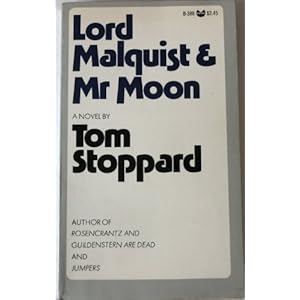
Friday's Forgotten Books: Lord Malquist & Mr Moon

Although a bit late in the day (just got home this afternoon and had to spend some time soothing Kipper's complaints about being abandoned for a whole day and a half), I wanted to try to get back in the habit of writing up a "forgotten" book for Patti's round-up of titles.

"Let it be said of me that I was born appalled, lived disaffected, and died in the height of fashion."

Lord Malquist and Mr Moon is (to date) Tom Stoppard's only novel. Of course he's one of the most celebrated playwrights in the world, but this novel seems to often be forgotten in discussions of his work. Not quite out of print (there's a trade paperback edition from Grove that came out about five years ago), it's seems to have a very low profile. The novel came out in 1966 just before Rosencrantz & Guildenstern are Dead and Stoppard's first real success, although he had been writing short dramatic works for both stage and radio (the collection of his radio plays appears to actually be out of print and is also a wonderful book to pick up). 

In this novel, the Czech-born British knight (by way of Singapore and India) indulges in some of the same obsessions that fill his plays -- peculiarities of class and station, misunderstandings, confusions, sexual entanglements, surreal slapstick humor and an actual ticking bomb. It's by turns hilarious and insightful and always brilliantly timed. So I'm just going to give a few random quotes to give you the flavor of the story that mixes up the would-be Boswell Mr Moon and the haughty noble (as well as his wife, a cowboy, a lion and more):

"I find crowds extraordinarily lacking," said the ninth earl. "Taken as a whole they have no sense of form or colour. I long to impose some aesthetic discipline on them, rearrange them into art. It would give a point to their existence."

It was all a question of preparing one's material. There was no point in beginning to write before one's material had been prepared. Moon, who had experimented on a number of variations of a first sentence, felt this quite strongly. He found that the vastness of his chosen field reassuring rather than daunting but it did cramp his style; he could not put down a word without suspecting that it might be the wrong one and that if he held back for another day the intermediate experience would provide the right one. There was no end to that, and Moon fearfully glimpsed himself as a pure writer who after a lifetime of absolutely no output whatever, would prepare on his deathbed the single sentence that was the distillation of everything he had saved up, and die before he was able to utter it.

"I got dizzy," he explained.
"I should think you did -- what were you doing?"
"Nothing," said Moon. "I was trying to face one way or the other and I got confused and fell over."
Let that be my epitaph.

For Style is an aesthetic, inbred and disengaged, and in such precarious times these are virtues. We all have an enormous capacity for inflicting harm, and hereto the only moral issue has been the choice of the most deserving recipient..."

"You see, he understood that substance is ephemeral, but style is eternal."

"Be poetic, dear boy, be poetic and take your text from d'Aurevilley -- La verité m'ennuie."

"Idealism is the thin edge of madness -- console yourself, dear boy, with the thought that if life is the pursuit of perfection then imperfection is the nature of life."

As in his plays, Stoppard enjoys creating characters whose opinions oppose diametrically and then setting them at each other. The hapless Moon manages to be both pathetic and hopeful, the imperious earl both infuriating and amusing. Sex has its allure but always seems just out of reach. The randomness of life (as deliberately arranged by the writer) creates mad moments of black humor. I'd love to see Stoppard write another novel, but he seems happy with plays (not that I mind). Nonetheless, it would be fun.

Wednesday, November 10, 2010

Review: A Disappearing Number and The Real Inspector Hound

The National Theatre live broadcast of A Disappearing Number proved to be a stunning experience. A heady mix of drama, math, physics, love, romance, ritual, music, classical Indian dance and rhythms -- it sounds too complicated to work, but it does. In fact, it's kind of magical. Put together by the theatre company Complicite, this production explained a lot of complicated math, but weaved it together with a love story, a history lesson, an explanation of the beauty of numbers and their patterns, an insightful examination of the situation for an Indian in Britain before the first world war and the ways we build our own private languages of love.

It sounds like an awkward jigsaw puzzle of clashing pieces: yet it was over two hours of non-stop dazzle of ideas, characters, ritual and movement. This is the kind of piece that shows all theatre can be, how it can be so much more than a story unfolding on stage before an audience. It was exciting, it was enthralling and it was inspiring. Thank you, Spectrum 8 for carrying the broadcasts; thank you, National Theatre for broadcasting these productions; thank you Complicite for visionary theatre; thank you to a talented cast and crew for a spellbinding experience.

Sunday was the last performance of Stoppard's The Real Inspector Hound at Shakespeare & Co. As one of Stoppard's early plays, it's more about playful and clever fun than about weighty issues, though there's an underlying almost hysterical theme of anxiety about the elasticity of reality as the observers get dragged into the play they're observing. This element, however, became completely buried with the focus on physical humor.

Directed by actor Jonathan Croy, the cast made the most of the opportunities for slapstick wackiness, even making the dementedly brilliant choice to have the charwoman, Mrs. Drudge, be blind. The actors had a ball. Moon and Birdboot, the two critics reviewing the play and talking through it, were sitting next to us in the first row stage left. It really invited audience interaction, which happened, including a young man telling the two troublemakers at the end of the interval that he hoped they would be less disruptive in the second half.

Second half: that was the problem. This is a one act play. All the slapstick inserts helped stretch it to two hours with an interval. You could really feel the stretching in the first half. Stoppard's dialogue suits a snappy pacing that ties the moments together. All the inserted bits subsumed the dialogue. The physical humor clearly pleased the audience and the actors seemed to be having a ball. It was fun, and I was probably the only one chafing at the slackness of the pace. The set pieces like the card games and the tea service were funny, but also brought the story to a standstill, so it had to start up again and pick up speed once more. They may have decided that a one-act would not leave an audience feeling as if it got its money's worth; when the Home Made Theatre Company put it on, they added The Fifteen Minute Hamlet, which made a nice addition to the production. Great fun.

By the by, I got my contributor's copy of this so I conclude it's available now. The volume includes my essays "The Gilda Stories" and "The Vampire Lifestyle":

Sunday, November 07, 2010

Publication: Sex and How to Get It

Drop by Polite Company magazine to see my humor piece, "Sex and How to Get It." Worth a chuckle or two, I hope. Feel free to leave a comment or repost it to Twitter or Facebook. That's how word of mouth spreads these days.

Which reminds me: Kit Marlowe's The Big Splash can now be purchased through Amazon as well as with the publisher, so now it's listed on GoodReads and LibraryThing as well. Reviews or recommendations would be really helpful! If you've read it, consider offering your opinion in any of the above.

Off this afternoon to catch the last performance of Stoppard's The Real Inspector Hound at Shakespeare & Co. You know much I love Stoppard. I've seen other productions of this play, so it will be fun to see S&Co's take on it. Witty and lively and full of clever twists and turns, it's a play as much about the theatre experience as it is a tightly plotted murder mystery.

Wednesday, July 28, 2010

Theatre Round-Up

I've been lucky enough to have some great theatre outings in the last few weeks, but I've been short on time to talk about them. I slipped off to Massachusetts to visit Shakespeare & Co and catch both The Comedy of Errors and Richard III. The former was in the Bernstein Theatre with the troupe of interns. They had a circus theme which fit the wacky mix-ups well. I always find it fascinating to see the creative ways companies adjust to small spaces and small casts. They even employed a dressmaker's dummy for one of the characters because the actor had to play two parts in the climactic scene. Great fun.

Richard III was still in previews, so the director reminded us that things were still in flux. I had a seat up on the side hanging over the stage (yes, already a hot ticket in previews) and so I ended up having to move aside during the scene where Richard pretends to eschew the crown a few times before 'reluctantly' accepting it. He and his entourage leaned over the balcony to the crowd below.  They whipped up the audience response so we were all cheering for Richard, thus complicit in the events. A good technique.  John Douglas Thompson made for an energetic villain, but one of the things that really came out of this production was a clear image of the women who were ignored and pushed aside by these nakedly ambitious men. The first scene with Anne really makes or breaks the play -- we have to believe that this monster can charm -- and it came off beautifully. Terrific cast and much glorious mayhem.

One of the things that helps me miss London a little less is the wonderful NT Live broadcasts. This time around it was London Assurance, which I hadn't managed to see while I was there. The broadcasts give you the feeling of being in the theatre, but also the close interaction zooming cameras allow. I am soooo grateful The Spectrum is participating in the project. The play is a HOOT. I knew nothing about Dion Boucicault, the 19th century Irish playwright, but this was a terrifically funny farce. Stars Simon Russell Beale and Fiona Shaw were just loving every minute of their over-the-top roles; the entire cast was superb, even when the part wasn't enormous, like Nick Sampson as the gentleman's valet Cool. And what a delight to see Richard Briers! The performance was sold out, so they broadcast the play outside the NT on the "grass" (the astroturfed area where the giant furniture usually sits in the summer time) and the cast ran out to take a bow there at the end as well. Sheer delight.

Then the other day was a quick trip up to Saratoga Springs for Shakespeare in the Park. My theatre buddy Ron and I were looking forward to Hamlet, but I was also looking forward to some barbecue at PJ's as it had been ages since I'd had any -- yum! Oh, their ribs and all the sauces. Mmmmm. And the play was much fun, too. It took me a little while to warm up to the Hamlet (who sounded more like he was a lost Belushi brother than a Dane) but most of the rest of the cast was good and there were some interesting choices in staging, like having the ghost return at the end to help Claudius meet his end. Timing was good, too; the play finished just as the mosquitoes began to make themselves known. It was a slimmed down production, but the cuts didn't feel too drastic (unsurprisingly, no Fortinbras at the end).

I'm crazy busy with some expected and unexpected deadlines this week, but I'm already trying to figure out when I can make it back to Shakespeare & Co for The Winter's Tale. They're doing some Stoppard this fall, too, so hurrah.

Monday, June 07, 2010

Review: The Real Thing

Wednesday I caught The Old Vic production of Tom Stoppard's The Real Thing, as I mentioned in a recent post.  Most of you know how I am enamoured of Stoppard's work and I had heard good things about this production. The bar was set high by the most recent production of his Arcadia, which was one of the most compelling productions I have seen despite an unbelievably hot theatre.

The cast included the wonderful Toby Stephens, Hattie Morahan, Fenella Woolgar and Barnaby Kay.  It's a surprisingly affectionate look at love, something I suppose most people don't associate with Stoppard. It does begin with a little bit of a trick that you do associate with him: the opening scene -- you begin to realise during the one that follows it -- is part of a play within a play, written by Henry (Stephens) and acted by his wife (Woolgar) and friend (Kay), whose girlfriend, we come to find, has begun falling for Henry.

Much of the play circles around Henry and Annie as they deal with happiness and their own insecurities. Henry wants to write a play for Annie, but finds that happiness is not very inspiring for good writing, that love and lust lead only to banalities and clichés.  Annie gets upset because Henry fails to be jealous of a love scene she has with an attractive co-star. Like all couples, they had divergent tastes that can't necessarily be reconciled. Annie tries to get Henry to appreciate classical music, but he's stuck on vintage pop songs (which punctuate many of the scene changes) which he finds the best way to express those 'banal' feelings of love.

The excellent cast inhabit their roles with real verve. Stephens manages to give Henry a down-to-earth friendliness that balances the sometimes knowing speeches about writing and the power of words that often infuriate Annie when she's trying to convince him of the importance of her cause celébre 'political prisoner's' play.  The famous 'cricket bat' speech -- where Henry compares good writing to the crafting of a bat in contrast to a similarly shaped bit of wood -- can easily sound pedantic, but Stephens gives it a kind of eager enthusiasm that makes it seem entirely inspired by a spur of the moment thought.

Morahan's Annie has a harder job because she has to be a bit histrionic at times, very much an actor, and occasionally her gestures seemed a bit too controlled for effect, but then again, it fits the role. With the slight hoarseness in her voice and some of the mannerism, I couldn't help seeing her as Felicity Kendal which was likely just my knowing the history of the playwright.  The wonderful Woolgar did so much with the largely thankless task of the discarded spouse, infusing   with such wit and intelligence that you couldn't help but wonder why Henry would have left her for the more emotional Annie, but the heart is an unpredictable little muscle.

Stoppard seems almost apologetic dealing with 'the real thing' here; it gives Henry and the play a kind of charming awkwardness, but it also offers a compelling meditation on the ways we learn to deal with the ebb and flow of love and the hunger to find it that makes us step out into the darkness time and again with a leap of faith -- and the hope that the next time it will be real.  As the strains of "Daydream Believer" ring out, you can't help but smile and wish the best for Henry and Annie.

Some wandering today along the Thames and back to the Tate Modern: on Waterloo Bridge I happened to run into Nigel Planer, who looked very good. I had just missed my bus and it began to rain.  A cooler day than the last couple -- hurrah!

Wednesday, June 02, 2010

Magus: The Alan Moore Conference (Day Two)

Here's another one of Adele's photos: just out of shot to Alan's left is me holding Melinda's glass. One of these days, I'm going to remember to take a picture with them. But don't they look sweet together? More on thee two later. I left London on the same train as I had the day before, but bank holiday weekend engineering works made sure that I was late. The cab dropped me off just after the time slated for panels to begin; fortunately, things were running slightly late, so Andrés was just introducing Gary Lloyd when I arrived, waving a belated hello to Adele.

Gary had worked with Alan on Brought to Light—not one of my favourites among the CDs, but an important work nonetheless. I was interested to see what he would talk about as his title "Moore and Music" could cover a lot of ground. It was fascinating to hear him talk about working together and how Alan has 'perfect pitch' but a voice so deep his falsetto doesn't sound like a falsetto. He was amusing, too, illustrating his talk with imaginary charts (all of which worked in an off-hand reference to SKIZZ), Homer Simpson eating a donut, and his six year old nephew's drawing of Watchmen, a drawing that showed superheroes like Spider-man, Batman and Hulk at the bottom of a cliff crying for help and Rorschak simply saying, "No."

Cyril Camus of the University of Toulouse traced the many ways in which Neil Gaiman had been inspired by Moore's work, often quite directly and how the friendship and influence of Moore helped shape Gaiman's career.  U Northampton's Jasmine Shadrack presented a lively discussion "V Versus Hollywood: A Discourse on Polemic Thievery" with a V mask hanging from the podium.  She traced her unexpected reaction to the movie version of V for Vendetta, which had been a singularly affecting novel for her on first reading it.  While the film changed much, there was still a great deal to celebrate.

I chose to go to the film panel after the break, perhaps perversely, because most of the films made from Moore's material have been so exquisitely bad. Stephen Keane, also from Northampton, covered "Watching the Watchmen: From Panels to Frames in Watchmen" which he warned us would be a loose presentation, more preliminary than final and it was, but he had a few interesting points to make from film studies approach.  Aine Young from Queen's University Belfast, examined "From Hell: The Adverse Journey from Page to Screen" and how Moore's carefully constructed Victorian landscape (among other details) was flattened and homogenized by the filmmakers.  The Hughes Brothers may have wanted to capture the grit and the slums, but in the end could not escape the Disneyfication of the project.  Ian Dawe of Selkirk College spoke about "The Moore Film Adaptations and the Erotic-Grotesque" as a way of measuring the success of the film versions, as he found those that removed that quality from Moore's texts were sure to render a bland product.  While it seemed an intriguing concept, I couldn't really agree with his declaration of From Hell as the best adaptation.

Then it was lunch and more chat with Adele and with Marc, whose paper I had missed (but it went well, he said). As I was getting yet another cup of tea, I suddenly found myself handing a tea bag to Alan. I wasn't sure he'd remember me, but he did and we chatted a bit as we made our teas, mostly about what a strange thing it was to have a conference all about one's work.  But then as he said, "I've had a weird life, so this is just one more bit."  Since I hadn't met Melinda before, he made a point of taking me over to introduce us and she's just as delightful in person as she had been on the phone (and gave me a nice compliment too, "We love your writing!"). Yes, I made sure to introduce Adele, who snapped that lovely photo. We all went in for the Q&A, which Paul Gravett was hosting. I brought my new Flip camera and managed to video most of the session, while Paul talked with Alan and then Melinda and then they both responded to audience questions. But the session went long (no one complained!) and my camera ran out of memory, so I'm missing the last bit.

I hope to put up the video on line, so let me just mention a few things that came up at the end, including Alan's comment that "art is a kind of possession" and that "I'm a very possessive person!"  Most people in Northampton seem to know him (and judging by folks at the conference, have stories to tell about him), except for some employee at Sainsbury's who threatened the "scruffy guy" with calling the police if he came in again. I loved how Melinda described how we should all realise we're mushrooms who seem to be separate, but under the ground we all share roots. Referring to some of the people who claim him as an influence, Alan suggested that all they had picked up was the idea that "more sex, more violence, be incomprehensible" was what created "that Alan Moore feeling." Subjects ranged form Lost Girls, Jerusalem, Dodgem Logic and Melinda's autobiographical project to upcoming appearances by Alan on Radio 4 with scientist Brian Cox and in the newly opened catacombs under Waterloo (with musicians in July – argh!)  They were both generous enough to stick around for a good while chatting with people and signing things, though Alan said it was really just an excuse to mow through the buffet table. I shared a cab back to the train station and the trip to London with some colleagues chatting about the conference. Everyone seemed delighted.

While Saturday had been rainy and grey, Sunday was gorgeous though blustery, perfect for cycling over to Battersea Park to check out the boating. Baby coots, ducklings and goslings abounded and an entourage of ducks followed the boat quacking loudly for the apple bits I tossed behind me. Pub lunch was a nice roast dinner—yum!  Monday coming back from shopping I got caught in the midst of the pro-Palestinian protestors who gathered at the entrance to Downing Street and lay down in front of the bus I was on. Good thing I didn't have any ice cream in my bag of groceries.

Today I'm off to see a matinee of Tom Stoppard's The Real Thing at the Old Vic with Toby Stephens. Can't wait!

Tuesday, July 14, 2009

UK Week 2: Mad Men and English Dogs (part one)

The second week kicked off with a bang and one of my favorite plays by one of my favorite playwrights: Tom Stoppard's Arcadia. I had just taught the play in my grad class in the spring, so it was fresh in my mind, particularly from our reading in the pub. I *love* the poster for this production (more about that in week 3 ;-) and it had the novel twist of including Stoppard's son in the cast.

I'm fond of the Duke of York, too, what with its history and the many plays I've seen there, like Embers. It was another lovely production, no surprise. It starred Samantha "Moneypenny" Bond as Hannah, Lucy "Marian" Griffiths as Chloë and Neil Pearson ("Drop the Dead Donkey") as Bernard. Hannah can sometimes come off as a bit stuffy, so it was great to have her so full of good humor. Pearson is always good at playing jerks, but he did manage to make Bernard appealing as well, which is not easy (what? Stoppard making an academic a figure of fun?! Shock!).

Dan Stevens made for a very sexy Septimus, who was well matched by the elegant yet barely subdued passion of Lady Croom as played by Nancy Carroll. Of course the lynchpin is Thomasina, who has to stretch from thirteen to seventeen over the course of the play. As played by Jessie Cave (who's about to get a big boost playing Lavender Brown in the latest Harry Potter film), she looked far too young for seventeen (though she's not) but captured the innocent enthusiasm of this girl genius in a way that no previous production I've seen had done. I always feel a stab of sadness in the final scene, despite all the happy dancing, but this is the first time I cried knowing what will happen to Thomasina.

Ed Stoppard plays Valentine as a very serious, almost dour demeanour, yearning for Hannah but stymied as to how he should appeal to her markedly different sensibilities. As he unravels Thomasina's work, he begins to understand the beauties that he has dismissed and begins to change. So yeah, did he get any advice from his father about playing the role? Can't help but wonder.

It was a terrific production with the one killer drawback that that theatre was absolutely BOILING that night. As wonderful as the production was, many people could barely keep their eyes open because of the heat. Yet there was Jonathan Pryce at the interval looking very dashing with a scarf around his neck. I guess a good actor can overcome any weather.

The next part of the recap to follow anon. It's taken me ages to get to this between other things, so you'll have to be patient: it was an eventful week!

Friday, August 29, 2008

Leeching

There's a somewhat ridiculous scholar in Tom Stoppard's India Ink who says, "This is why God made writers, so the rest of us can publish." I love that quote because it speaks to an uncomfortable tendency in my academic field (and in many others, too) to feel like a kind of leech. We loot the work of others, digging into its richness and extracting the gems we find. It can seem like grave robbing at times, I suppose. I guess I'm less inclined to feel that impulse because I create as well as loot, but scholars are often afraid of feeling like vultures noshing at a corpse. It leads to a kind of tentativeness on the part of scholars -- and a great deal of mistrust on the part of writers, even ones like Stoppard who should be confident enough to survive the scrutiny.

I'm thinking about this because at present I'm working on revising a paper I gave at Oxford earlier this year and the process reminds me just how creative scholarship really is -- something even we who practice it tend to forget. It's all about solving puzzles, grappling with mountains of evidence and trying to find the best way to build that little castle of persuasion. We're often less conscious of that deliberate process when it comes to creative works, although the novel I just finished relied on research, on a knowledge of previous works from which I was borrowing stealing (usually inaccurately, but on purpose) and on a very calculated sense of persuasion. Writing is always a Scheherazadean task of seducing your reader to continue, whether it's to the next line of a poem, the next page of a novel or the next step in your argument.

Well, it's a holiday weekend for many of us -- I will be working, but that's not unusual. I've been putting off the tedious task of transferring files from the old computer to the new one. Maybe it will finally get done.

Monday, February 25, 2008

Weekend Round-up

Friday night we headed out with friends to celebrate a birthday and a new job (yay, Maryann!) at Koto Japanese Steak House. They have a great koi pond and the decor is simple and restrained. Everyone seemed eager for hibachi, but I was looking forward to sushi -- it's been ages since I had any. Our chef put on the usual show, which might be the same in every J-steak house across the country, but an energetic chef can make it fun. The food was fresh and tasty. Afterward we headed over to Dee's to hang out and chat. Gene was in rare form, leading Allan to ask, "Have you ever done stand-up?" Hee hee -- he should.

Yesterday, we were off to Saratoga to meet Crispinus and his long suffering uxor, Krista, for the Home Made Theater presentation of Stoppard's The Real Inspector Hound and the Fifteen Minute Hamlet. Having looked at the company's website and having been to the Saratoga Spa State Park, I thought it would be a breeze getting there. It turned out to be clear as mud (I thought it was part of the performance center...nope).

Once we finally found ourselves in the right place, the next challenge was finding a place to park. Making a run for the theater, we found that the line was so long for picking up tickets that there was no way the play could start on time anyway. Dan and Krista joined us on line as we snaked our way slowly to the box office. There was a big group of Red Hats in the audience, all chatting excitedly. We were down in the second or third row, so right on top of the action.

The oddest thing was realizing that Stoppard's playful meta-narratives have become mainstream. I suppose it will always be the case with what was once innovative and strange. The cast seemed to be having a good time; they have a difficult challenge in Hound playing melodramatic "types" and repeating scenes with new partners. I was distracted at times by the coincidental similarities some actors had to other actors: Chris Cook looking just a little like Eddie Izzard, Phil Sheehan looking a bit like Spike Milligan (especially during Hamlet) and Winnie Bowen looking rather like Jane Curtain disguised as an elderly woman. Bowen had a good sense of comic timing -- she had to carry a lot of the physical comedy, although I have to say I really admired the way Lauren Cognato went all out for the prat fall with her Ophelia in Hamlet. You can't go far wrong with Stoppard.

After the show we headed over to the Crispinus domicile for a fantastic meal (mmmm, orangey-beefy stew and tasty antipasto) and the usual abuse of Crispinus (a game for the whole family). Thanks guys, that was great! We came home and watched the Oscars while I finished some grading. Best speech? Tilda Swinton's!

Tuesday, November 13, 2007

Review: Rock 'n' Roll

No more mid-week matinées.

You know how we're always hearing about "kids these days" -- they have no respect, they're far too familiar, casual, thoughtless, etc.?

They're not a patch on their grandparents.

I have never experienced a more rude theater audience in my life than the elderly folks in the Jacobs Theatre last Wednesday. I am including high school and junior high theater performances. They wouldn't sit down, shut up or turn off their cell phones. There were two warning tones for the curtain and still they blabbed on, standing in the aisles. The music started and still they bickered about which seat to sit in. The actors began to speak -- in that all important scene that sets up the theme of the entire play -- and still they talked, although they were nearly drowned out by the well-meaning, but endless and loud shushing.

And it was all repeated at the interval. Fortunately the grumbly people right in front of us stalked out then, never to return -- why? Who knows! They were offended by something. The language? The music? Hey, it's called Rock 'n' Roll!

So I'm sure the actors were likewise peeved by this terrible audience. Theater is a symbiosis. The audience, the actors, the crew all work together with the magic of the script to bring something to life for a short time (three hours in this case). When any of them fail, they all suffer. So if the performance fell short of magic, I know where to point the finger.

The cast were excellent. Brian Cox inhabited the gruff Cambridge professor with a mixture of dogged stubbornness and whimsical romance. Sinead Cusack played both Eleanor -- the classics professor with quick wit, slowly defeated by cancer -- and her daughter Esme later in life. While Eleanor is full of authority and confidence (appearing with a tea cosy on her head at one point, but still looking magisterial), Esme wanders uncertain and somewhat wounded -- and with completely different body language. Rufus Sewell takes a break from playing thunderous villains in film to embody Jan, the Czech student in love with rock-n-roll, who can't get interested in politics until his favorite band gets imprisoned. It was uncanny how he reminded me (physically) of Rik Mayall especially as time went on; he became more and more abject as he was beaten down by the increasing political crack-downs.

The story -- like most Stoppard plays -- weaves together a number of themes. Chief of course is the rock-n-roll music, set up in that crucial first scene as the voice of Pan in the modern world. Jan's refusal to engage with the political maelstrom around him rests in his tacit confidence that the music will prove more lasting, that it's more important than the political posturing (a hint perhaps at Stoppard's own apparent political disengagement?). Esme's slow disintegration into despair connects directly to the fate of her personal Pan, the late Syd Barrett. I didn't really know much of Barrett's music, so I was pleasantly surprised (I don't much like Pink Floyd, so I assumed I wouldn't like his solo stuff -- I've been wrong before).

It's hard to convey all the complexities of the play: arguments about whether communism's ideals could ever be realized in the world, whether we are more than the material from which we are made, and when to make a stand against oppressive political forces (and whether the opposition creates the dialectic necessary to keep those forces in power). There was even an extra insert in the Playbill with a précis of Czechoslovakian history, a page on the Plastic People of the Universe and a list of all the music that played between scenes.

Did it work? Well, not entirely. The first act in particular was so episodic that it was impossible to feel close to the characters. The music, which ought to have infused the performance with jangling energy, instead seemed to make the quieter moments feel flat. The second half worked better with fewer breaks and more continuous interaction. Perhaps if the music had been integrated into the action it would have become more of a character itself, embodying that rebellious spirit. But when it comes in at the end for a final moment of triumph, instead the climax feels like a sudden ending without resolution.

Yet less-than-top-notch Stoppard is still head and shoulders above so much else on stage at present. The cast was superb -- I should also mention in particular Alice Eve who played the young Esme and her daughter Alice, moving from sixteen to about thirty in the second act. I enjoyed the performance, even if I would have changed the script and pacing if I could.

At least I kept myself from doing violence to elderly people -- just barely.

Friday, October 26, 2007

Rock-n-Roll

Whoo hoo! Got tickets to Tom Stoppard's Rock-n-Roll which is opening on Broadway at the Jacobs with the original West End cast: Brian Cox, Sinead Cusack and Rufus Sewell. I can't wait -- we never did get around to catching one of the marathon sessions of Coast of Utopia, so I'm glad to be able to catch this (assuming those e-tickets come to me soon! Gaah -- $2.50 service charge to print them out myself. Someone's getting rich...). We haven't been down to the city for a while, so it's a good excuse to go. Do I hear the Strand beckoning...? Or is it just that special shop in Times Square?