I have Many Happy Returns: An Unofficial Guide to Your Income Tax Problems by Groucho Marx. I believe my brother Bertie bought it for me (either that or the lovely edition of Beds or quite possibly both). Alas, it's in storage in New York (having seen what it's going for, I hope it is in the good storage and not the outdoor place), so I won't be able to quote directly. Trust me, it's fun. As the man said,"Time flies like an arrow. Fruit flies like a banana," so we can all say,"From the moment I picked your book up until I laid it down I was convulsed with laughter. Someday I intend reading it."
"The Wombat is a Joy, a Triumph, a Delight, a Madness!" ~ Dante Gabriel Rossetti
Showing posts with label books. Show all posts
Friday, April 06, 2012
Friday's Forgotten Books: Many Happy Returns
I am doing my taxes today which leaves little time for writing at present. I am somewhat abashed to find I spent over $6300 on travel last year. As luxuries go, that's one of the best.
I have Many Happy Returns: An Unofficial Guide to Your Income Tax Problems by Groucho Marx. I believe my brother Bertie bought it for me (either that or the lovely edition of Beds or quite possibly both). Alas, it's in storage in New York (having seen what it's going for, I hope it is in the good storage and not the outdoor place), so I won't be able to quote directly. Trust me, it's fun. As the man said,"Time flies like an arrow. Fruit flies like a banana," so we can all say,"From the moment I picked your book up until I laid it down I was convulsed with laughter. Someday I intend reading it."
As always, see the round-up of recommendations at Patti's blog.
I have Many Happy Returns: An Unofficial Guide to Your Income Tax Problems by Groucho Marx. I believe my brother Bertie bought it for me (either that or the lovely edition of Beds or quite possibly both). Alas, it's in storage in New York (having seen what it's going for, I hope it is in the good storage and not the outdoor place), so I won't be able to quote directly. Trust me, it's fun. As the man said,"Time flies like an arrow. Fruit flies like a banana," so we can all say,"From the moment I picked your book up until I laid it down I was convulsed with laughter. Someday I intend reading it."
Labels:
books,
Friday's Forgotten Books,
Groucho,
humor,
Marx Brothers
Location:
Fort Knox, KY, USA
Tuesday, February 28, 2012
Tuesday's Overlooked A/V: The Fantastic Flying Books of Mr. Morris Lessmore
This blog takes its name from my first film, Un Amor Peligroso or The Wombat's World. I joked about my anticipating the success of The Artist by making a silent film back in 1978, but then there was also Mel Brooks' Silent Movie about then, so I can't take much credit. There may be something in the air at present that provokes a longing for wordless -- or at least speechless -- entertainment. Maybe it's the 24/7 shouty news cycle. Maybe it's social media and the endless blaring of words, words, words (and pictures, pictures, LOLcat pictures). Perhaps it's simply the awfulness of movie dialogue created by a "creative" process that really means each producer who passes through has to change something just to be able to point to it and say, "That's mine." A process that has contempt for its audience, so it spells out every action with words and makes good actors speak horrible lines.
So here's the Academy Award winning animated short, The Fantastic Flying Books of Mr. Morris Lessmore. It's got plenty of words, but they're mostly flying away. It nods to Buster Keaton in its main character and to The Wizard of Oz and takes place (at least initially) in lovely New Orleans. It will make any book lover cry and sigh. And it's only 15 minutes long. You've got time for that in your busy schedule. Take a break and be delighted.
And in a bizarre and completely unrelated space in Glasgow, a most unusual performance takes place. Dare you attend An Appointment with the Wicker Man?
As usual, see the round up of fine recommendations over at Sweet Freedom (I forgot to add that earlier, D'oh!).
Friday, January 20, 2012
Friday's Forgotten Books: If You Want to Write
As I get ready to teach another Creative Writing course, I think about books to recommend at the end and here's a perennial recommendation. I'd also recommend Lynda Barry's What It Is as well, especially if you yearn to write but haven't quite figured out how to get the inchoate thoughts in your head out onto paper( and yes, Barry wants you to use paper). Like Barry's book Ueland's classic will give you confidence in your words. I chose this image because that's the edition I first had: it's been through many since then.
Ueland gets to the heart of the matter with her concise assertion: "everybody is talented, original and has something important to say." Everybody: that's an important underpinning of all that she writes here. You don't have to go out and live adventures or make yourself 'interesting' (a most films about writers suggest) in order to write. She's about the process -- the work of writing -- as the way to discover what you have to say. "I learned...that inspiration does not come like a bolt, nor is it kinetic, energetic striving, but it comes into us slowly and quietly and all the time, though we must regularly and every day give it a little chance to start flowing, prime it with a little solitude and idleness."
One of her "ah ha!" moments comes from reading one of Van Gogh's letters in which he begins by talking about how beautiful the scene outside his window is, then decides to try to sketch it. "And then on his cheap ruled note paper, he made the most beautiful, tender, little drawing of it," Ueland writes, and "the moment I read Van Gogh's letter I knew what art was, and the
creative impulse. It is a feeling of love and enthusiasm for something,
and in a direct, simple, passionate and true way, you try to show this
beauty in things to others, by drawing it." That's the key: recognising something that matters to you and conveying it as accurately as possible.
Never ask yourself if your ideas are important. Don't worry about being profound: "I learned that you should feel when writing, not like Lord Byron on a mountain top, but like a child stringing beads in kindergarten - happy, absorbed and quietly putting one bead on after another." Remember, "...writing is not a performance but a generosity."
Obviously she and I agree about Blake, but there's a key there, too. "Don't always be appraising yourself, wondering if you are better or worse than other writers. 'I will not Reason and Compare,' said Blake; 'my business is to Create.' Besides, since you are like no other being ever created since the beginning of Time, you are incomparable."
I like to have her reminders. Ueland nourishes the soul and reinvigorates the heart
As always, check Patti's blog for a roundup of overlooked tomes.
Ueland gets to the heart of the matter with her concise assertion: "everybody is talented, original and has something important to say." Everybody: that's an important underpinning of all that she writes here. You don't have to go out and live adventures or make yourself 'interesting' (a most films about writers suggest) in order to write. She's about the process -- the work of writing -- as the way to discover what you have to say. "I learned...that inspiration does not come like a bolt, nor is it kinetic, energetic striving, but it comes into us slowly and quietly and all the time, though we must regularly and every day give it a little chance to start flowing, prime it with a little solitude and idleness."
Never ask yourself if your ideas are important. Don't worry about being profound: "I learned that you should feel when writing, not like Lord Byron on a mountain top, but like a child stringing beads in kindergarten - happy, absorbed and quietly putting one bead on after another." Remember, "...writing is not a performance but a generosity."
Obviously she and I agree about Blake, but there's a key there, too. "Don't always be appraising yourself, wondering if you are better or worse than other writers. 'I will not Reason and Compare,' said Blake; 'my business is to Create.' Besides, since you are like no other being ever created since the beginning of Time, you are incomparable."
I like to have her reminders. Ueland nourishes the soul and reinvigorates the heart
As always, check Patti's blog for a roundup of overlooked tomes.
Friday, January 13, 2012
Happy Friday the 13th Hearts & Werewolves
UPDATE: My short sharp interview over at Mr B's is up, too! Drop by for more lies and exaggerations.
Happy Friday the 13th! If you're not superstitious, then you won't mind that I put a spell on you. Don't worry -- it's just to get you to join in the Valentine's Day giveaway that my publisher Trestle Press has cooked up. I'll be giving away FIVE copies of It's a Curse: Drunk on the Moon 7 at Goodreads. Just RSVP to the event to be in the running for the freebies. Be sure to find me on Goodreads if you haven't done so already. Some people give hearts and chocolates: I give you a free book. What could be better than that?
But the fun doesn't stop there: lots of the Trestle Press folks are doing the same thing, so you have lots of opportunities to win. I know the books aren't really that expensive, but I also know how much more fun it is to get away with paying nothing at all. Oh, I know you people, yes I do.
Here's a wee excerpt of It's a Curse, where Roman first meets his client. Hazard a guess at who Jameson might be based on (g'wan g'wan g'wan):
Hope that whets your appetite. Don't forget I'm over at the Writer's Block Party and all the folks from The Girl's Guide to Surviving the Apocalypse are over at Pornokitsch talking about why we do what we do.
Happy Friday the 13th! If you're not superstitious, then you won't mind that I put a spell on you. Don't worry -- it's just to get you to join in the Valentine's Day giveaway that my publisher Trestle Press has cooked up. I'll be giving away FIVE copies of It's a Curse: Drunk on the Moon 7 at Goodreads. Just RSVP to the event to be in the running for the freebies. Be sure to find me on Goodreads if you haven't done so already. Some people give hearts and chocolates: I give you a free book. What could be better than that?
But the fun doesn't stop there: lots of the Trestle Press folks are doing the same thing, so you have lots of opportunities to win. I know the books aren't really that expensive, but I also know how much more fun it is to get away with paying nothing at all. Oh, I know you people, yes I do.
Here's a wee excerpt of It's a Curse, where Roman first meets his client. Hazard a guess at who Jameson might be based on (g'wan g'wan g'wan):
"Coffee? Or are you ready to start oiling your neck again?" Duffy flipped the battered National Geographic over on the counter so that the unnaturally green frog smiled upside down from the cover as I sat on a stool.
"Coffee." I wished I had thrown a few more aspirins down my gullet but another cup ought to sort that out. Duffy's java had about five times the strength of a normal brew. He claimed the beans had come from his cousin the alchemist. On days like this, I almost believed him.
He slid a mug across the counter and grinned a little too widely in its wake. "So, we gonna hear some wedding bells soon?"
A growl rumbled in my throat. The full moon was still days off, but the wolf already ran under my skin. He never really left anymore.
"Come on, Roman. You were awfully friendly with her last night."
This time I did snarl. "I don't remember a thing."
Duffy grinned. "You missed a good show. Those metal jockeys never had a chance."
I let the hot black blast fill my throat and ignored him. The wasps in my head were beginning to drown at last and a little silence would have aided their demise. Unfortunately Duffy blathered on, a pointless tale of drunken boasts, a damsel in distress and damage to the furniture that he blamed on me.
"Mr. Dalton, I presume?"
I swiveled my neck to the right, a mistake as the wasps took flight once more. "Who wants to know?"
He was tall and trim, clad in a Saville Row suit worn with such utter carelessness that he had to have been born to it. Sandy brown hair topped a face with the bluest eyes I'd ever seen and an amused look that its wearer probably never lost. He took a drag on a Gauloise and favoured me with a broad smile that managed not to suggest any sort of friendliness. "Edward Jameson."
"You're a long way from home, Mr. Jameson. Why didn't you send your butler instead?"
One eyebrow raised just enough to deepen the picture of amusement. "It's a rather delicate matter. My butler and I have a little understanding; he pretends not to know all my intimate secrets and I pretend to believe him. May I sit down?"
****
Hope that whets your appetite. Don't forget I'm over at the Writer's Block Party and all the folks from The Girl's Guide to Surviving the Apocalypse are over at Pornokitsch talking about why we do what we do.
Labels:
books,
contest,
crime,
Drunk on the Moon,
Friday the 13th,
Goodreads,
horror,
interviews,
Paul D. Brazill,
Trestle Press,
werewolves
Friday, September 16, 2011
Friday's Forgotten Books: The Way We Live Now
I have a great love for nineteenth century novels. Their leisurely nature and broad scope allows readers to inhabit their worlds entirely. It makes them perfect for long afternoons reading, but I've found, too, that they suit perfectly for piecemeal ebook reading as well, which may at first seem unlikely. The truth is that depth and leisure make it very easy to pick up a book days or weeks later and fall back into the adventures without hesitation. I have read Trollope's The Way We Live Now over a matter of months, whenever I might be idle for a moment and have my iPod to hand.Barchester Towers has generally been acknowledged as Trollope's masterpiece and I can't recommend it enough, but there's something timely about The Way We Live Now with its financial shenanigans—bounders, bubbles bursting and fortunes ruined—that fits our time perfectly. That it begins with a writer struggling to make ends meet likewise endears the book to me. The depiction of Americans in London—with their wild and brash ways including a woman who wields pistols—made me laugh, but by the end Trollope has characters acknowledging that while "They do tell bad things about them Americans," as the owner of a boarding house put it, some might be quite good to know.
The good characters nearly break your heart and the bad characters prove so fascinating that you almost understand their motivations even if you can't quite forgive their horrible behaviours. Let me offer some bon mots from the book to demonstrate Trollope's style such as his description of the Evening Pulpit, one of the papers Lady Carbury (the struggling writer) implores for a good review. The paper was meant to record events of the day and predict those of the morrow. "This was effected with an air of wonderful omniscience, and not infrequently with an ignorance hardly surpassed by its arrogance. But the writing was clever. The facts, if not true, were well invented; the arguments, if not logical, were seductive… A newspaper that wishes to make its fortune should never waste its columns and weary its readers by praising anything."
Of course her pleas were vain, and she appealed to her publisher to defend her. "Mr Leadham did not care a straw for facts or figures—had no opinion of his own whether the lady or the reviewer were right; but he knew very well that the Evening Pulpit would surely get the better of any mere author in such a contention. 'Never fight the newspapers, Lady Carbury. Who ever got any satisfaction by that kind of thing?'"
I think Trollope felt the sting of the situation sharply. It's hard to believe he might get such cutting reviews with his wonderful sense of nuance. Of the American woman he writes: "Mrs. Hurtle got up to receive him with her sweetest smile—and her smile could be very sweet. She was a witch of a woman, and, as like most witches she could be terrible, so like most witches she could charm."
Of the swindler Melmotte who ends up winning the seat for Westminster despite rumours of his financial misdeeds: "The more arrogant he became the more vulgar he was, till even Lord Alfred would almost be tempted to rush away to impecuniosity and freedom. Perhaps there were some with whom this conduct had a salutary effect. No doubt arrogance will produce submission; and there are men who take other men at the price those other men put upon themselves. Such persons could not refrain from thinking Melmotte to be mighty because he swaggered; and gave their hinder parts to be kicked merely because he put up his toe."
At a low point, Lady Carbury repeats to herself "those well known lines from the satirist — Oh, Amos Cottle, for a moment think / what meager profits spread from pen and ink." She plunges on anyway: if our characters were not to make so many errors of judgment, we would not enjoy their lives quite so much. Lady Carbury finds much to console her in the writing of her novel: "One becomes so absorbed in one's plot and one's characters! One loves the loveable so intensely, and hates with such fixed aversion those who are intended to be hated." However, on the bad days, "on a sudden everything becomes flat, tedious, and unnatural. The heroine who was yesterday alive with the celestial spark is found to-day to be a lump of motionless clay."
Trollope's gentle affection and even gentler derision invites the reader to think generously of characters despite their many faults. He says of the good, if unimaginative man Roger Carbury: "To a man not accustomed to thinking there is nothing in the world so difficult as to think."
Enjoy.
Friday, February 25, 2011
Friday's Forgotten Books: Beowulf
I was thinking, "oh dear, I haven't had any time at all to read lately and there's nothing I've gotten far enough into [i.e. the Avram Davidson books, thanks Todd :-)] to write up" and then it hit me: Beowulf.
Forgotten, you say with the questioning look in your eye. Don't you teach it every semester? Don't high schools still require it as reading? My argument here -- and what I face every semester -- is that Beowulf is the most misread book I think there is. Okay, the bible probably tops it. Second most misread book, then.
If you Google Beowulf in search of an image of it you'll come up mostly with pictures from the Zemeckis' film, which I have already mentioned is utter pants. What that tells us is that most people when looking for something called "Beowulf" are looking for a crap film full of modern "twists" on the tale, cynicism about heroics and gross misunderstandings of the poem. Apparently the writers read the Heaney-Wulf, not the original. Heaney is a great poet, but his poem is not Beowulf.
Sadly, for many years I was one of those folks who dreaded the book. I took to heart Woody Allen's character's advice to Diane Keaton's Annie Hall on going back to college, "Just don't take any class where they make you read Beowulf!" I was all too willing to believe that it was something for laying down and avoiding.
Then my Swedish teacher at Harvard (where I was assiduously making use of my employee benefits, something a minuscule percentage of employees do) suggested I take the course "The Heroic Tradition in Northern Europe" with Stephen Mitchell. That course was the one-two punch that changed my life and made me a medievalist. We read Beowulf, Njal's Saga and The Völsunga Saga and my head exploded (in the good way). My first reaction was fury -- why did people keep me away from Beowulf all these years?! It was amazing! And why did no one tell me that books like the Icelandic sagas existed? They belong up there with Shakespeare and Austen. Flabbergasted, genuinely so. I am forever grateful to Mitchell (and have had the chance to tell him so :-).
Yet there's something to be said for being prepared to read Beowulf. Most of my students who "read" the book in high school seem to have had it taught by someone who hated it as much as they end up doing. I like to think I rescue a few of them from the errors of their ways. The key is understanding the culture from which it arises: a Christian culture that nonetheless not only looks back at a heroic past, but embraces much of it while trying to convince themselves it can jibe with orthodoxy.
The Anglo-Saxons, after all, had to imagine that Christ climbed up on the cross, because they had to see that hero acting the way they expected their leaders to act. The poem is written down in a time when the tensions between the English (descendants of the Angle, Saxon and Jute Germanic tribes who invaded the Celtic Britons after the Romans left) and the Viking kings who had ruled parts of the country off and on for some time.
Consider how odd it is to have a poem written in English and copied down by monks at a time when a Danish king might be ruling England -- a poem that valorizes the ancient pagan past of Danes and Geats and Swedes and Frisians. I could go on and on (and do, regularly) but consider also, its narrative voice, which is consistently Christian and yet admiring of these often brutal kings of the past. The opening lines which set up the poem tell us Scyld Scefing, who intimidates his enemies and steals their wealth, is "a good king." This isn't modern American Christianity, which the medieval world would mostly find appalling and wrong-headed, it's their own brand of heroicism, largely situated in the stories of the old testament, not the new.
It's a story about heroes and monsters, first and foremost. Like all good stories, however, it touches on many themes: the mysteriousness of the vast world, the difficulties of ruling, the pride of the warrior, the use of public performance (we don't hear anyone's thoughts, everyone is conscious of speaking before a crowd), the treacherousness that can grow in those closest to your heart and the brutality of life. While Anglo-Saxon poetry concerns itself seldom with women or romantic love, the two central women, Wealtheow and Grendel's unnamed mother, show the respect that women held in the Anglo-Saxon world. Wealtheow's wise words, when her husband goes overboard thanking the champion, seem to echo in Beowulf's mind years later when the people urge him to take the crown, but he defers to his king's young son as tradition dictates. The Danish queen would be proud.
I urge you to learn Anglo-Saxon and read it in the original: there's no comparison. Translation, however, is going to be the way most people encounter it. So I recommend these two as the best: Liuzza's as the most accurate, Crossley-Holland's as the most engaging with nonetheless good accuracy.
Friday, February 11, 2011
Friday's Forgotten Books: Three Men in a Boat
This might be an odd choice for "forgotten": after all it's a classic, at least as acknowledged by humorists. But I find that the "in print" edition listed on Amazon (that gauge of what's available) is actually a CreateSpace edition, though there's a Tor edition from 2001. I am pleased to see that the version illustrated by comedian Vic Reeves has been scheduled for release here in May.
Jerome asserts that the strength of this narrative is its root in the truth. "There were four of us," he begins, "George, and William Samuel Harris and myself, and Montmorency. We were sitting in my room, smoling, and talking about how bad we were -- bad from a medical point of view I mean, of course." After discussing various symptoms and ailments (like the Beowulf poet, Jerome's digressions from the stated purpose prove infinitely entertaining), they hit upon the idea of a a trip up the river as a perfect solution.
It hardly seems the sort of genius stroke it proves to be. The novel follows that meandering path of the Thames with a gentle but persistent humor that sneaks up on the reader. You find yourself laughing out loud at the oddest things. And between the comic moments, Jerome slips in moments of poignancy and even history with painless deftness. Sometimes they all combine at once, as when he describes the effect of a hearty meal on the cranky boaters.
Perhaps the best film version is the one that has a script by Tom Stoppard: Michael Palin has said he counts it among the finest work he has done and remains quite proud of having been in it with Tim Curry (as J) and Stephen Moore (George). Stoppard's script captures the heart of the book, but the biggest laughs end up falling in different places due to the switch from verbal to visual. It only makes sense, after all.
You can find the complete list of FFBs at Patti Abbott's blog.
I have more reviews to write: Fela! the National Theatre broadcast from this week and Mike Leigh's Another Year which I saw yesterday afternoon when I ought to have been working. To say nothing of the hot chocolate I drank while lounging in the café after the film...
Jerome asserts that the strength of this narrative is its root in the truth. "There were four of us," he begins, "George, and William Samuel Harris and myself, and Montmorency. We were sitting in my room, smoling, and talking about how bad we were -- bad from a medical point of view I mean, of course." After discussing various symptoms and ailments (like the Beowulf poet, Jerome's digressions from the stated purpose prove infinitely entertaining), they hit upon the idea of a a trip up the river as a perfect solution.
It hardly seems the sort of genius stroke it proves to be. The novel follows that meandering path of the Thames with a gentle but persistent humor that sneaks up on the reader. You find yourself laughing out loud at the oddest things. And between the comic moments, Jerome slips in moments of poignancy and even history with painless deftness. Sometimes they all combine at once, as when he describes the effect of a hearty meal on the cranky boaters.
It is very strange, this domination of our intellect by our digestive organs. We cannot work, we cannot think, unless our stomach wills so. It dictates our emotions, our passions. After eggs and bacon, it says: 'Work!' After beefsteak and porter, it says: 'Sleep!' After a cup of tea (two spoonfuls for each cup, and don't let it stand for more than three minutes), it says to the brain: 'Now, rise, and show your strength. Be eloquent, and deep, and tender; see with a clear eye, into Nature and into life; spread your white wings of quivering thought, and soar, a godlike spirit, over the whirling world beneath you, up through the long lanes of flaming stars to the gates of eternity!'The book has been a favourite of many. It spawned Connie Willis' To Say Nothing of the Dog (the subtitle of Jerome's tome). Not gut-busting humor, but an inviting story you would be glad to encounter at any time. Like the friend you're glad to see, especially when you don't have time, but gladly neglect your duties to idle away the afternoon. When you find someone who's read it, you need only smile and say "the cheese!" and the two of you will be old friends.
Perhaps the best film version is the one that has a script by Tom Stoppard: Michael Palin has said he counts it among the finest work he has done and remains quite proud of having been in it with Tim Curry (as J) and Stephen Moore (George). Stoppard's script captures the heart of the book, but the biggest laughs end up falling in different places due to the switch from verbal to visual. It only makes sense, after all.
You can find the complete list of FFBs at Patti Abbott's blog.
I have more reviews to write: Fela! the National Theatre broadcast from this week and Mike Leigh's Another Year which I saw yesterday afternoon when I ought to have been working. To say nothing of the hot chocolate I drank while lounging in the café after the film...
Wednesday, December 15, 2010
The Mangrove Legacy ON SALE NOW!
Kit Marlowe's novel The Mangrove Legacy is out!
For sale now at All Romance eBooks -- just $5.99.
Two English girls, pirates, kidnappers, orphans, disguises, a ghost, interesting facts about insects, cheese, the King of Naples and at least one improving book:
This ain't your mama's Gothic!
Yes, very pleased to have this out. Thanks for everyone who was there for the rather prolonged composition process. Give yourselves a pat on the back for helping me. Cheers!
You can win a copy over at Kit's Facebook page.
UPDATE: I'm also the featured Wednesday writer over at UnBound. Thanks, Adele. Join me to talk about zombies!
Friday, December 10, 2010
Friday's Forgotten Books: Kleinzeit
I find it amazing that Russell Hoban's singular book Kleinzeit seems to be out of print in the US. Amazon lists the version on the left as the most recent one (2002) but he doesn't seem to have the same popularity here as he does in Britain (where the Pennsylvania-born writer lives, no surprise). Most of you probably know the Frances books and I've certainly gone on at length about my love for Riddley Walker on various occasions, but I hadn't read Kleinzeit until recently.
While reading it in November, I decided to recommend it to everyone who was doing NaNoWriMo as the perfect inspiration for the difficult task of writing, especially for the first time. It mashes up a sort of Pynchon-esque mystery of coincidences and misheard words with a delightful surrealism: the titular character ends up in the hospital for trouble with his hypotenuse. His troubles begin on the most mundane sort of day when he begins to experience a sudden pain. But then something else happens:
Kleinzeit got out of the train, poured into the morning rush in the corridor. Among the feet he saw a sheet of yellow paper, A4 size, on the floor, unstepped-on. He picked it up. Clean on both sides. He put it in his attaché case. He rode up on the escalator, looking up the skirt of the girl nine steps above him. Bottom of the morning, he said to himself.
Little does he know that yellow sheet of A4 will take over his life: he loses his job, he's admitted to the hospital, he takes up the glockenspiel and he takes up with Sister (nurses in Britain are still referred to as "sister"), he meets a red-bearded man who lives in the Underground. And everything seems conspired either to kill him or turn him into a writer. It's not surprising that Hoban has said that this novel is where he found his voice.
One of my favourite passages comes when Kleinziet reads from Thucydides' The Pelopennesian War as he contemplates Athenians and the blank page of yellow A4:
I promise, said Kleinzeit to his dead mother, I'll be, I'll make, I'll do. You'll be proud of me.
Suppose [the Athenians] fail in some undertaking; they make good the loss immediately by setting their hopes in some other direction. Of them alone it may be said that they possess a thing almost as soon as they have begun to desire it, so quickly with them does action follow upon decision. And so they go on working away in hardship and danger all the days of their lives, seldom enjoying their possessions because they are always adding to them. Their view of a holiday is to do what needs doing; they prefer hardship and activity to peace and quiet. In a word, they are by nature incapable of either living a quiet life themselves or of allowing anyone else to do so.
Right, said Kleinzeit. Enough, He opened the door of the yellow paper's cage, and it sprang upon him, Over and over they rolled together, bloody and roaring, Doesn't matter what the title is to start with, he said, anything will do. HERO, I'll call it. Chapter I. He wrote the first line while the yellow paper clawed his guts, the pain was blinding. It'll kill me, said Kleinzeit, there's no surviving this. He wrote the second line, the third, completed the first paragraph. The roaring and the blood stopped, the yellow paper rubbed purring against his leg, the first paragraph danced and sang, leaped and played on the green grass in the dawn.
Up the Athenians, said Kleinzeit, and went to sleep.
It delights me to no end that Hoban fans go around on February 4th leaving sheets of yellow A4 in the tube and other public places with quotes from the author. I can't imagine a more wonderful tradition to have connected with one's books. This novel is quite wonderful and I recommend it highly -- and then go get Riddley Walker and the rest of his books! I love Hoban because his stories all make their own singular way, ignoring genres and rules and convention. What better way to write?
See more "forgotten" books at Patti Abbot's blog where you'll doubtless find friends like Todd.
Friday, November 26, 2010
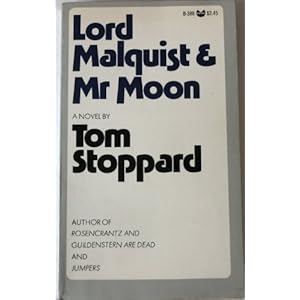
Friday's Forgotten Books: Lord Malquist & Mr Moon
Although a bit late in the day (just got home this afternoon and had to spend some time soothing Kipper's complaints about being abandoned for a whole day and a half), I wanted to try to get back in the habit of writing up a "forgotten" book for Patti's round-up of titles.
"Let it be said of me that I was born appalled, lived disaffected, and died in the height of fashion."
Lord Malquist and Mr Moon is (to date) Tom Stoppard's only novel. Of course he's one of the most celebrated playwrights in the world, but this novel seems to often be forgotten in discussions of his work. Not quite out of print (there's a trade paperback edition from Grove that came out about five years ago), it's seems to have a very low profile. The novel came out in 1966 just before Rosencrantz & Guildenstern are Dead and Stoppard's first real success, although he had been writing short dramatic works for both stage and radio (the collection of his radio plays appears to actually be out of print and is also a wonderful book to pick up).
In this novel, the Czech-born British knight (by way of Singapore and India) indulges in some of the same obsessions that fill his plays -- peculiarities of class and station, misunderstandings, confusions, sexual entanglements, surreal slapstick humor and an actual ticking bomb. It's by turns hilarious and insightful and always brilliantly timed. So I'm just going to give a few random quotes to give you the flavor of the story that mixes up the would-be Boswell Mr Moon and the haughty noble (as well as his wife, a cowboy, a lion and more):
"I find crowds extraordinarily lacking," said the ninth earl. "Taken as a whole they have no sense of form or colour. I long to impose some aesthetic discipline on them, rearrange them into art. It would give a point to their existence."
It was all a question of preparing one's material. There was no point in beginning to write before one's material had been prepared. Moon, who had experimented on a number of variations of a first sentence, felt this quite strongly. He found that the vastness of his chosen field reassuring rather than daunting but it did cramp his style; he could not put down a word without suspecting that it might be the wrong one and that if he held back for another day the intermediate experience would provide the right one. There was no end to that, and Moon fearfully glimpsed himself as a pure writer who after a lifetime of absolutely no output whatever, would prepare on his deathbed the single sentence that was the distillation of everything he had saved up, and die before he was able to utter it.
"I got dizzy," he explained.
"I should think you did -- what were you doing?"
"Nothing," said Moon. "I was trying to face one way or the other and I got confused and fell over."
Let that be my epitaph.
For Style is an aesthetic, inbred and disengaged, and in such precarious times these are virtues. We all have an enormous capacity for inflicting harm, and hereto the only moral issue has been the choice of the most deserving recipient..."
"You see, he understood that substance is ephemeral, but style is eternal."
"Be poetic, dear boy, be poetic and take your text from d'Aurevilley -- La verité m'ennuie."
"Idealism is the thin edge of madness -- console yourself, dear boy, with the thought that if life is the pursuit of perfection then imperfection is the nature of life."
As in his plays, Stoppard enjoys creating characters whose opinions oppose diametrically and then setting them at each other. The hapless Moon manages to be both pathetic and hopeful, the imperious earl both infuriating and amusing. Sex has its allure but always seems just out of reach. The randomness of life (as deliberately arranged by the writer) creates mad moments of black humor. I'd love to see Stoppard write another novel, but he seems happy with plays (not that I mind). Nonetheless, it would be fun.
Monday, November 22, 2010
Carrot & Stick
I have a favor to ask of you: it's not really much and this time of year, you might be spending a lot of time in the particular location anyway. I have a birthday wish. I realise it's a few weeks away yet, but you need some preparation time. The good news is that it costs you nothing but a small amount of time (otherwise I'd be hitting you up for donations to Heifer International or Kiva for micro-loans).
As you know, there are more places than ever to get the word out on your books and products, and even more people trying to do the same. It's hard to get a signal through all the noise. But there are a few things that will help get the word out on my behalf: tags and reviews.
Over at Amazon, it is possible to tag items so people know this book is in the same category as this other one. The more tags -- and the more agreement about the appropriateness of tags -- the better, as people are more likely to find your book in searches ("if you liked X you may also enjoy Y"). So if you have some time on your hands, I'd love more tags for all my books on Amazon.
And reviews! They needn't be elaborate, but they are helpful to have there so people have some idea what the book is like; be creative. Once you're on a roll, consider adding reviews (they could be the same ones) to places like GoodReads and Library Thing. Be sure to friend me there, too. Most of my Library Thing entries have been done by the lovely grad students (thank you!).
Thanks in advance for your help! It's the best birthday present I could get (other than a big lottery win -- I can hope).
Now the carrot: I hope you've all seen the new series Sherlock which revamped Conan Doyle's stories for the 21st Century. Fun stuff! Sherlocking is a fan site for show and they ran a fan fiction contest recently (no, not the naughty kind). I had been poked on Twitter to submit a story but with one thing and another, I nearly forgot until the last day. So, not my best work, I suppose -- and it may not make much sense to someone who's not seen the show -- but the kind of exercise that can be fun in a thousand words or less. So here it is:
"A Charming Situation": Holmes and Watson visit the London Zoo
Enjoy! If you prefer something less linear, drop by my page at the New Absurdist. Or if steampunk is more your style, drop by the serial. I think I finally figured out where I was going off the rails there: I got sidetracked on Helen's father before I developed her enough. That's the thing with first drafts; they seldom stay that way.
Friday, November 12, 2010
Friday's Forgotten Books: Renegade
"I don't really write from a solid idea. It's never that certain at the start. You get to what you're saying through the writing, the process; and then you move on." ~ Mark E. Smith

My entry may not really be 'forgotten' so much as completely unfamiliar to many. I bought a copy in one of the bookstores on the Southbank last year, which was near the start of my growing obsession with The Fall. I'd only seen them live once, but I've been obsessed ever since. A big part of that is irascible frontman Mark E. Smith who has keep the band going through various personnel changes since the heyday of punks. Their most recent release, Your Future, Our Clutter, proves they are still amazing all these years later.
Smith's narrative ranges freely over the many years of his career, projects as diverse as the ballet performed at the Edinburgh Fringe to accompany I am Kurious Oranj and the play he wrote about the rumored stories behind the sudden death of the first Pope John Paul, Hey, Luciani -- not to mention a lot of great music in between, as well as fights, marriages, sackings and a lot more. I can think of no better way to tell you what this book is like than to let the man speak for himself.
When I was five I used to go and sit with my next-door neighbour, Stan the pigeon guy, in his back garden. He was a Teddy Boy, and in those days, before everyone had phones, the Teds used to send pigeons off to their girlfriends in Blackpool or wherever, with little messages attached.
Sometimes he'd have three pigeons, each with a girl's name on it. I'd say to him, 'Why you doing that, Stan?'
'So at least one of them will get through.' (11)
That's why I've never aligned myself to the whole punk thing. To me, punk is and was a quick statement. That's why most of the main players couldn't handle the fall-out of it all, they were like a bunch of shell-shocked army majors stuck in time, endlessly repeating their once-successful war cries. Nothing wrong with that, I suppose, but I wanted something with a bit more longevity. (42)
I used to do tarot readings as well. I went through a phase of reading books on the occult. I was fascinated by it. I still believe that things leave vibrations. America, for instance; I've visited all these Civil War sites and the atmosphere is incredible. You can almost reach out and feel it. (67)
Women are more in tune with rhythms than men. It's very hard being in an all-male group. They don't get anything I say to them. The tunes in my head don't go past three chords. But men can't get it. There's something in their brain that's out of touch with this idea. I feel alienated from men musically, whereas women can transform my ideas into reality a lot more accurately. (129)
I've always tried to dress smart. It's important... (130)
[On Orson Welles] He was in another zone. Telling stories on stories until in the end he himself is a story. He didn't seem afraid of living in that world; and it's childish in a way, but when you can deal with it and use it, the results are evident. I think it's like heightened awareness, similar to when you don't eat for a few days, or you've been on a bit of a bender -- you see things differently. And not always in an obvious way. (235)
See the other Forgotten Friday Books rounded up at Patti Abbott's blog and of course, Todd (who persuaded me to take part again with some guilt-provoking) always does an FFB.
Friday, September 03, 2010
Talking Book Trailers at Sia's
Here's Sia's introduction to my piece on what I learned from making book trailers: please stop by and comment, and be sure to check out the many interviews with writers featured on her blog.
My guest is a favorite of mine, Kate Laity. She's written some wonderfully entertaining stories under various names, including tales of magic, myths, and legends, as K. A. Laity.
Thanks, Sia! You're very kind.
A hectic day so far: webmail isn't working so if you've emailed me, you're going to have to be patient. Maybe when I get home I'll be able to download it, but here on campus I keep getting "unknown error" when I try to login. Curse you, Mercury! My "quiet" semester has so far been a non-stop whirl of things that must get done NOW and I am scrambling to get to everything in a timely manner, so I look forward to catching up on things while everyone else is enjoying a long holiday this weekend. I'd like to be able to breathe again! And one of these Fridays I will get back to Forgotten Books; in the mean time, read Todd's andPatti's George's round-up of all the others for the vacationing Patti.
PROMOTION AND BOOKTRAILERS
My guest is a favorite of mine, Kate Laity. She's written some wonderfully entertaining stories under various names, including tales of magic, myths, and legends, as K. A. Laity. Branding and promotion is something of interest to authors. We talk about both quite a bit and you see resulting conversations on many blogs. Another aspect of promotion is what I call gadgets. Really, they are various promotion tools used to capture the interest of potential readers and can include everything from bookmarks to booktrailers.
Like websites, booktrailers visually solidify your brand as an author. There are professionals out there that will produce both. Many writers choose to make their own. So how does one go about creating a good, eye-catching booktrailer? How much is too much? Not enough?
A hectic day so far: webmail isn't working so if you've emailed me, you're going to have to be patient. Maybe when I get home I'll be able to download it, but here on campus I keep getting "unknown error" when I try to login. Curse you, Mercury! My "quiet" semester has so far been a non-stop whirl of things that must get done NOW and I am scrambling to get to everything in a timely manner, so I look forward to catching up on things while everyone else is enjoying a long holiday this weekend. I'd like to be able to breathe again! And one of these Fridays I will get back to Forgotten Books; in the mean time, read Todd's and
Friday, July 23, 2010
Friday's Forgotten Books: You Can't Do Both
I read this novel in England this summer; I've been on a bit of an Amis kick, filling in missing volumes while I mull over the overall effect of this pursuit. Projects tends to develop this way; I get obsessed about something, immerse myself in it, then when the time is right, chuck it all away and write. I'm also knee-deep in Angela Carter, so I can't really explain how they intertwine (could two people be less likely to intertwine?).You Can't Do Both tells the story of Robin Davies, who lives in a south London suburb, winds up going to Oxford and then the Second World War and eventually into the adventure that is marriage, though not on purpose. Davies' father is a weird amalgamation of strident atheism and puritanical control. His mother offers a sometime refuge against his father's rigidity, but without much substantial help. When at last he's freed of his stifling suburban home, he tries to live up to his fevered sexual dreams but encounters the realities of women who are likewise a bundle of eagerness, confusion and contradictions.
Amis plays this for some wonderful laughs, no surprise. But he also carefully details the way that the misogynist tendencies develop from these encounters. Women are denying him the one thing he must have. As Richard Bradford suggests in Lucky Him, this novel comes much closer to the truth of Amis' life than his memoirs, a highly fanciful selection of events and memories. There is a sensitive and moving depiction of a friend of Robin's who turns out to be gay which makes plain the costs and dangers of that identity in the not so distant past. You'll also find an evocation of what the Oxford days with Larkin might have been like and the awkward development of his first marriage, grown out of an uncertain alliance that quickly developed into habit because of the sexual connection, then threatened by pregnancy.
Davies never ends up being likeable exactly; by the end, he's distinctly unlikeable. But the dissection is fascinating and if not really an apology, it does seem to offer a bit of an explanation for how Amis became what he was. And at his best, that was a lot.
Now to get hold of a copy of Colonel Sun...
See the round-up of other neglected tomes over at Patti Abbott's blog.
Thursday, July 01, 2010
Friday, June 04, 2010
Interviewed at UnBound / BitchBuzz
The wonderful Adele over at the fabulous book review (and more) blog, UnBound has interviewed me and wormed many secrets out of me :-) and that's me laughing at the noodle restaurant the week before. It was such a pleasure getting to know in real life someone I had got to know over the 'net. I love the internet! So many friends and opportunities I would not have had but for it.
Yesterday I dawdled along the Thames near Millbank mudlarking. There was the usual assortment of glass and pottery shards, but I also found odd things like the front part of a telelvision set (no screen of course), a camera, a set of rusty keys with a Galapagos diving fob, which amused me (surviving all that diving and then losing your keys in the river? Then again maybe it was all a pose anyway). I went to the Tate Britain afterward. I'm still amazed at how much I love the new Turner section, mostly for his unfinished paintings which seem like precursors of the Impressionists. There's a new room of early Bacon works that include a painted screen and three rugs (!) from his interior design business in the 30s.
And my latest column is up, too, at BitchBuzz: a mad mash-up of the Stoppard matineé, the guy behind me on the bus, random musings about the Middle Ages and the usual weird stuff in my head. Enjoy!
Tuesday, March 30, 2010
Meme: The Ten Books That Most Influenced Me
Via Patti Abbot's blog (and a bunch of others) AKA a swift post as I rush through last minute things:Alice in Wonderland: the book of my life, the set me up for a lifetime of absurdity and nonsense -- and wonder;
Mary Poppins: ditto -- the books have little to do with the wretchedly painful Disney version (of COURSE), but I read ALL of them; magic without the twee fluff;
Shrieks at Midnight: gave me a taste for the macabre at a very young age, which has never changed either;
Beowulf: read with Njal's Saga in Stephen Mitchell's course and literally changed my life -- grad school, academia, a whole new level of writing inspired;
The Books of Blood: fearless imagination, bold writing, horror inside out;
Lucky Jim: One of the first books that both touched on my love/hate relationship with academia and made me laugh so hard that I cried;
The Bloody Chamber: Fearless writing, grotesque and beautiful, infinitely inspiring;
Pride and Prejudice: The genius, sheer genius of her observation, the rapier intensity of her wit, the horrible weight of her knowledge;
Waiting for Godot: hilarious and painfully sad, not a wasted word in the text, the ultimate in efficient writing;
The Dagenham Dialogues: funniest damn thing ever; that they live on the page without the impeccable delivery of Cook and Moore is miraculous wonder.
In half an hour, I would give totally different answers, but at this moment, with these things sifting around my brain and writing furiously, these are the ones...
Friday, March 12, 2010
Adele AKA Hagelrat: Why People Don't Read
Adele is the fabulous hostess of Unbound, a lively book blog that covers a broad swath of authors (yes, I was recently a guest there myself!). She's also pretty darn funny and an astute reviewer. As her post shows, she's passionate about sharing the flame of reading.Our awesome hostess has invited me to come and talk about something that matters to me about books. So that was easy really, it matters to me that people read. So I thought I'd take a quick look at some of the barriers to reading generally.
First and foremost the simple ability to read. I worked in young offender institutes briefly when I first left uni and the psychologist in one of those YOI's told me that in that particular one only 19% of the kids were educated to primary level or above. These are 16 - 18 year olds who cannot read or write to the same level as six year old. Add to that that in the UK when I was small dyslexia was a middle class excuse for stupid and few people could afford to get their dyslexic kids an appropriate education. The attitude to learning difficulties has improved massively over the last 30 years but there are plenty of people in the UK right now of every age who simply cannot read. They therefore do not have access to the quiet pleasure of written stories. Many of them have never had the joy of being read to either so the whole world of non visual story telling is lost to them. When you think of how fundamental story telling is to us as a species, part of our identity, our moral code, the offer of adventure and experience beyond what we can hope to actually have for ourselves and illiteracy is a huge tragedy and the loss of part of our social identity.
Perhaps the power of social media should be harnessed for the forces of good, to raise awareness and push this massive problem into the public consciousness so that in another 30 years time we won't be having this conversation again?
Another thing that is becoming a cause for concern is access to books. For those of us who already have a passion for reading it sounds silly, there are libraries and bookstores and the internet and frankly the hundreds of books in our homes already. There are friends to borrow from and paperback exchanges and the charity shops. But many of these things are disappearing.
Waterstones is the last big bookstore throughout the UK, there are a few smaller specialist chains like Forbidden Planet, but the high street bookstores are gradually disapearing. What happened to Dillons, Ottakers, Blackwells? Are they still around at all? Borders UK has gone, Blackwells I think is just a campus store now. WHSmith spreads itself too thin and is hardly a soothing browsing experience now, especially in Leicester where book browsers are bumped aside by the billions of visitors to the post office that is now situated there.
Libraries in schools are already becoming digital centres and city libraries are being chipped away at bit by bit serving community functions in priority to actually providing books and knowledge. I think there is room for libraries to do both, but to do both well requires money and commitment.
Gradually the processes by which we push the first paperbacks into people's hands and let them discover the worlds within, get Kidnapped or seach for Treasure Island are being eroded. We have initiatives to fight back, World Book Day for one, BookDoctors (and ours here is both lovely and wonderful) but it's not enough.I am not considering ebooks here for a simple reason, browsing. In order to seek out, purchase and read and ebook you have to know you want to read, the discovery of reading comes from other sources than the computer. That of course segue's me nicely into where the love of reading comes from. Grasping for the Wind recently did an around the blogosphere on this and I didn't get my answer in on time, so you get my personal answer and my views generally now.
Love of reading for many of us comes from people who love to read. It's simple but it's true. My mother loved to read and won prizes for her poetry readings as a child so watching her stalk around the room reading Tennyson was enchanting. In the great tradition of our species my mother passed on her passion to me through oral storytelling, like a greek bard bringing stories to life in my mind while I listened. In order to get more stories than she had time for reading became my priority for myself.
At the points in my life where my reading habit has waned it has been friends lending me something that really captured my imagination that drew me back in: Tigs lending me a Clive Barker book when we were fourteen, Mandy lending me a selection of horror a couple of years ago when I was stuck for something new. Just being around other people who read has made a huge difference all through my life. One friend and I used to sneak out of school at lunch time to go to the local library because we'd exhausted the school one and when I left the area I gave her my library card because the six book limit was causing her problems. Now I am a book blogger and amateur reviewer, surrounded by people from all over the world that share this all consuming passion and I have realised two things: How many other people there are for me to share this with and how small the literary world really is.
One of the top sites for book reviews in the Booksmugglers blog, I believe they get about 26,000 visitors a month. In book blogging terms that's huge, the publishers who specify usually state between 1,000 - 3,000 before they will put you on their lists.
It seems sometimes that everyone reads, because we surround ourselves with people like us, but in the grand scheme of things regular readers are a minority group. Perhaps we should register ourselves as a charity and start a programme of aid work, doing live readings in school playgrounds at breaktime.
If people who love reading are the way in for new readers, then perhaps we have a civic duty to tout that love everywhere we go and at least try and provoke the question why.
Wednesday, March 10, 2010
BitchBuzz: Mashing Jane
There's something to be said for injecting new life into a mouldering corpse, as both Mary Shelley and Herbert West knew. However, it is usually best to wait until the body actually dies. While Jane Austen may not be dancing a hornpipe these days, her legacy is as sprightly as ever.
I know this book, Sense and Sensibility and Sea Monsters -- and the one that preceded it and the ones that will inevitably follow it like mutant spawn or enchanted brooms -- is really at heart just a mash note of fondness for everyone's favourite Regency babe, but like the tentacled Colonel Brandon the Dashwoods first meet in its pages, it is difficult not to look away with a grimace.
Remember when mash-ups first hit? Wasn't it cool to hear "Paperback Believer" and "Smells Like Booty" or um, that one with Cher? Well, for about five minutes or so, it was cool. Video mash-ups, too -- they were popular for a while....
As always, peruse the rest over at BBHQ.
I should also mention my other publication this week, also a review, of Faust: My Soul Be Damned for the World by E. A. Bucchianeri in the Journal of Folklore Research. It's a two volume set all about Faust (for those of you who can't get enough of the mad necromancer).
I've got more guest bloggers coming up; hope you're enjoying the special Women's History Month celebration. It's wonderful to be able to celebrate the multi-talented women I know -- and the women they admire and find inspiring. Men like 'em, too!
Sunday, March 07, 2010
London, Books and Catching Up
I'll do a proper round up (I hope) once I'm caught up: Van Gogh, the V&A's new medieval wing, Richard Hamilton, JG Ballard inspired CRASH exhibit at the Gagosian, Sir Ian in Beckett's Waiting for Godot, Jane Bown at the National Portrait Gallery, the Argentinian film, La mujer sin cabeza and comedian/magician Jerry Sadowitz. In between was a lot of pub food, beer and idling -- well, a lot of it was work-related, like meeting with my editor and brainstorming. Also I was planning for the student trip in May, so while I'm in the habit of always making myself sound like a loafer, I did accomplish things.
Lost in the shuffle -- I was guest blogger over at Unbound, where I wrote about bibliomania and my plans to cure it. Please drop by and leave comments! Also see Adele's terrific write up of the Writing Industries Conference.
While frustrating at the start -- and a little bit at the end (those three dread words, "rail replacement service", meant a bus between Hammersmith and Osterley; status computers going down meant that the employees were bored, so gave a lot of complete searches at the gate; and seated with a gaggle of teens for a seven hour flight is always lovely), it's always worth it.
I love London.
Subscribe to:
Posts (Atom)