I have featured Tony Hancock before on a Tuesday (though I don't seem to have done The Rebel yet which amazes me; and this reminds me too that I haven't yet done the apocalyptic comedy The Bedsitting Room). This is an episode of the half hour shows, but an unusual one as it's the first after he decided to end the partnership with Sid James and to move from the original setting at 23 Railway Cuttings, East Cheam to a bedsit in Earl's Court. To signal the change, this first episode of the last season (1961) features Hancock completely on his own. This solo exploration of boredom offers a wonderful showcase of Hancock's timing and precision without the exuberant foil of Sid's unflappable humour. And it's marvelous -- just marvelous.
Part 1
Part 2
Part 3
I'm off teaching the doctoral students in digital humanities today, so amuse yourself by checking out all the other overlooked gems at Todd's blog. With luck, I'll get to the P-Con recap tomorrow, although I am teaching as usual on Wednesday (it never ends, eh?).
"The Wombat is a Joy, a Triumph, a Delight, a Madness!" ~ Dante Gabriel Rossetti
Showing posts with label Tuesday's Overlooked Films. Show all posts
Tuesday, March 06, 2012
Tuesday, February 28, 2012
Tuesday's Overlooked A/V: The Fantastic Flying Books of Mr. Morris Lessmore
This blog takes its name from my first film, Un Amor Peligroso or The Wombat's World. I joked about my anticipating the success of The Artist by making a silent film back in 1978, but then there was also Mel Brooks' Silent Movie about then, so I can't take much credit. There may be something in the air at present that provokes a longing for wordless -- or at least speechless -- entertainment. Maybe it's the 24/7 shouty news cycle. Maybe it's social media and the endless blaring of words, words, words (and pictures, pictures, LOLcat pictures). Perhaps it's simply the awfulness of movie dialogue created by a "creative" process that really means each producer who passes through has to change something just to be able to point to it and say, "That's mine." A process that has contempt for its audience, so it spells out every action with words and makes good actors speak horrible lines.
So here's the Academy Award winning animated short, The Fantastic Flying Books of Mr. Morris Lessmore. It's got plenty of words, but they're mostly flying away. It nods to Buster Keaton in its main character and to The Wizard of Oz and takes place (at least initially) in lovely New Orleans. It will make any book lover cry and sigh. And it's only 15 minutes long. You've got time for that in your busy schedule. Take a break and be delighted.
And in a bizarre and completely unrelated space in Glasgow, a most unusual performance takes place. Dare you attend An Appointment with the Wicker Man?
As usual, see the round up of fine recommendations over at Sweet Freedom (I forgot to add that earlier, D'oh!).
Tuesday, February 21, 2012
Tuesday's Overlooked A/V: Thirst & Linear Obsessional Recordings
A bit of news first: my story that asks the question "what if Christopher Marlowe wrote like an Elizabethan Hunter S. Thompson?"AKA "Fear and Loathing in Deptford," is featured at the World SF Blog. World SF is dedicated to posting links, news and original content related to science fiction, fantasy, horror and comics from around the world, so check them out for a wide variety of tales you won't see elsewhere.
THIRST: I'm slowly catching up on my Korean horror films. I am fond of Park's films and glad to have finally seen this one. It was part of the vampire run on Film 4 this past week. I'd seen just about everything else, so this was a nice surprise. In Thirst Kang-ho Song plays a priest who inadvertently becomes a vampire in his attempt to try to heal. He's driven to try to rescue the beaten-down Tae-ju, but saving the damsel in distress turns out to be a lot more complicated than he anticipates. Ok-bin Kim gives the orphaned outsider bride a mercurial character that reflects the deprivations of her marginalised life and her greed for excess that cannot be quenched. A very entertaining take on the vampire mythos.
LINEAR OBSESSIONAL RECORDINGS: Social networking brings you into contact with unexpected delights. Facebook connections brought me to Linear Obsessional Recordings and their coalition of experimental musicians. You'll find everything from a deconstruction of J. G Ballard's "The Atrocity Exhibit" to music for barges to found sounds as well as collages of loops and various improvisations. If you enjoy experimental work and ambient sounds, you'll find plenty to interest you there. You can stream all the music and download many for free (donations also accepted) -- some you can even remix as they're under a Creative Commons license. I spent all day yesterday listening to their recordings while writing. Good stuff. A lot to enjoy here.
Support indie music!
Wednesday, February 15, 2012
Tuesday's Overlooked A/V: Pop Hive & Galway Races
Happy Valentine's Day to my sweetie xxx Glad I could spend at least part of the day with you :-)
Good news from Mr B, who shared the link from Dark Valentine Press who now lists the Drunk on the Moon collection as forthcoming this spring (so just around the corner). Also my Fall-inspired noir story "Bill is Dead" will also be appearing soon. Linkage when it's available...
POP HIVE
My BitchBuzz editor Cate Sevilla has started up a new pop culture-themed web tv series. Drop by and experience the bright bubble of fun. Episodes on Vimeo.
Pop Hive: Episode 2 from Pop Hive on Vimeo.
GALWAY RACES/RAISA NA GAILLIMHE
When we visited TG4 the station director told us about the second series of the Irish language soap "Galway Races" so I figured it would be fun. It's a hoot - distinctly odd and I can already see the very local touches. You can watch it and all the Irish-language programming for free anywhere in the world. Next episode is tomorrow night. I'll be watching! Let's make it an international phenomenon. Besides, you get to visit all the familiar sights around Galway. Imagine "Dynasty" in a fairly small town. There's a crashed and burned politician, a tough police chief trying to reform a laughable force when her ne'er-do-well hippie brother shows up and an assortment of hustling would be entrepreneurs all around.
Tuesday, February 07, 2012
Tuesday's Overlooked A/V: Red Cliff
O for a muse of fire that would ascend / the highest brightest heaven of invention / a kingdom for a stage, princes to act / and monarchs to behold the swelling scene...
There aren't many pieces I can quote from memory (I gave the habit of misremembering every quote to my main character Ro in Owl Stetching; trust nothing she says!), but this is one. Yes, I just double-checked it. Okay, one word off. That's rather good for me.
Anyway, surely this is the emotion swelling in John Woo's bosom that urged him to make this epic battle film. Or this half of it, anyway. The three hour film I saw, Cultural Gutter tells me, is only the condensed version of the complete five hour movei. Wow. Epic indeed.
The narrative follows an historical battle, no surprise. For the man made famous by a film with the tag line, "Two men. Ten Thousand Bullets." Woo has stepped up the munitions even more here: let's say a million billion arrows, lances and swords. And that's not even mentioning the fire bombs.
I had my doubts when the film began with an awful American voice over: fortunately it disappears too quickly. Once again Hollywood assumes people are too stupid to just pick things up from the narrative. Woo actually does the zoom-in and highlight with title card when we first meet the key players.
At the center, the always patient world-weariness of Tony Leung as Zhou Yu, who would rather there were no more wars, an opinion shared by his impossibly radiant and artistic wife, Xiao Ciao (Lin Chi-ling) but they're both mindful of the greater good. Zhang Fengyi gives the power-hungry Cao Cao a realism despite his embodiment of the arrogant man of power. Zhao Wei gives a plucky performance as the cross-dressing Sun Shangxiang -- they actually make her look androgynous enough in costume to be somewhat believable. You never for a minute believe anyone could mistake Brigitte Lin for a man ("But she's wearing a man's hat!"). The young but clever strategist Zhuge Liang (Takeshi Kaneshiro) comes up with some of the most bizarre and yet effective plans that often seem divinely inspired -- or at least inventively creative.
There's a great cast and all kinds of pyrotechnics, flying arrows and spurting blood. There's nothing you haven't seen before if you've watched a lot of wu xia, but it's an enjoyable epic that hits all the high points and feels satisfying if you've got nowhere to go for a few hours. Here's the trailer, so you can see it is chock full of stunning visuals (and yes, a patented Woo dove -- and yes (>_<) Don LaFontaine doing the voiceover).
Tuesday, January 31, 2012
Tuesday's Overlooked A/V: Delius
Another in the Ken Russell oeuvre: another composer too. Unlike the Elgar film, this is a fully embodied story and not just a biographical overview. Written with the assistance of Eric Fenby, Frederick Delius' amanuensis in his final years, it gives us a personal insight into the composer at a specific point in his life. I'll admit, I first knew of Delius (and as it happens, Fenby) from Kate Bush's song about Delius that captures the pivotal moment in the film [Kate based a lot of her songs on films -- "It's in the trees! It's coming!"] where Fenby first takes Delius' dictation for what would become "Song of Summer" and the young man's initial confusion and panic when he can't understand Delius' "Ta ta ta ta!" Her video nods to the images of Russell's film as well -- the wicker wheelchair! When I am old and need a chair, I want a wicker one.
Russell's film makes as much of their native Yorkshire as of the "exotic" location in Grez, although Fenby's fish-out-of-water feeling offers the viewer an entré into Delius and Jelka's world. The arrival of fellow composer Percy Grainger to the quietly obsessive menage breaks open the narrative delightfully. While not as visually arresting as the Elgar documentary, this short film showcases a lot of the visual acuity that sometimes gets overwhelming in later films. Russell had a very fine eye. You can watch this on YouTube if you don't have access to BBC4.
As always, see the round up of overlooked gems over at Sweet Freedom.
Labels:
Delius,
Ken Russell,
music,
Tuesday's Overlooked Films
Location:
Grez-en-Bouère, France
Tuesday, January 24, 2012
Tuesday's Overlooked Films: Ken Russell's Elgar
The BBC has been pulling out a bunch of Russell films from the vault in a grudging sort of admiration for the filmmaker's passing, including a doco on his life, A Bit of a Devil. So my DVR seems to be filling up with an assortment of things (which means I'll finally see The Boyfriend). I actually watched this in real time and plan to re-watch it soon. We're all used to thinking of Russell as the bad boy of excess (who, having seen it, can get the giant penis of Listomania out of their eyeballs?). Certainly a number of his films live up to that surreal excess.
But there is a range to his work -- even within his most excessive films (what would qualify for that? The Devils?) there are quiet enigmas. Elgar, a short film made for Monitor shows a restrained Russell at work but one who (as the doco tells us) delighted in dancing naked to extraordinary music. People tend to remember Elgar most for the song they hear at graduations, but there's so much more. Another one of those weird confluences of the zeitgeist: the events in Penda's Fen hinge on Elgar's Dream of Gerontius and the composer makes an appearance as the story takes place in the same location, the hills of Malvern.
I was talking about this on Twitter with a friend about how sensitive and deft the film was, how it put the music at the center. It tread the line between documentary and re-enactment without falling into the silliness that usually means. As Susie said, this was in sharp contrast to the slickness of current documentaries "and no silly camera work, no 'acting' Loved shot of Elgar walking into room of draped chairs to his draped billiard table." The film is full of striking images that encapsulate significant moments of Elgar's life (some of which reappear in Russell's work, but they're integrated into Elgar's story well). The music is the real star and Russell allows the audience to embrace the music full on, giving us space to really listen with visuals that compliment but never intrude on that experience. You can watch it in pieces on YouTube: not ideal, but worthwhile nonetheless. Excellent work.
See the roundup of recommendations over at Sweet Freedom.
Teaching tomorrow: eek. So much to do! Fortunately it seems as if the zeitgeist has taken the initiative to come up with a PR campaign for my forthcoming novel Owl Stretching, so that will save me some time.
Don't forget: enter to win a free copy of It's a Curse: Drunk on the Moon 7 over at Goodreads.
Tuesday, January 17, 2012
Tuesday's Overlooked Films: The Devil and Miss Jones
A few things to mention before I get to this lovely little film: the BOGO sale at Trestle continues! I have a new short horror story coming out, "Yuletide Feast," which will be up soon: it's actually a rather old story that I stumbled across, realised had never been published, so shined up and sent off. Waste not, want not. I put the 1k story "A Charming Situation" I wrote for the Sherlocking site back in 2010 up on Scribd: just to help you with those withdrawal symptoms while waiting for series three. I somehow missed that Drink Tank's issue 300 has appeared already, featuring my piece "Viking Wrestling" on page 58 (it's a jam-packed gigantor issue with 300 entries and almost as many pages). I particularly like the illo by Mell Hoppe that accompanies it.
All, now for Miss Jones -- not to be confused with the similarly titled The Devil in Miss Jones which is very different to be sure. The Devil and Miss Jones stars the always luminous Jean Arthur (I seem to love that word luminous) who's also very funny. I want to see You Can't Take it With You right now! She's just glorious in that. It also stars the very funny Charles Coburn (you might know him best from Gentlemen Prefer Blondes where he was diamond mine owner Sir Charles Beekman AKA Piggy). Spring Byington charms as Arthur's friend Elizabeth and Robert Cummings plays the passionate labour organiser Joe.
It's almost impossible to imagine this film getting the green light. In a world where Hollywood has made a hero of millionaire industrialists like Tony Stark (the theme seems to be 'he's an asshole, but he's our asshole') and sold the idea that your personal fortune is just around the corner, it's amazing to see this picture that's completely on the side of the working people. In the current American climate, where "patriotism" has been writ as straight-laced morality and obedience to corporate overlords, it's astounding to see a film in praise of what is now the Occupy Wall Street folk. How has it become a radical notion to suggest that working people have rights and should be treated with dignity? It only takes Coburn's millionaire Merrick a few days with the plucky poor to realise how horrible his policies (and his empty life) have been. Cumming's impassioned delivery of the Declaration of Independence in the police station shows the vast gap between the patriotism of the former ideals of freedom and dignity that have been replaced by 'personhood' for corporations and draconian civil engineering masquerading as 'morality'.
The only thing that's kept his film from being acknowledged as a classic is the stumble at the end. It feels as if the filmmakers decided it was going on too long and just wrapped things up a little too quickly. Nevertheless, it's a fun film with plenty of great comedy moments (Jean Arthur's expressions are priceless when she's trying to work up the nerve to knock Coburn out) and an inspiring message.
As always, see the roundup of recommendations over at Sweet Freedom.
Tuesday, January 10, 2012
Tuesday's Overlooked A/V: Penda's Fen
Big birthday wishes to my li'l brother, Bertie. He wouldn't want me posting a picture that was not pre-approved or artfully touched up, so I will refrain from posting that pouty school photo from when he was about seven...
Much as I might be tempted.
Today's overlooked A/V owes a big thanks to Mr B, who pointed me to where Iain Rowan blogged about this film (and more owls -- awesome! [wait, not supposed to say that anymore; what did we come up with? Prodigious! I don't think it's going to work out though...]). Ahem.
Let's go back to a magical time: 1974. Okay, no so much magical as really really weird, especially when you consider British television. And not just scary PSAs, just really weird programs -- often aimed at kids! I give you Penda's Fen, which you can watch in its entirety online [so sorry the video freeze frames on an instance of animal cruelty! not intentional but I guess that will warn some of you away -- apologies!].
This is a film that would have trouble airing now in the States. Never mind that it deals with Elgar's Dream of Gerontius and Manichaeism (o_O) and homoeroticism, it also deals with the relationship between paganism and Christianity; not simply as atavistic past threatening its 'evolutionary' successor, but with a faith in the power of that pagan past and with a view of Christianity as a corrupt reflection of mechanised modernity.
Wow.
Among the things that would doubtless give many fundies apoplexy, there's the suggestion that Joan of Arc might have been a follower of the Old Religion. The titular pagan Anglo-Saxon king offers a positive model, too. One of the real knock-outs of the film are the dream sequences which are truly unsettling in a very simple way. Two words: uncanny angel! Really creepy! I suspect this film alone may have warped a generation. Wonderful!
As always, catch up on all the recommendations over at Sweet Freedom.
And yes, it's the last day to vote in the Preditors & Editors Poll...
Tuesday, January 03, 2012
Tuesday's Overlooked A/V: Brett's Holmes
We had thought to head out to the islands today but the winds put the kibosh on that idea. So we may head out to the movies, which reminds me it's time for Tuesday's overlooked films or in this case, television. With all the attention being given to the new Sherlock and the Guy Ritchie Holmes, it's well worth reminding folks of my fave version of the detective's adventures starring Jeremy Brett. Absolutely wonderful. If you're unfamiliar, do find yourself the DVDs or the stream and treat yourself.
And if you like things a little lighter, there's always Brett's fine turn as Freddy in My Fair Lady.
Be sure to check out the full range of suggestions for your audio/visual pleasure over at Todd's.
And if you like things a little lighter, there's always Brett's fine turn as Freddy in My Fair Lady.
Be sure to check out the full range of suggestions for your audio/visual pleasure over at Todd's.
Tuesday, December 13, 2011
Tuesday's Overlooked Films: The Long Kiss Goodnight
I got into a discussion on Twitter with Anne Billson about Finnish music and films, and we both lamented the lack of love in Hollywood for Renny Harlin when people like Ridley Scott continue to be trumpeted. I suppose I have a weakness for a Finnish director who always manages a little nod to his homeland in the midst of a blockbuster, whether it's a pirate ship flying the blue and white flag in Cutthroat Island or the Finlandia vodka prominently served in Deep Blue Sea. I find it hard to believe that I have not written about this film here before, but I searched the blog and turned up nothing, so let's assume it's true (yes, I did mention it in a column on holiday films for BitchBuzz).
I love this movie.
A lot of this is down to Geena Davis' winning performance as the amnesiac suburban mom who discovers she's really a lethal weapon. Davis has done a lot of work behind the scenes since then with the Geena Davis Institute on Gender in Media and while promoting the film she spoke about how her then-husband Harlin would balance the punishment she took on screen with therapeutic massage at night. She takes a beating in this film, but she's also warm and funny as well.
Samuel L. Jackson is great fun of course: Shane Black's script (written before repeating Lethal Weapon films sucked a lot of life out of him) sets him up as fairly hapless and yet always hopeful, though he can't get song lyrics right (heh!). Brian Cox is terrific (of course) in a small role and utters one of the funniest lines in the film (although the humour is due as much to his dry delivery as to the line). Craig Bierko makes for a fetching psychopath. David Morse and Patrick Malahide offer terrific performances as well in supporting roles. But this is Davis' star turn and she makes the most of it.
Chefs do that.
See the round-up of overlooked films, television and other audio-visuals over at Todd's blog. And if you haven't seen this film? Do. Look, it's really cheap. And it totally kicks ass.
Labels:
Brian Cox,
films,
Finnish,
Geena Davis,
gender,
humor,
movies,
Renny Harlin,
Samuel L. Jackson,
Tuesday's Overlooked Films,
women
Monday, November 07, 2011
Know-vember: Todd Mason
Todd, of course, shows up here frequently whether as a fellow participant and sometime host of Friday's Forgotten Books and the host of Tuesday's Overlooked A/V or just as one of the regular kibitzers. He's on the left in this picture from a family wedding.
1. What's the first thing you do upon waking in the morning?
Pat/skritch the dominant, female cat in the house, Niki, who has probably awakened me so I can pat her and then feed the entire trio of household cats.
2. What's a song you might be persuaded to dance to?
Some of the music I've actually danced to: THE MAIDEN IN THE TOWER performed by the Brubeck Quartet (a ballet suite that Brubeck didn't complete, but on the album COUNTDOWN the quartet recorded four pieces DB had finished); "She Said Yeah" as recorded by the Rolling Stones; "She's Not There" by the Zombies (introduced a party full of fellow high-schoolers, including eventual pro musician Deb Fox, to them at that time); THE FREEDOM NOW SUITE by Max Roach, et al.; Jawbox’s “Twister” and The Specials’ “Ghost Town.”
3. Where in the world do you live?
A house in Collingswood, NJ, though I also rent an apartment in Media, PA...but entirely too much time is spent in a gray cubicle in Radnor, PA.
4. What's a great night out for you?
Good conversation, a good meal, perhaps a performance and a good bookstore (a/v materials also good).
5. What's a great night in?
Conversation, meal, sex, perhaps other performance, and good literature (a/v materials also good).
6. If you were offered an all expenses paid trip anywhere in the world, where would you go?
Tough call. I so rarely enjoy travel, having had entirely too much of the bad sort in my youth. There are all sorts of places I'd be interested in seeing, but getting there is less than half the fun. If it isn't a round-the-world journey, with many destinations (with rest breaks between), I'd be torn between, say, Italy and Australia, Guyana and Japan...
7. What book do you wish everyone would read so you could talk about it?
I've spent several years citing those weekly, but among the very best ones are THE EXILE by William Kotzwinkle, LIVING MY LIFE by Emma Goldman, CONJURE WIFE by Fritz Leiber, THE FEMALE MAN by Joanna Russ, THE ENQUIRIES OF DR. ESZTERHAZY by Avram Davidson, THE ALEPH AND OTHER STORIES, 1933-1969 by Jorge Luis Borges, GOING OUT OF OUR MINDS by Sonia Johnson, TROPHIES AND DEAD THINGS by Marcia Muller. Dozens of others.
8. What movie makes you cry?
In reverse chronological order, among those I recall causing some tears to well: SHAME (the Bergman sf film); PONETTE (who doesn't love a good setpiece of an recently-orphaned child of about six being tormented for her status by schoolmates?); PATHS OF GLORY (with the laughter); THE 400 BLOWS; SNOOPY COME HOME; "The Last of the Curlews" (the first ABC AFTERSCHOOL SPECIAL...they were trying, then).
9. What makes you laugh?
Unexpected jokes, and well-executed expected ones. Humor that is not about others getting hurt (chided is OK).
10. Are there fairies at the bottom of your garden?
David Campton's "At the Bottom of the Garden" convinced me at a young age to have them ruthlessly extirpated.
Thank you!
You're welcome.
Tuesday, October 25, 2011
Tuesday's Overlooked A/V: Keeping it Peel
I am showing great restraint by not simply posting a bunch of clips of John Peel introducing The Fall. Are you proud of me? You should be. Here's a nice four part interview with Peel talking about the reality of punk music and its development in his usual straightforward way (further parts on this other site). Even if you've never heard of John Peel, if you like good music, you owe him a lot. Today's his remembrance day, a good reason for Keeping it Peel.
Be sure to drop by Sweet Freedom to read the rest of the overlooked recommendations.
Tuesday, October 18, 2011
Tuesday's Overlooked A/V: Do Not Adjust Your Set
I'm looking forward to Holy Flying Circus tomorrow night, the documentary on the fight against the Python's Life of Brian. I know I've likely seen a lot of the footage already, but I'm sure it will be enjoyable nonetheless. Good example of how bonkers people can get over something they assume will offend them. At heart, Brian is a very moral film, which focuses on the all-too familiar foibles of human behaviour. Ah, but if you're reading this you likely already know that.
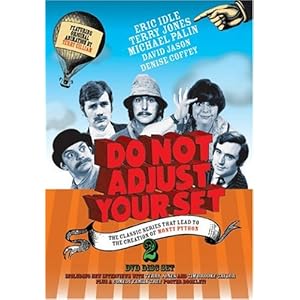
Something you might not know about is Do Not Adjust Your Set, one of the many training grounds for the future Pythons, like The Frost Report and At Last the 1948 Show (source of the original Four Yorkshiremen sketch). DNAYS featured Michael Palin and Terry Jones (who had also worked on The Complete and Utter History of Britain) as well as Eric Idle. This was a kids show, which is kind of stunning (although if you look at a lot of the mad kids show at the time, perhaps not quite so odd) so a lot of the humour is very nonsensical in the Goons/Spike Milligan/NOBA vein of absurdity. You can really see the connections between the Pythons and what came before them.
Of course one of the key reasons to see DNAYS is the Bonzo Dog Band. Why anyone thought they were safe for children, I don't know. The ginger geezer Vivian Stanshall and the delightfully daffy Neil Innes headed a rotating roster of musicians but those two were really the magnets. I've gone on at length about both of them, so if you don't know them yet, you should stop reading right now and just go look at the videos widely available at a certain tubish site.
A fave moment, appropriate for the season: the Bonzos sing "Monster Mash" for your delight.
As usual, find the whole roundup of overlooked a/v over at Sweet Freedom.
Labels:
Bonzo Dog Band,
British comedy,
comedy,
Monty Python,
Neil Innes,
Not Only But Also,
Peter Cook,
Spike Milligan,
television,
Tuesday's Overlooked Films,
Vivian Stanshall
Location:
Eyre Square, Galway, Co. Galway, Ireland
Tuesday, October 11, 2011
Tuesday's Overlooked Films: Derek Jarman's Caravaggio
What can I say? One of my favourite painters in all the world (and I repeat unending thanks to Alessandra for taking me around to see the Caravaggios in the little churches of Rome). A glorious young Tilda Swinton plus Nigel Terry looking rough, Sean Bean, Robbie Coltrane, Michael Gough. Jarman's eye captures it all with a brilliant palette that mimics Caravaggio's earthy voluptuousness. Get the film. Watch it.
See the rest of the roundup over at Todd's blog (yes, in haste today, much to do).
Tuesday, October 04, 2011
Tuesday's Overlooked Films: Curse of the Werewolf
My fondness for Oliver Reed is well know, I suspect. Curse of the Werewolf is a fine Hammer offering that doesn't get the love Cushing and Lee get or the vamps and Frankies do. But as it's October already, it seems appropriate to highlight one of the less well known films of the famous British studio that brought cleavage to horror (well, maybe not single-handedly, but --) and helped boost a number of new actors into the spotlight.
Before Curse, Reed had mostly had parts with titles like "Man with Bucket on his Head" and "Teddy Boy in Cinema Fight"although he also had "Poet" and in Tony Hancock's The Rebel a rather noticeable (okay, maybe it was just me) French "Artist in Café" who help inspire Anthony.
In Curse, Ollie turns out to be the Christmas-born spawn of a mute servant girl raped by a bestial beggar, thrown together by an evil Marques. Raised by the kindly Don Corledo, the wolfish boy learns his terrible curse and gets cautioned that only love can tame the beast. When a friend takes the grown up Leon to a brothel, the beast emerges (Freud who?) and only his innocent fiancée can keep the beast at bay. But can the beast be chained?
Well, it is a Hammer film, so don't expect that all will be well. For more overlooked films, drop by Sweet Freedom for Todd's compendium. In case you missed it, I am now an officially registered alien and have my card to prove it. A long day, but at last it's done.
Tuesday, September 20, 2011
Tuesday's Overlooked Media: Hancock's Half Hour
I may well be cheating by having used Hancock's Half Hour before (although if I weren't too lazy to do a search myself, I suspect it may actually have been one of the films, either The Punch and Judy Man or The Rebel). However, as I'm without cable or internet at home, I have been entertaining myself when too tired to write anymore by working my way through the 8 DVD set of Tony's best half hours. Appropriately enough for Talk Like a Pirate Day, I was watching this episode last night where Anthony pulls out his fine Robert Newton impression to do Hamlet's soliloquy. Arr, Jim boy!
Enjoy :-)
As always, drop by Todd's place to get the full round up of AV gems.
Tuesday, August 09, 2011
Tuesday's Overlooked Films: The School for Scoundrels
Heartsick watching the events in London -- and seeing them spread across the country. I hope things are better today. I cannot remain transfixed by the news on Twitter, as I must try to get some work done. So here's a mood lightener, the classic comedy The School for Scoundrels (1960) with Terry-Thomas playing his best cad ever and Ian Carmichael as the most put-upon nice guy around. Don't worry, nice guys win in the end, of course. Fantastic supporting cast including Irene Handl, Alastair Sim, Dennis Price and John Le Mesurier. Hard cheese!
As always, see Sweet Freedom for a round-up of other overlooked A/V.
Labels:
British comedy,
comedy,
films,
humor,
Terry-Thomas,
Tuesday's Overlooked Films
Location:
Greater London, UK
Tuesday, August 02, 2011
Tuesday's Overlooked Films: The Passion of Joan of Arc
I kicked off the Visualising Medieval Women course with Carl Theodore Dreyer's The Passion of Joan of Arc; yes, a daring choice as I could more or less assume that none of my students had ever seen a silent film. But after showing them Terry Jones' "The Damsel" episode from Medieval Lives, I wanted to hammer home the point that Joan was not "burnt as a witch" but for usurping male clothes and by implication, a male role, which gave suitable grounds in what was really a political battle. Witch burning, by the by, is from the so-called age of Enlightenment the so-called Renaissance gave us -- just another myth about the Middle Ages.
Dreyer's film -- like all his work -- is richly imagined and visually stunning. The Criterion DVD features the evocative "Voices of Light," a choral and orchestral work composed by Richard Einhorn and performed by the wonderful Anonymous 4 and the Radio Netherlands Philharmonic and Choir. This edition of the long-thought-to-be-lost film came when a complete version was located in a Norwegian mental institute in 1981.
Dreyer's vision is always arresting. For a film awash in white, it often seems so dark. Renée Falconetti's Joan offers a compelling vision of a suffering young woman who nonetheless stubbornly fights for her beliefs against harsh treatment. We examined how the internal space of the trial (ecclesiastic, confined and male) suddenly explodes into the public space (cacophonous, open and mostly female). Good to see a young Antonin Artaud as a sympathetic priest; practising for that theatre of cruelty, eh?
See all the recommendations for overlooked media at Sweet Freedom.
Labels:
films,
medieval,
Tuesday's Overlooked Films
Location:
Orléans, France
Tuesday, July 26, 2011
Tuesday's Overlooked Film: Jade Warrior
FUN WITH SLEDGEHAMMERS OR
"IN SEARCH OF THE SAMPO"
When did these filmmakers look into my dreams? I am, perhaps, one of a small number who form the ideal audience for this film that spins together Finnish mythology and wu xia action, but I’m sure its magic will appeal to a wide audience—if they can get over the strangeness of the concept.
Admittedly it sounds a bit esoteric: a mixture of the ancient Finnish story collection, THE KALEVALA, and the sword and sorcery of early China—with a little modern Helsinki life thrown in, too. The film opens on the provocative image of a woman with a lock tattooed on the back of her neck. We see her lover wrap his arms around her, then title cards begin to tell us of the ancient story of the Sampo, awkwardly translated on this Bonzai Media DVD as “the happiness bringing machine.”
Well, sort of.
The Sampo was the magic mill forged by the mythic smith Ilmarinen. Out one side it produced salt, out another flour and out the third side, gold. With refrigeration and various chemical preservatives, we forget how important salt has always been as a preservative. Flour—well, the bread is the life. Gold’s value is still clear to us. The point is the same. Everybody wanted it, everybody fought over it, and consequently, it was reduced to rubble.
Next there is the story of Loviatar from the 45th runo of THE KALEVALA. She’s the mother of the nine diseases, the last of which is too horrifying to even have a name (although later in the book, they’re defeated by the eternal sage, Väinämöinen—yes, it does begin to sound like a J.R.R. Tolkien saga; where do you think he got a lot of his ideas?). The filmmakers present this tale as an Chinese legend, however, where the ninth son is a demon so evil that he steals the Sampo.
This conflation is not as whimsical as it first appears. Many scholars have argued for an Asian connection to the story of the Sampo (the most accessible information in English can be found in Juha Pentikäinen’s KALEVALA MYTHOLOGY, Bloomington, Indiana: Indiana University Press, 1989). Although the Sang Fu [“Sampo”] Temple in Tibet turned out not to be the direct link many eager readers hoped for (see, for example, Helsingin Sanomat’s article “Was the Sampo in Tibet?” ), there is much to connect these seemingly disparate cultures. There may even be a rough parallel between Loviatar’s nine demon sons and the nine major dragons in Chinese mythology (or their nine children).
In the movie, this connection between the two cultures comes through most often in the stoic taciturnity of the characters who feel they must accept fate. There’s the abrupt Ronja (Krista Kosonen) who comes to Sang Fu, the antique shop, to unload the belongings of her ex, the morose blacksmith Kai (Tommi Eronen). We get voiceovers from the archaeologist Weckström (Elle Kull), but her quick eyes say more than her words. The only voluble talker is her partner, Berg (played by the delightful Markku Peltola, best known to American audiences as the nearly silent Man Without a Past in Aki Kaurismäki’s film of that name—I swear, the little plastic duck by Kai’s forge must be a nod to that master of filmmaking himself and his film HAMLET GOES BUSINESS, where the melancholy Dane is the scion of a rubber ducky-making business). Berg becomes convinced that Kai can open the mysterious metal box whose polygon shape his workshop echoes.
The two cultures are linked more directly through trips to the past in both ancient Finland and China. It takes longer to tell than it does to see it—there’s the 2000-year-old man clutching that iron box with Chinese lettering on top, then there are Iron Age Karelians meeting up with a wolf who has two warriors with consummate fighting skills on his heels. One of them is the lovely Jingchu Zhang (RUSH HOUR 3) who plays the titular warrior, Pin Yu. As details accrue, it becomes clear that we’re dealing with a narrative of reincarnation and of karmic checks and balances. While the enigmatic Berg taunts Kai into getting in touch with his mystic past as the descendent of the mythic smith, that past gradually begins to impinge on the present of all the characters, much to their surprise. Kai relives a past life when he was Sintai, the son of a smith with an appointment to meet a demon—until he gets sidetracked by the oldest story of all, love.
There’s an elegiac beauty to this film that its €2.5 million price tag would seem to make impossible. Yes, there’s digital enhancing, but a lot of the credit is due to the detailed vision of every scene and also to the fine cast, in particular Tommi Eronen, who seems to have done yeoman’s work getting in shape for both the smithing demands and the martial arts. While this is not the nonstop fight fest that many wu xia films become, the fight scenes work to direct conflict and add a poetic melancholy. Unlike Ang Lee, Annila understands that wiring should enhance the athleticism of a leap, not replace it. The visual aspects of the fights are well thought out, too, complementing the physical repartee with details like Zhang’s fan-like weapon and a variety of swords. In one scene, Eronen wields a kantele (the traditional Finnish lap-harp, also celebrated in THE KALEVALA) both for its plaintive music and for defense.
Not surprisingly, language plays a huge role in the story, requiring the Chinese actors to speak a few lines in Finnish and the Finnish actors to speak Mandarin. While there is some awkwardness involved on both sides, they do surprisingly well (although Eronen’s Mandarin sounds a little too deliberate and awkward at times). For most audience members in this country anyway, both languages will likely seem impenetrably exotic, but their blending does work as part of the thoughtful blend of cultures, myths and times. There was supposed to be an official Region 1 release in the works (no sign at IMDB though) but you can find it on Amazon and eBay; with luck this film will get to an audience who can appreciate its intricate mysteries, millennia-spanning romances and choreographed fights.
When’s the last time you saw a good sledgehammer fight anyway?
[NB: This originally appeared in Up Against the Wall, but I've trotted it out as I need to write about this film some more; plus I am lazy. And busy. So, nyeh!]
Labels:
films,
Finnish,
folklore,
Kalevala,
kantele,
myth,
speculative fiction,
Tuesday's Overlooked Films
Location:
Helsinki, Finland
Subscribe to:
Posts (Atom)