Showing posts with label myth. Show all posts

Saturday, September 03, 2011

Publications: Blink Ink & Scribing Ibis

Here's the lovely package you get when you order the Noir issue of Blink|Ink. And you will order it, won't you? It's got a lovely story by me and gruesomely hilarious one by Mr B (Paul Brazill) and loads of great photography as well as some terrific stories told in a flash -- and for just two bucks! A gorgeous little bit of mail to receive. I should also mention that the Scribing Ibis collection is now available at Amazon. It reprints my story "Sinikka Journeys North" along with a wealth of myth-inspired fiction.


The hell that is moving is over; big thanks to Robert for the final rescue (and sanctuary :-), thanks to Barb for giving Kipper a great foster home; thanks to Catherine for duty above and beyond, thanks to my pals on Twitter for listening to my panicky or whinging messages (especially @lochee :-), big thanks to Byron for a last burst of energy and to the countless others who helped, stored, or took things I needed to do without >_<


Not quite the foot massage I had in mind...


I had planned to have a bit of a lie in this morning, but this was not allowed.


Yes, multiply this by all the limbs (and stomach: how do you bruise your stomach? Very easily it turns out). Sore all over. The bruises will heal. And less achey already.

Wednesday, August 03, 2011

Talking Myth at Alt.Fiction

The fabulous Adele has worked her magic on the audio recording from Using Mythology in Writing panel from Alt.Fiction in June and it's now up as a podcast at Un:Bound. I appear alongside Mark Chadbourn and Adrian Tchaikovsky. I recall that we had to come up with one true myth and one fake one and the audience had to vote on which one was real, so there's some fun impromptu story-telling (because no, I didn't really prepare ahead of time despite being told). I can't recall if it's this session that was interrupted by a marching band passing outside. Something to listen for.

It was a lively session and we had a lot of fun and the audience seemed really engaged, too. Thanks again to Adele for thrusting me into the conference -- I really enjoyed myself.

Just got back from Robert's. Last night he made me crab cakes and roasted potatoes, then this fabulous tomato-watermelon salad with local goat cheese. Oooh. And to top it all off: freshly made peach ice cream right from the orchard and a helping of strawberry ice cream right from his porch! Mmm. Best of all: leftovers!

Tuesday, July 26, 2011

Tuesday's Overlooked Film: Jade Warrior

FUN WITH SLEDGEHAMMERS OR
"IN SEARCH OF THE SAMPO"

When did these filmmakers look into my dreams? I am, perhaps, one of a small number who form the ideal audience for this film that spins together Finnish mythology and wu xia action, but I’m sure its magic will appeal to a wide audience—if they can get over the strangeness of the concept.

Admittedly it sounds a bit esoteric: a mixture of the ancient Finnish story collection, THE KALEVALA, and the sword and sorcery of early China—with a little modern Helsinki life thrown in, too. The film opens on the provocative image of a woman with a lock tattooed on the back of her neck. We see her lover wrap his arms around her, then title cards begin to tell us of the ancient story of the Sampo, awkwardly translated on this Bonzai Media DVD as “the happiness bringing machine.”

Well, sort of.

The Sampo was the magic mill forged by the mythic smith Ilmarinen. Out one side it produced salt, out another flour and out the third side, gold. With refrigeration and various chemical preservatives, we forget how important salt has always been as a preservative. Flour—well, the bread is the life. Gold’s value is still clear to us. The point is the same. Everybody wanted it, everybody fought over it, and consequently, it was reduced to rubble.

Next there is the story of Loviatar from the 45th runo of THE KALEVALA. She’s the mother of the nine diseases, the last of which is too horrifying to even have a name (although later in the book, they’re defeated by the eternal sage, Väinämöinen—yes, it does begin to sound like a J.R.R. Tolkien saga; where do you think he got a lot of his ideas?). The filmmakers present this tale as an Chinese legend, however, where the ninth son is a demon so evil that he steals the Sampo.

This conflation is not as whimsical as it first appears. Many scholars have argued for an Asian connection to the story of the Sampo (the most accessible information in English can be found in Juha Pentikäinen’s KALEVALA MYTHOLOGY, Bloomington, Indiana: Indiana University Press, 1989). Although the Sang Fu [“Sampo”] Temple in Tibet turned out not to be the direct link many eager readers hoped for (see, for example, Helsingin Sanomat’s article “Was the Sampo in Tibet?” ), there is much to connect these seemingly disparate cultures. There may even be a rough parallel between Loviatar’s nine demon sons and the nine major dragons in Chinese mythology (or their nine children).

In the movie, this connection between the two cultures comes through most often in the stoic taciturnity of the characters who feel they must accept fate. There’s the abrupt Ronja (Krista Kosonen) who comes to Sang Fu, the antique shop, to unload the belongings of her ex, the morose blacksmith Kai (Tommi Eronen). We get voiceovers from the archaeologist Weckström (Elle Kull), but her quick eyes say more than her words. The only voluble talker is her partner, Berg (played by the delightful Markku Peltola, best known to American audiences as the nearly silent Man Without a Past in Aki Kaurismäki’s film of that name—I swear, the little plastic duck by Kai’s forge must be a nod to that master of filmmaking himself and his film HAMLET GOES BUSINESS, where the melancholy Dane is the scion of a rubber ducky-making business). Berg becomes convinced that Kai can open the mysterious metal box whose polygon shape his workshop echoes.

The two cultures are linked more directly through trips to the past in both ancient Finland and China. It takes longer to tell than it does to see it—there’s the 2000-year-old man clutching that iron box with Chinese lettering on top, then there are Iron Age Karelians meeting up with a wolf who has two warriors with consummate fighting skills on his heels. One of them is the lovely Jingchu Zhang (RUSH HOUR 3) who plays the titular warrior, Pin Yu. As details accrue, it becomes clear that we’re dealing with a narrative of reincarnation and of karmic checks and balances. While the enigmatic Berg taunts Kai into getting in touch with his mystic past as the descendent of the mythic smith, that past gradually begins to impinge on the present of all the characters, much to their surprise. Kai relives a past life when he was Sintai, the son of a smith with an appointment to meet a demon—until he gets sidetracked by the oldest story of all, love.

There’s an elegiac beauty to this film that its €2.5 million price tag would seem to make impossible. Yes, there’s digital enhancing, but a lot of the credit is due to the detailed vision of every scene and also to the fine cast, in particular Tommi Eronen, who seems to have done yeoman’s work getting in shape for both the smithing demands and the martial arts. While this is not the nonstop fight fest that many wu xia films become, the fight scenes work to direct conflict and add a poetic melancholy. Unlike Ang Lee, Annila understands that wiring should enhance the athleticism of a leap, not replace it. The visual aspects of the fights are well thought out, too, complementing the physical repartee with details like Zhang’s fan-like weapon and a variety of swords. In one scene, Eronen wields a kantele (the traditional Finnish lap-harp, also celebrated in THE KALEVALA) both for its plaintive music and for defense.

Not surprisingly, language plays a huge role in the story, requiring the Chinese actors to speak a few lines in Finnish and the Finnish actors to speak Mandarin. While there is some awkwardness involved on both sides, they do surprisingly well (although Eronen’s Mandarin sounds a little too deliberate and awkward at times). For most audience members in this country anyway, both languages will likely seem impenetrably exotic, but their blending does work as part of the thoughtful blend of cultures, myths and times. There was supposed to be an official Region 1 release in the works (no sign at IMDB though) but you can find it on Amazon and eBay; with luck this film will get to an audience who can appreciate its intricate mysteries, millennia-spanning romances and choreographed fights.

When’s the last time you saw a good sledgehammer fight anyway?

[NB: This originally appeared in Up Against the Wall, but I've trotted it out as I need to write about this film some more; plus I am lazy. And busy. So, nyeh!]

Wednesday, December 22, 2010

New Ink

I realise I posted this on Facebook and Twitter but not here (multiple media streams is the key to success for writers, they tell me [insert rolling eyes]). So here it is and here's a bit about the image of Akka. I bought the brooch at the National Museum in Helsinki. It's just above the bruising on my ankle that's still there from the torn ligaments. Yeah, still there. Got a new piercing, too.

Saturday, August 21, 2010

Reviewed: PELZMANTEL

The Pagan and The Pen has reviewed Pelzmantel. I'm pleased they liked it enough to give it four tarot cards, too. I recommended my editor send a copy there because I know their sensibilities are in sync with mine and they gave such a nice review of Unikirja, too. From their review:

K. A. Laity is a wonderful storyteller. She does a great job of immersing the reader into the world that she has built. I truly enjoyed losing myself in the lives of these characters making me feel like a young child again listening to the fantastical bedtime Fairy tales of witches and castles and dreaming of being a Princess myself...

Read the rest on their site -- and consider leaving a comment. Reviewers like to know their work is being read, too.

I'm off to Pi-Con today; I'm doing a rapid-fire reading with the Broads of Broad Universe. We're doing a book signing party afterward, too. If you're anywhere near Enfield, CT stop in and say hi!

Wednesday, August 11, 2010

Publication: Wild Desire

My essay on Johanna Sinisalo's Troll: A Love Story is up on the new magazine for the Mythic Imagination Institute. "Wild Desire" was originally a conference paper given at the International Conference on the Fantastic in the Arts a few years back.


Here's a snippet:

Wild Desire: Gendering the Other in Sinisalo's Troll: A Love Story
by K. A. Laity

Trolls have long had a firm grip on the Finnish imagination. While written records do not reach far enough back to find its roots, no doubt the traditions of folk religion play a role. As Matti Salo has argued, it "recognized no sharp distinction between the natural and supernatural" and the world was seen to be peopled with a variety of gods, spirits and creatures. Things may not have changed as much in the twenty-first century as you might be tempted to believe. As Johanna Sinisalo writes in her introduction to the Dedalus Book of Finnish Fantasy, "To this day, Finns live in a very sparsely populated country, surrounded by lakes and large expanses of forest. Every Finn appears to have very close, personal ties to nature. In Finland culture and nature do not struggle against one another, they are not mutually exclusive, they merge and influence one another" (9). That unique creature, the troll, seems to spring from this melding of nature and culture, realism and fantasy. Perhaps the greatest flowering of troll love erupted in the mid-twentieth century, embracing Tove Jansson's Moomin family and their often melancholy young son Moomintroll. While the robust attendance at Moominworld in Naantali would seem to suggest that everyone loves trolls, the realities of that affection have remained entirely fantastical until recently...

Read the rest and explore the wonders of the Mythic Institute.

Friday, January 01, 2010

BitchBuzz: Keeping Your Heart Light

Yes, in contrast with my earlier rant, here's something more uplifting (maybe I've been taken over by the spirit of Robert Mitchum), AKA my latest column from BitchBuzz. Yes, vagaries of the holiday schedules have given you a kind of "blue moon" from me (I'm mooning you?!). I tried to keep it from getting too maudlin:

It's a time of manifold anxieties: the end of the year, the end of a decade—and not just any decade, but the first of a new millennium.

For most feeling human beings, it's a time of wistfully reviewing the past and assessing successes and failures. In a year plagued by economic downturn and unemployment, there may well a great number of you who see your year as a dark column in your personal ledger.

If we look around us, the news doesn't seem to be all that good either: war, starvation, terrorism, murder, politicians. Around the world an inordinate amount of poverty and suffering lies on the shoulders of women and children. We have so polluted the planet that the very water than rains down upon us may be poisoning us in return...


But then it gets cheerier! See for yourself at BBHQ.

Happy Hogmanay, Happy New Year!

Sunday, August 23, 2009

Unikirja Reviewed!


Rie McGaha over at the Pagan and the Pen reviewed Unikirja and had some really wonderful things to say about it. In fact, I'm thinking my feet aren't quite touching the ground:

K. A. Laity has written a marvelous collection of stories that have the dreamlike quality of bedtime stories. I was mesmerized by these stories with their intelligence, simplicity and warmth. From the very first story with its simple message that life has its ups and downs for everyone, to the humor of Raising Lempi, you will want to savor every word, every page and read this book over and over. The warmth and peacefulness these stories bring to the reader feels like a big, comfortable blanket on a cold wintry day. I am just so impressed, I can’t say enough for Unikirja-Dream Book, except what a wonderful treat.

Wow, eh? It's makes all the hard work of writing worth it when you can have this kind of impact on a reader.

Be sure to drop by the Pagan and the Pen and check out all their book reviews and articles!

Thursday, August 20, 2009

Review: Ponyo

My pal Peg convinced me to run off for a matinee this week even though I have a million and one things to do what with the approaching semester. We saw the latest Ghibli film, Ponyo. I love Miyazai's films, so no surprise, I really enjoyed this one, too, though it doesn't rate with the best of his work. Pitched at a very young audience, it lacks the complex nuance of works like Mononoke Hime or Kiki. Peg thought it needed a lot more backstory on characters, too. But there is a mythic thread that underscores the fairly subtle environmental message (obvious enough in the sight of all the trash that fills the ocean) in this retelling of Andersen's Little Mermaid story.

I'm so accustomed to the soaring heights of Miyazaki's imagination, that it's odd to think of him doing an underwater film, yet water allows for the same fluid joyful movement. It also allows him to people the ocean with all manner of amazing creatures. Some are amazing because they're unusual sights: when the ocean becomes unbalanced by the "goldfish" Ponyo's attempt to become human and surges over much of the land, ancient fish (coelacanths!) swim down the streets of the town.

But even the less impressive creatures are a delight. I recall in particular an octopus sidling in the doorway behind Ponyo and Sosuke, the little boy who has befriended her, as they stare in wonder at the newly watery world around them. Miyazaki invests so much into these details. The whole of the screen comes alive with magic. The sheer delight of watching Ponyo run atop the waves is equally matched by her total captivation with the simple actions of making tea and noodles. Impossible not to smile.

The American voice cast is on the whole good. Considering the horrible effects that can have -- Mononoke was poorly served by its central voice actors -- this is praise indeed, with standouts Tina Fey, Cloris Leachman, Betty White, Lily Tomlin and Cate Blanchett as Ponyo's mother, the mère of the mere, who's described as "beautiful" but also big and a little bit frightening (which is quite wonderful -- the awesome power of the ocean goddess).

The only real Disney effect (apart from the tacked on logo, which we booed) was the horrible pop song at the end. The rest is pure Miyazaki. Not the best he has done, but still delightful.

Monday, June 01, 2009

Guest Blogging at Sia McKye's Thoughts over Coffee


Join me over at Sia McKye's Thoughts...Over Coffee where I'm blogging about the difficulty of introducing my weirdly-titled short story collection, Unikirja, as well as Finnish folklore and mythology. Sia is a terrific blogger who hosts all kinds of writers and writing tips, so you would do well to bookmark her.

I'll be checking in to comment myself, while I do all the last minute things necessary before I get on that plane. It's a challenge being away a whole month so many details to take care of; at least most of my bills are set to be paid automatically -- what a help!

Saturday, May 30, 2009

Signing: Eastline Books TODAY!

Yes, it all begins at noon: East Line Books, Old Village Plaza, 1714 Route 9, Clifton Park, NY 12065 (Just north of Rt. 146 on Rt. 9 across from Snyder's Restaurant, between Clifton Park Pizza and Captain's Treasures).

I will be playing my kantele off and on -- and if that's not enough of a draw, Robyn is having a BIG SALE all weekend, so there are deals to be had!

So much to do before Monday -- I don't know how it will all get done, but it will have to be done. Nonetheless, this will be a welcome change from sitting in front of my computer or in the classroom (going to try to wrap up the story of the summer immersion tomorrow).

Sunday, May 10, 2009

A Taste of Unikirja: Palakainen

Here's another taste from Unikirja, "Palakainen". This one's quite a bit different from the comic tale "Vipunen" because it's based on a murder ballad from The Kanteletar. When I began to compose this story, I found it developed a peculiar rhythm to capture the feel of a ballad narrative, including the repetitions of phrases peculiar to that style. It was quite complicated and taxing to maintain that feeling and took more than the usual amount of revision to keep the rhythm consistent. Here's a taste:

He came with raven feathers. He came to woo our daughter. Had the wind whispered her secrets into his ear? For she would not have become the wife of any ordinary man, Kommi stubbornness made sure of that. Swanlike she was born, swanlike did she grow, with white hands and a graceful neck and eyes that looked unblinking at you. The servants, who all grumbled day and night about their work, would give her the best of the cream, the finest weaving, the sweetest olut brewed for her. Her brothers and sisters too, who should be jealous of the attention our little star received, instead protected her, coddled her. Her sisters did the mending rather than let her prick her fingers. Her brothers gathered kindling, which should be her job, carried hay to the cows in winter, rather than let her chap her hands. Swanlike they stayed, white.

Palakainen she was named, our little tidbit, our little treat.

The wind must have carried her sighs to the ears of Kojo's son. For all her gentle ways, for all her pampering, she dreamed as any child would — of growing up, of going away. None of the suitors would be good enough. Kommi, proud father, had sworn at her birth, when the white shock of hair made us all gasp, sworn that she would be protected, cosseted, loved. No fumbling farmboy would wed this child, no simple smithy get her hand. She was the sweet light of our hearth. And so it has always been, until now...

[Read more]

Saturday, May 09, 2009

A Taste of Unikirja: Vipunen

In order to give people a little sample of my collection, Unikirja, today I want to offer one of the stories that previously appeared in print. "Vipunen" is based -- oh, so loosely -- on Runo 17 of the Kalevala. That runo has been interpreted in various ways, including musically by Estonian composer Veljo Tormis. My version is a comic one; a hiker falls into the mythic realm (i.e. into Vipunen's belly with Väinämöinen, the ancient rune singer) and is unprepared to deal with what transpires:

"Well, quite a way to meet!" the old man said warmly, as if for the first time, but I could only glare at him. How long had we been down here? How long had I been down here — he could have been here for centuries for all I knew. It felt like days but looking at my watch — if the time was still right — who knew with all these strange things going on; it appeared as if it were only half past four. But was that day or night? And why did that pool smell like something gangrenous had recently choked out its life in the black waters?

In the cavern my exhalation of disgust and annoyance echoed on for long after I had shut my mouth, the quiet susurrations crawling away from me like escaping mice. It was a very creepy moment. I looked over at the old man who seemed, at first, to have nodded off. I studied his clothes. They were not from this decade. To be charitable, they were not from this century, unless he was one of those re-enactor types or perhaps a folk-dancer. Well, that seemed more likely an explanation for the red skull cap, the wooly tunic and the cross-tied leggings. Was he actually wearing birch bark shoes?! Heavens! Well, that would have to be folk dancing. I don't think anyone's re-enacting the Kalevala, unless the folk movement here in Finland has taken a new and horrifying turn...
[read more]

Friday, May 08, 2009

The Kalevala and Kanteletar

One of the difficulties involved in introducing my story collection Unikirja has to do with most people's unfamiliarity with The Kalevala and The Kanteletar, the twin tomes of Finnish myth and folklore. The stories and songs that make up these collections are very old, but were gathered together in the nineteenth century as a surging sense of national pride grew. The tiny nation straddles the dividing line between the Baltic and Scandinavia, and had been dominated alternately by its two larger neighbours Sweden and Russia.

A doctor with a fascination for folklore, Elias Lönnrot set out to collect examples of the old tunes and stories that people told to try to capture what he saw as a vanishing way of life. In The Kalevala, he arranged these stories in runos to link together story arcs. You can read an English version online, but let me acquaint you with some of the recurring characters who show up in my stories.

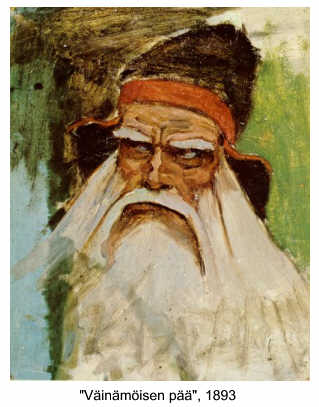
Väinämöinen is the eternal sage. After Ilmatar the goddess gives birth to the world, he is the first human born. He knows all manner of magic. I've always found it fascinating that much of Finnish magic comes from know the true names of things and being able to sing them. At one point, Väinämöinen faces a young challenger who thinks he can take on the old man, but he gets sung right into a swamp. The panicky Joukahainen offers his sister's hand in marriage, which starts another theme for the old magician: he never gets the girl.

Aino is the sister offered to Väinämöinen. Her parents think it's an advantageous marriage, but the beautiful young maiden finds little appeal in being joined to the ancient sage and finally drowns herself to escape. She comes back, however, as a salmon to taunt Väinämöinen, so she lives again. Väinämöinen's mother suggests he should go north to find a bride instead.

Louhi is the witch of the northern lands. There's a great split in the Kalevala between the people of the south in Kaleva and those in the north, so they're always portrayed as adversaries. Louhi, while seemingly as powerful as Väinämöinen, inevitably the stories depict her as "evil" which just sat wrong with me. As you might guess from our name, Louhi's Daughters, my friends Minna and Kasha shared the opinion that we were getting a rather one-sided view of Louhi and in our performances we tried to give a more balanced picture of this amazing woman. Our very first performance together was a retelling of the Aino story, which also proved a resonant touchstone for Unikirja.

While The Kalevala has a series of narrative threads, The Kanteletar is a looser collection of songs grouped by who sings them, i.e. men, women or children. There are also a number of ballads that would be sung by everyone. Not surprisingly, one of the songs is all about the kantele. The name of the collection is kantele plus the feminine ending, so you might think of "Kanteletar" meaning the spirit of the kantele, the source of all the songs.

Tomorrow and Sunday, I'll offer a taste of these stories.

Monday, May 04, 2009

Signing: Eastline Books

Just a quick note to let you know that I will be doing a signing for Unikirja May 30th at Eastline Books in Clifton Park, NY. The fabulous Robyn Ringler hosts many events at her independent book store and it's a great place to browse -- in fact, she'll be having a big sale that day. I expect there will be a lot of walk-ins and will be playing my kantele to intrigue them.

What's a kantele? That's tomorrow's topic (yes, it includes magic). In the meantime, off to the post office and then back to grading.

Saturday, May 02, 2009

Blog Tour

In an attempt to beef up my poor PR skills, I have joined a group that helps you develop a blog tour to promote your book. Of course, I want to promote Unikirja, but I'm a little uncertain about ways to do that well.

What's a blog tour? Instead of going out to various book stores or what not, you simply travel virtually from one blog to another. Like any kind of travel, it takes planning and coordination to go smoothly. Once it's set up, you try to get people to stop by -- offering them incentives of useful information and of course, free stuff. So, I'm adding a link on the side to all the folks who are doing the blog tour class together. Please drop by and check out their blogs.

One of the difficulties of this PR thing, is turning your work into a product. Given my book, it's a bit difficult because it's not a niche book. Finnish folklore? Myth? Legend? Magic? Spec Fic? A little bit of everything. In marketing, they talk a lot lately about "branding" (our new college website is all about the branding, hence the lack of flexibility).

So, what's my brand? Hell if I know. My first thought, "An acquired taste." Perhaps not as compelling as "It's The Real Thing" or "Finger-Lickin' Good." Guess I've got some work ahead of me. Suggestions welcome.

Tuesday, April 07, 2009

Two weeks to Unikrja


Available for sale in just TWO WEEKS! Hurrah! I will be scheduling a reading at East Line Books in late April or early May. Whoo hoo!

All right, no time to be giddy. Loads to do before heading to New Orleans at dawn tomorrow.

Wednesday, April 01, 2009

Not a Joke!


Proof copy! Thanks for bringing it down to my office, Gene. There is a least one little fix to be done, but it will be available for purchase within a week (yes, it will be on Amazon)! Hurrah!

Friday, March 13, 2009

Publication: Kantele

As I headed out the door to the office this afternoon, I found the premiere issue of Kippis in the mailbox. It features my story "Kantele" which is from the forthcoming (I swear!) collection, Unikirja.

I also finally got confirmation that I have been accepted for the Angela Carter conference, so very pleased with that as well. Everything's coming up Millhouse! When I can spare a moment from dashing around, I will write up this jam-packed week of fun -- which, as many of you already know, features an interview with some well-known residents of Northampton.