Showing posts with label Kanteletar. Show all posts

Sunday, February 12, 2012

Six Sentence Sunday: Palakainen

A simple concept: six sentences to win you over. Here's mine, from "Palakainen," one of the stories from Unikirja. As a special treat, you can read the entire story at Mythic Journeys. See the rest of the titbits at Six Sentence Sunday. And think about buying the ebook version of Unikirja. Kiitos.

 Swanlike she was born, swanlike did she grow, with white hands and a graceful neck and eyes that looked unblinking at you. The servants, who all grumbled day and night about their work, would give her the best of the cream, the finest weaving, the sweetest olut brewed for her. Her brothers and sisters too, who should be jealous of the attention our little star received, instead protected her, coddled her. Her sisters did the mending rather than let her prick her fingers. Her brothers gathered kindling, which should be her job, carried hay to the cows in winter, rather than let her chap her hands. Swanlike they stayed, white.


Palakainen she was named, our little tidbit, our little treat...


Thursday, May 26, 2011

Publication: Finnish Charms

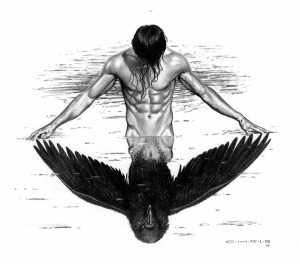
I had nearly forgotten about this: the Mythic Journeys folks have been going through some interesting transitions (which seems entirely appropriate) but the journal is back at last. I gave this paper at the Forging Folklore Conference at Harvard University in May 3-5 2007. Great conference! Peg and Hannah put together a terrific bunch of presenters including Ron Hutton (whom I teased about Kyrie whose voice always accompanied him on Historyonics), my mentors Steve Mitchell and Joe Harris, and the fabulous Byron, whom I met for the first time there. Before I gave the paper, I played the kantele and sang. Yes, me -- singing. I wasn't sure I'd do it until I opened my mouth. Good to do things that terrify you now and then. Love the image they chose.


Finnish Charms:
Appropriating Folk Magic from
the Kalevala and Kanteletar


By K.A. Laity

Kylä vuotti uutta kuuta,
miero päivän nousendoa.
Miepä vuotin minjoavani,
miepä vuotin minjovani.


The village waited for the new moon.
They said my brother would return
empty handed when he was off hunting.
They were wrong. The eagle caught the duck.

Värttinä, “Kylä vuotti uutta kuuta”
Truly they lie, they
Talk utter nonsense
Who say that music
Reckon that the kantele
was carved by Väinämöinen…
out of  a great pike’s shoulders…
no, music was made from grief
molded from sorrow…
so my kantele will not
play, will not rejoice at all…
for it was fashioned from cares
moulded from sorrow.                        
                       

My Kantele, Kanteletar 1:1

One of the least well known of modern reconstructions of folk magic must certainly be the realm of Baltic magic found in the ancient texts of Finland, but it has found a perhaps surprising popular resurgence in  recent years. The reprinting of Kati Koppana’s Snakefat and Knotted Threads has brought a handbook of folk magic to a new generation of reconstructionists, but the nineteenth-century collections The Kalevala and The Kanteletar continue to provide a rich supply of magical practices.  While originally the outgrowth of a rising sense of nationalism in nineteenth-century Finland, the two collections of myth and folklore also record a number of magical charms that give some insight into the ancient practices of the Finns, since lost in the (relatively) late conversion to Christianity and the long-practiced denigration of the indigenous tongues particularly by Swedish and then Russian political control...[read the rest and check out Anya's essay on Egypt, too]

Friday, May 08, 2009

The Kalevala and Kanteletar

One of the difficulties involved in introducing my story collection Unikirja has to do with most people's unfamiliarity with The Kalevala and The Kanteletar, the twin tomes of Finnish myth and folklore. The stories and songs that make up these collections are very old, but were gathered together in the nineteenth century as a surging sense of national pride grew. The tiny nation straddles the dividing line between the Baltic and Scandinavia, and had been dominated alternately by its two larger neighbours Sweden and Russia.

A doctor with a fascination for folklore, Elias Lönnrot set out to collect examples of the old tunes and stories that people told to try to capture what he saw as a vanishing way of life. In The Kalevala, he arranged these stories in runos to link together story arcs. You can read an English version online, but let me acquaint you with some of the recurring characters who show up in my stories.

Väinämöinen is the eternal sage. After Ilmatar the goddess gives birth to the world, he is the first human born. He knows all manner of magic. I've always found it fascinating that much of Finnish magic comes from know the true names of things and being able to sing them. At one point, Väinämöinen faces a young challenger who thinks he can take on the old man, but he gets sung right into a swamp. The panicky Joukahainen offers his sister's hand in marriage, which starts another theme for the old magician: he never gets the girl.

Aino is the sister offered to Väinämöinen. Her parents think it's an advantageous marriage, but the beautiful young maiden finds little appeal in being joined to the ancient sage and finally drowns herself to escape. She comes back, however, as a salmon to taunt Väinämöinen, so she lives again. Väinämöinen's mother suggests he should go north to find a bride instead.

Louhi is the witch of the northern lands. There's a great split in the Kalevala between the people of the south in Kaleva and those in the north, so they're always portrayed as adversaries. Louhi, while seemingly as powerful as Väinämöinen, inevitably the stories depict her as "evil" which just sat wrong with me. As you might guess from our name, Louhi's Daughters, my friends Minna and Kasha shared the opinion that we were getting a rather one-sided view of Louhi and in our performances we tried to give a more balanced picture of this amazing woman. Our very first performance together was a retelling of the Aino story, which also proved a resonant touchstone for Unikirja.

While The Kalevala has a series of narrative threads, The Kanteletar is a looser collection of songs grouped by who sings them, i.e. men, women or children. There are also a number of ballads that would be sung by everyone. Not surprisingly, one of the songs is all about the kantele. The name of the collection is kantele plus the feminine ending, so you might think of "Kanteletar" meaning the spirit of the kantele, the source of all the songs.

Tomorrow and Sunday, I'll offer a taste of these stories.