Showing posts with label inspiration. Show all posts

Wednesday, May 23, 2012

Writer Wednesday: Post Card Fiction Prizes


Making your mark in the world can be a tenuous thing; as long as the good will of others holds up or their indifference doesn't take over, you stand the chances of being forgotten within your lifetime. You may find fame and fortune, but the odds are against it. So don't be depressed by that! Make every day fun. Create something, anything. I made a lovely postcard for a friend this morning with my Tate Mod postcard book (a book of blank postcards of heavy paper stock) with my watercolour pencils and it sort of turned out like I imagined it.

As far as I'm concerned, that's success.

I got paid very well for a very short story: that's success, too. But it can't be the reason for doing it because writing takes so long even for a rather short story. The pleasure of creating, of figuring out the myriad puzzles that go into anything you make, that has to be its own reward -- often it will be the only one you get. Hey, I didn't say stop trying for more mundane success -- keep at it. As the lottery ads in NY say, "Hey, you never know." You stand a better chance at succeeding with your creativity that you do with the lottery anyway.

If you need a laugh, go read my silly poem "On Seeking a Place for a Picnic." If you want something more substantial, go read my reviews and whatnot over at A Knife & A Quill. Or go "like" our Burning Bridges book trailer: it's got a "dislike" -- I suspect our former publisher has found it.

All right, enough delay: let me announce the first annual Postcard Fiction Contest prize winners. First, let me thank everyone who entered. I was well pleased with your cards and stories -- some of you went all out and I have to say the postcards did enter into my deliberations. How could they not?

So I read and re-read and finally narrowed it down to three finalists. Because I promised a cash prize for the top winner, I decided I needed some other kind of prize, so it will be titles.

DICKINSON PRIZE (AKA second runner up)

"alessandra" for 'Amherst's Mad Pastoral' on postcard of Trastevere (I can almost taste the food)


MOORE PRIZE (AKA first runner up)

"mbilokur" for 'Better the devil you know' on postcard of Frida Kahlo, Diego Rivera & a giant papier maché demon


and the grand prize including cash in the current value of US$25 goes to --

[drum roll]

POSTCARD FICTION GRAND PRIZE

"shloobee" for 'Don't do it, Salvador!' on postcard of 'Salvador Dalí in jener fiktiven Position, die auf sein Gemälde La gare de perpignan übertragen wurde, assistiert von Dr. Soler-Roig in einem Helikopter' of which the text here follows:

'Don't do it, Salvador!' The lemur sounded more alarmed than she felt. Dalí was always up to some sort of ballbaggery and usually came out of it quite well. A token protest was always welcome to the artist's ears, however, and the lemur liked to please. 'Do not fear, my little one,' said Salvador, 'nothing can go wrong. This world is but an oyster in a jam jar ripe for the taking.' The lemur watched as Salvador pushed himself from the balustrade and swan dived out into the empty space. He hung there for a moment, or so it seemed...and then plummeted to earth. The lemur watched him hit the ground. 'Oh dear,' she said. 'Who does he suppose is going to clean that up?'

Congratulations, all!

Friday, May 18, 2012

Friday's Forgotten Books: Jean Craighead George

I was saddened to hear of the death of Jean Craighead George yesterday. I think Liz Hand first published a link on Facebook, but loads of others shared the news with the same feeling of loss for her absence and joy for her vivid adventures of the outdoors. One of my former students said she gives a copy of My Side of the Mountain to all the children she knows on their eleventh birthday. What a wonderful habit!

It's no hyperbole to say that book changed my life. A born pagan, I spent months afterward trying to live in the wilds of our back yard (>_<), constructing a "home" in the grapevines dividing my grandparents' house from the Tabors' next door, forming ambitious plans for the giant maple at the corner of our yard in the elbow of the L-shaped fields belonging to St. Gerard's, and attempting to mash acorns into some kind of pancakes -- producing bitter results, which I think Bertie can attest to as well (what are brothers for, but to experiment upon?).

I still long for a falcon.

She has an immense list of publications, which she admits to find intimidating:
This alphabetical list of books is enough to scare off even me. Some of the books listed below are no longer available in print. If you're interested, you probably can find them in the library. The list is not really long when you consider that there are almost 250 million beautiful plants and animals on this earth that I could have written about. 

Generous with herself she posted her email for people to write to her and gave children advice on how to write:
Most of us need a prod to get ideas swirling in our heads. Once that happens it is easy to write. Here are a few prods for writing a story. Perhaps you can use them, perhaps you will say "ugh" and come up with your own original way to write a book. No matter which - write - and write out of the love of words.
Drop by and see some videos with this lovely author and celebrate her life.

See the roundup of FFBs over at Todd's this week.

✍ And a proper announcement later, but check out the new dark fiction site, A Knife and a Quill, for whom I'll be writing reviews; they've kicked off with an interview with me. ☠


Sunday, May 13, 2012

Six Sentence Sunday: The Claddagh Icon

Another Sunday has rolled around; in the States it's Mother's Day, so happy Mother's Day to my mother and all the other mothers out there. It's also Six Sentence Sunday, so I've selected another story to tease you with. It's definitely a tease, because while I've sent the story off to my publisher in Italy, I don't know exactly when it's coming out or even if it will be available in English (I think so). It will be part of a series of sexy noirish tales set in different cities around the world -- yes, another publication venue that Mr B pointed me toward.

The story is named after a local landmark, this sculpture that appears on the Claddagh side of the bay, which is doubtless hardly surprising. Across Grattan Road there's another statue which really does look as I describe it in these opening lines. I enjoyed finding the voice of this character. As you might expect, I've spent a lot of my time here listening to the ways people talk:

I first saw her standing by the icon. I was saying hello to Father Burke's statue as he raised a glass to the offie across the street and thinking about indulging myself, it being a grey sort of day that calls for a smoky glass of the gold nectar. Under the halo of the icon, her golden hair glowed. The cormorant rose above her as if to proclaim her beauty to the world. I'm not sure what the boat represented: maybe it was my hopes sailing away...

This story won't be for everyone: steamy! And noirish, so not everything's going to go well for everyone. I'm enjoying the crime groove. My head's full of interesting ideas.

Don't forget -- you can sample a bunch of writers' sixes at the official site.

Thursday, May 03, 2012

Reviews: Guerilla Blues & Beowulf

Guerrilla Blues
Alessandra Bava


People tend to think writers give their friends good reviews because they're pals; the truth is you become friends with people who write stories or poems that inspire you to be better, to do more, to aim for dizzying heights. My jester -- the poet of Rome -- Alessandra's new collection offers wonderful evidence of that. Inspired by poets and revolutionaries the poems converse with everyone from Che Guevara and Simone Weil to Artaud, the Beats, Akhmatova and Pasolini. All are people who burned with inspiration and a revolutionary zeal.

That's the fire that burns through these verses. This dual language edition shows how Bava shines with incendiary passion in both Italian and English. Setting aside the incredible skill that speaks to (composing poetry in one's childhood tongue proves challenging enough, but to practise the art in another tongue --) the inherent desire to find as wide an audience as possible. In Bava's hand poetry is not a detached art of the drawing room, but a call to the barriers and a shout in the streets.

Burn writing to the stake &
immolate yourself in the form of
Poetry. Then, like Phoenixes,
rise in the form of Action.
Every line forms a potential molotov, from the titular poem's description of "Tattered books / of flesh as bomb / shrapnel / bleeding truth" and the ringing lines of "Sons of Disobedience" with its lines of fury, flesh and teeth. "This is No Chimera" speaks to the forces of acquiescence and conformity that press upon us all, maintaining that "The only requirement / is to believe in / hazardous deeds" lest we turn into Gregor Samsa-like bugs as "Wake Up!" warns, too.

It's all part of her "Rules of Poetry" (which also gives the name to her blog) which include "be fearless" as well as "demand respect" but most of all "kill indifference" because in the end

demand attention:
the poet is You.

Beowulf
adapted by Joshua Gray
illustrated by Sean Yates

As a medievalist, I always despair of people's dismissal of the time especially early works like this epic poem. Most people -- if they're exposed to it at all -- get it in school, taught very badly by someone who likewise knows nothing about the poem and its context. I wish I had a dime for every student who expressed surprise at the poem being nothing like they encountered in high school (hmmm, maybe I do...). So I'm always pleased to see attempts to introduce readers to the poem in new ways. Gray and Yates' volume attempts to bring the old story to new, young readers with bold illustrations and a simplified story.

The illustrations capture a dark mood of adventure; they're sufficiently gruesome though only suggestively so -- safe for parents, inviting for younger readers. Gray's text reduces the story to a speedy series of adventures in the conquering of the three monsters with efficiency and some flair. Hrothgar's "sermon" gets boiled down to its essentials: don't let pride rule, when you're king you're responsible for more than just your fame. The publicity materials refer to this as a "verse adaptation" but it reads like prose, but the language is lively enough to be engaging.

There are some contextual errors that made me give very Biggs-ian head snaps: wet suit?! Surely even a child completely ignorant of the time period would know that a wet suit is a very modern invention. A sword does not go into a "holster" and Heorot is not a "castle" in any way. None of these anomalies are quite as egregious as the mistakes in Cigale's introduction conflating time periods, clearly unfamiliar with the difference between a scop and a bard, and missing the cadence of half-lines. But he highlights one lynchpin of this adaptation: the eternal bond between fathers and sons and "all men", which is apparently the aim of all storytelling.

Because there are, of course, no women in this telling of the story (monsters excepting).

I feel like banging my head against the wall again. Why is it the 11th century monks who wrote this story down in England can have more regard for the importance of women than 21st century (seemingly) secular men? It's not as insulting as the Zemeckis film, where women are reduced to powerless concubines, but I'm mystified by this need to completely remove women from the story in order to glorify men. Is that really the message to give your sons? That they somehow exist outside the world of women and girls? I hope not.


Wednesday, May 02, 2012

Writer Wednesday: Postcards, Bits & Bobs

The deadline is fast approaching for the inaugural Postcard Fiction Contest! Be sure to get your entries in the mail to me in order to be in the running for that $25 prize. Deadline is May 15, 2012.

I'm interviewed over at Vic Watson's blog about some of my current projects. Drop by, share, leave a comment and be sure to check out her other interviews.

I just got my author copy of ACTION!: Pulse Pounding Tales, Vol 1 which includes my story "Chickens": it's 1968 and some good ol' boys from Bakersfield decide to head down to the big city to mess around with the hippies they saw on Cronkite. Bonus appearance from Cal Worthington and his dog Spot! Editor Matt Hilton describes the genesis of this collection:

Back in the late 1970s and early 1980s I was reading books ‘borrowed’ from my father’s stack of dog-eared paperbacks, that he acquired through a read and share scheme with his friends. It seemed that my father and his pals all shared a love of action tales the likes of Don Pendleton’s ‘Mack Bolan’, Richard Sapir and Warren Murphy’s ‘Remo Williams’, or George G Gilman’s homegrown western books, ‘Edge’ or ‘Adam Steele’, or a Nick Carter: Killmaster book.

Those books were high-entertainment to me and I couldn’t get enough of them, or indeed Robert E Howard’s Conan series, or Lin Carter’s Thongor of Lemuria, or Karl Edward Wagner’s Kane. I loved my stories full of action and adventure, and it didn’t much matter to me where, when, or how the story unfolded. It was through reading those kinds of books that got me into writing. I wanted to emulate the kind of books that I loved to read.

Apparently he's had an avalanche of interest, so Matt's already planning a second volume (and maybe more). The book will be available within days. I'll let you know when it's up. I should tell you too, that for every sale in the first month of publication, Matt will match with a donation of 50p to 'Help For Heroes'. We can all do our bit to help our injured servicemen and women: fictional heroes helping the 'real' heroes.

Of course there's also my story "Horse Clock" in Burning Bridges: A Renegade Fiction Anthology. You can get it for free on Smashwords, or you can get it for 99¢ on Amazon where all the proceeds will be going to to Literacy for Incarcerated Teens, a non-profit organization using the written word to help those in need of a fresh start.

And yes, there's still Drunk on the Moon as well: action packed paranormal noir with your favourite werewolf P.I. If you haven't got this yet, do -- it's a whole lot of fun and I'm not just saying that for my story "It's a Curse." You will rip through this collection hootin' and a hollerin' and havin' a good time. And while you're at it, think about getting another great charity-supporting anthology True Brit Grit.

All right: tomorrow I'll have some reviews for you including Guerilla Blues!


Tuesday, May 01, 2012

Tuesday's Overlooked A/V: What is Creativity?

Sculpture by David Batchelor at the McManus
Rabbit, rabbit! First of May and sumer is icumen in, lhude sing cucu! If you're out protesting in the streets, I hope you're enjoying a fine day. My film today is a bit of an odd choice, truly in the spirit of the "overlooked" like no other I've written on.

I *think* it's called What is Creativity? At least that's how I've remembered it all these years. I suspect it was an hour or less long, as it was shown to me in junior high art class in 6th and again in 7th grade. The only 'name' in it was John Astin, but it doesn't appear on his list of films in IMDB. The three things I remember from it are seemingly indelibly fixed on my memory -- however, given my proclivity for 'adjusting' quotations to suit me and never quite getting them right (a habit I gave to Ro in Owl Stretching) I'm sure I may have adjusted them somewhat. But they're so vivid! And as it was on creativity, I was sold from the start.

So, what I do recall of this elusive film: there's an animated sequence that covers the history of the world through art. The "dark ages" literally blackness until the 'Renaissance' comes along with a light [insert medievalist eye roll]. There's an exchange between Michaelangelo and someone else: "What are you doing?" "I'm painting a ceiling. What are you doing?" "I'm painting a floor."

There's another part that's a parable told with ping-pong balls almost Jonathan Livingston Seagull-ish, with one non-conformist ball who decides to try to bounce as high as he can, with an inconclusive ending, "Some say he never came down..."

My favourite bit was the part with John Astin, who played an artist who wasn't doing very well then suddenly had an inspiration to put together mannequin parts and gears and whatnot in a kinetic sculpture. He debuts it to a crowd of critics and suddenly he's dressed as a gunslinger as the potshots come in. He shoots back in vain until at last there's one positive voice in the noise: "I like it!" He leans forward, encouraging the comment, until he hears, "I mean the materials alone must be worth something!" Bang! And he goes down.


So, am I the only person who remembers this?

As always, find the complete round-up of neglected works over at Todd's.


Wednesday, April 11, 2012

Writer Wednesday: Postcard Fiction Contest


An inspiration I had: a contest to celebrate brevity in fiction. Write a story that fits on a postcard! Send it to me. I'll choose my favourite and give it a prize -- let's say $25. Entries open now until 15th May, 2012. All postcards I have received through that date will be in the running -- yes, from anyone anywhere in the world. My choice will be entirely capricious and not at all fair as it will be based on my own tastes. Yes, I'm sure the postcard itself could figure into my decision, so choose wisely. Stories remain your copyright, though you must allow me to post them here if I'm of a mind to do so (I will certainly post the winner). Winner to be announced within five days of the end of the contest. Failure to respond to my email indicating you are the winner within five days will lead to me choosing another winner. Anything else I need to clarify? Let me know.

How to do it:

1. Get a postcard.

2. Write a story on it.

3. Include your email address if you want a chance to win.

4. Send your postcard with sufficient stampage to:

Kate Laity c/o
Moore Institute/Institiúid de Móra
NUIG
University Road
Galway
Ireland

Please share the contest with all your writer and would-be-writer friends. Yes, I'm sure it will figure in my research somehow :-)

See our Facebook event page if you frequent those environs.

*This contest funded in part (though not authorised by) the Fulbright Foundation.

Sunday, March 25, 2012

Six Sentence Sunday: Horse Clock

This story was inspired by -- wait for it -- the clock on my mantelpiece and the Sekhmet postcard my friend Joey gave me. It started as a caption for the picture on my Facebook page. I liked the blue tone which resulted from the wrong setting on the phone ("fluorescent"? maybe). My friend Richard complimented me by calling it, "Hobanesque" which pleased me greatly. It will be in a collection soon; more as the details come together, but it will feature a number of writers all linked by the Burning Bridge theme.

My six:
 
At one time, there was another horse on the clock, but it fell in love with the chime and they ran off together, so the clock no longer keeps time. The horse that remains behind conceals his broken heart and keeps the ball ready in case anyone wants to play. Sekhmet awaits the desert breezes and the return of the rain.

"How does it begin?" The big hand asked the little hand.

"With laughter," said the little hand, "but it always ends in tears."

Drop by the Six Sentence Sunday blog to sample more writers.

Friday, March 23, 2012

Interview & Friday's Forgotten Book

Hey, that's me over at Book Reel talking about book trailers, my prodigious output and where I get my ideas (not Schenectady!). I had a terrific time answering the questions, so stop by and leave a comment if you're of a mind to and feel free to share the link where you can. Help me claw my way out of obscurity!

If you haven't already heard, the fabulous Alessandra Bava has a bilingual collection of poetry out, Guerrilla Blues. Her work is amazing: passionate, vivid, fearless. I can't wait to get my copy!

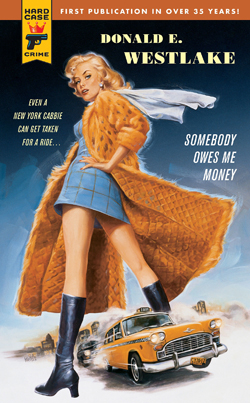
FRIDAY'S FORGOTTEN BOOK: Somebody Owes Me Money

Talk about prodigious outputs! Donald E. Westlake is a legend. Over a hundred novels, many under pseudonyms, mostly in crime but also in other genres as well. He was in the back of mind from some conversation this past week, so when I went to the library this week to return books I checked to see if they had any Westlake and sure enough, they did (not that my shiny shiny iPad Rook isn't groaning with books to be read >_<). This one looked like fun.

First published in 1969, Somebody Owes Me Money got this shiny new edition from Hard Case Crime in 2008. The main character is the hapless Chet Conway, cab driver and inveterate gambler. Not the sharpest tool in the shed, but he generally catches on eventually. There's something fun about writing a character that's going to be less swift than the reader and Chet fills the bill. The brilliant opening line plays with the gradual reveal: "I bet none of it would have happened if I wasn't so eloquent."

What happens is that Chet gets the tip of a lifetime, scores big, goes round to his bookie Tony and finds him dead. And then Tony's wife arrives and eventually the police and things don't look so good. Chet manages to get the police to believe he didn't kill Tony, but the next thing you know the bookie's sister Abbie arrives with a gun in hand, sure he did murder her brother and ready to get revenge.

Chet and Abbie make a winning pair, bickering and working at cross-purposes; she's way out of his league and Chet's constantly surprised to find her in the vicinity. If it weren't for Abbie, he'd have bought it in the first few chapters, which brings out his chivalrous desire to protect her, though as even he realises, "Abbie McKay was no helpless damsel in distress. She could take care of herself, that girl, I was sure of it."

Fun stuff: suspense, twists and turns as well as laugh out loud moments. Full of those nice little touches that give a richness to the story and fill in its world, like everyone arriving out of breath from the long walk up to Jerry's fifth floor apartment or the insane insurance calculations that obsess Chet's dad. Well worth a ride.

See all the FFB recommendations over at Patti Abbott's blog.

Friday, March 16, 2012

Friday's Forgotten Books: Angelica Lost and Found

When Russell Hoban died, I was among those who went first to Riddley Walker in mourning his passing. Somewhat neglected in the encomia was his latest book at the time, Angelica Lost and Found (though now Soonchild is out, too).

Angelica finds its inspiration from Ariosto's Orlando Furioso and from a painting of a key scene from the epic poem. Angelica is the woman chained to the rocks on the beach. The hero Ruggerio flies down on a hippogriff to rescue her from the sea monster, Orca. Girolamo da Carpi captured the scene in oils, now hanging in the Museum of Art in El Paso, Texas.

In Hoban's novel, our hero is the hippogriff who names himself Volatore and seeks out Angelica with whom he has fallen in love. How can an imaginary animal love a woman from a poem? He makes himself real, but finds she has become real, too, far away in San Francisco. Even when they find each other, their joy is momentary because reality just can't bear such dreams being made real. Some bon mots:

"Everything is real, Angelica. Reality is a house of many rooms, and sometimes we can enter more than one. Ariosto's words put real wind under my wings, made me fly. It was not only words on paper--I remember the air rushing past me, remember looking down on plains and forests, mountains and oceans. I lived, I flew over the sea in a painting by Girolamo da Carpi in a time long past."

"Why are you in my dream of reality?" 
"I don't know. Reality is a mystery to me and that's how I like it; an understood reality can only be an illusion." 

"Ok, Liv. If I told you I've had sex with an imaginary animal, what would your reaction be?"
"An imaginary animal?"
"That's right."
"What kind of imaginary animal?"
"A hippogriff."
"A hippogriff!"
"Named Volatore."
"Volatore!"
"Does repeating everything I say in italics help you to take it in?"

What can I say? It's Hoban-esque: playful, intelligent, sexy, irrational, thoughtful, sad, happy and fun. If you like that, you'll like this.

Look for the full list of overlooked books over at Patti Abbott's blog. er, Todd's blog.


Friday, February 03, 2012

Love and Theft

"I'm not quite as cool or forgiving as I sound..."

 "Floater" by Bob Dylan

I'll have some lovely photos from the trip to Connemara up soon, but there's something else I need to deal with first. This week has been a head shaking one in several ways that's ended up leaving me with a couple fewer publications than I had before.

However, before I get to that, a digression. Those of you who have experienced me teaching know my proclivity for doing that. I blame Beowulf: chock full of digressions. Like that great poem, however, my digressions have a point. Think of it as a parable and then a lesson if you like.

The other day on Facebook I shared Jim Jarmusch's quote that I love and have used before. It came in a nice graphic form, so I'll share it here, too.


I always say that becoming a medievalist saved me from the terror of "originality" -- because there's nothing like studying a thousand years of literature to show you without a doubt that every story has been told before. My creative writing students who find this revelation deflating I give the reassurance, "But no one has told your version." If I'd been paying more attention, I would have learned the lesson from Shakespeare. The bard's stories are not "original" -- looted from various sources from Ovid to histories to contemporary events. Yet no one told the tales as he did; that's why we still read him with such pleasure.

We need to recognize that we stand on the shoulders of giants; pretending that you have no influences is simply ignorance. The arrogance of believing that you can create anything without those myriad voices in your head, sights in your eyes, sounds in your ears, shapes in your hands is an illusion. The "stealing" Jarmusch refers to here is not a mindless copying of another's work but an appropriation of elements that resonate through your soul. Because once you've placed your stolen object in a new location, it transforms.

Bob Dylan is a master of this. Love and Theft offers a lot of "thefts" -- something Dylan's always been conscious of doing. His title comes from Eric Lott's book Love & Theft: Blackface Minstrelsy and the American Working Class. The album features what Greg Kot in the Chicago Tribune described as:

"The kind of twisted, instantly memorable characters one meets in John Ford's westerns, Jack Kerouac's road novels, but, most of all, in the blues and country songs of the 1920s, '30s and '40s. This is a tour of American music—jump blues, slow blues, rockabilly, Tin Pan Alley ballads, country swing—that evokes the sprawl, fatalism and subversive humor of Dylan's sacred text, Harry Smith's Anthology of American Folk Music, the pre-rock voicings of Hank Williams, Charley Patton and Johnnie Ray, among others, and the ultradry humor of Groucho Marx."

A fine list of looted treasures. What makes his work a success is not who he steals from, but what he does with the stolen goods. In my own small way, I've stolen from Dylan, too. My story "Tangled Up in Some Sort of Cerulean Hue" took Dylan's "Tangled Up in Blue" and mashed it up with Christopher Marlowe's Doctor Faustus and then just played around. My forthcoming novel Owl Stretching stole  its sadly funny tone from Kurt Vonnegut and stole as well as from William Blake (for all the quotes Ro gets wrong)  and The Descent of Inanna. I steal from everywhere; things collide in my head that would not collide the same way in anyone else's head. I run with those collisions and make something the original creators never intended and would not recognise. That's what Jarmusch means.

Witless theft, on the other hand, stealing without respect or transformation, is a crime not only in the legal sense, but to the spirit of creativity as well. Stealing someone else's work and passing it off as your own, you commit a shabby crime and a lazy one as well. In the digital realm, it's also easy to uncover. I've removed my two stories from Trestle Press for this kind of theft: cover art images, not words this time. I first got a tip off from Mr B and he has already found a new home for the Drunk on the Moon stories (well done!). I don't know what I'll do with "Mandrake and Magpies" yet. I'll think of something.

You can read other authors' (more timely) accounts of the revelations and fallout like Julia Madeleine's, Luca Veste's and BR Statetham's and they'll lead you to many more. I feel bad for the first time writers who received a painful lesson in the crazy world of publishing. After you've been through the folding magazine phenomenon and fly-by-night publishers you find it easier to shrug off the inevitable Dickensian Grubb Street betrayal. Swearing a lot helps at first, but then you just get back to writing -- it's what you need to do.

Tuesday, January 24, 2012

Tuesday's Overlooked Films: Ken Russell's Elgar

The BBC has been pulling out a bunch of Russell films from the vault in a grudging sort of admiration for the filmmaker's passing, including a doco on his life, A Bit of a Devil. So my DVR seems to be filling up with an assortment of things (which means I'll finally see The Boyfriend). I actually watched this in real time and plan to re-watch it soon. We're all used to thinking of Russell as the bad boy of excess (who, having seen it, can get the giant penis of Listomania out of their eyeballs?). Certainly a number of his films live up to that surreal excess.

But there is a range to his work -- even within his most excessive films (what would qualify for that? The Devils?) there are quiet enigmas. Elgar, a short film made for Monitor shows a restrained Russell at work but one who (as the doco tells us) delighted in dancing naked to extraordinary music. People tend to remember Elgar most for the song they hear at graduations, but there's so much more. Another one of those weird confluences of the zeitgeist: the events in Penda's Fen hinge on Elgar's Dream of Gerontius and the composer makes an appearance as the story takes place in the same location, the hills of Malvern.


I was talking about this on Twitter with a friend about how sensitive and deft the film was, how it put the music at the center. It tread the line between documentary and re-enactment without falling into the silliness that usually means. As Susie said, this was in sharp contrast to the slickness of current documentaries "and no silly camera work, no 'acting' Loved shot of Elgar walking into room of draped chairs to his draped billiard table." The film is full of striking images that encapsulate significant moments of Elgar's life (some of which reappear in Russell's work, but they're integrated into Elgar's story well). The music is the real star and Russell allows the audience to embrace the music full on, giving us space to really listen with visuals that compliment but never intrude on that experience. You can watch it in pieces on YouTube: not ideal, but worthwhile nonetheless. Excellent work.

See the roundup of recommendations over at Sweet Freedom.

Teaching tomorrow: eek. So much to do! Fortunately it seems as if the zeitgeist has taken the initiative to come up with a PR campaign for my forthcoming novel Owl Stretching, so that will save me some time.

Don't forget: enter to win a free copy of It's a Curse: Drunk on the Moon 7 over at Goodreads.

Monday, January 23, 2012

Haunted, Spies & a little Melancholia

Angela Carter: she's been a kind of spiritual mother to me since I first read The Bloody Chamber and knew I'd found a kindred soul. This week I finally started writing the novel that's been brewing in my head for some time now inspired by Carter and to some extent also by Kingsley Amis. Hard to imagine two writers more diametrically opposed, but there it is. They fit together in this project. So my head snapped back a little to see this story in the Guardian about Carter's postcards to her friend and literary executor Susannah Clapp. All kinds of resonance from the details in that story from her love of sending postcards to other coincidences that make me wonder just how much of Carter's life will intertwine with my story. Maybe it will only be at the start. Owl Stretching began the day I realised there would be no more sad, funny novels from Kurt Vonnegut, but his ghost only hung around now and then to remind me. He didn't really poke his nose into the proceedings much. Carter died far too soon (and about the age I am now). I feel a responsibility to write the kind of stories she might have written -- or at the very least, as fearlessly as she always sought to write. It's a goal. There's a slide show of the cards. Check it out.

I've got an interview up over at Ben Sobieck's blog, where he suggests I might really be a spy. It's funny how that theme keeps recurring: the first novel I ever wrote -- way back in high school -- followed the adventures of a wannabe spy. The title I'm sorry to say was Ace Spies Incorporated and the plot followed a similar path to just about every film from North by Northwest to The Man Who Knew Too Little with the innocent main character getting caught up with the real thing and quickly getting in over her head. The novel also featured thinly veiled versions of my teenage crushes, the Beatles (ah, that 70s resurgence of second wave Beatlemania). I don't think I have a copy of this anymore, although my old friend Carla might.

I finally saw Melancholia, but I'm not ready to write it up. Harrowing, I can say that much. Amazing, incredible visuals and powerful drama, yes -- but harrowing. And I start teaching Wednesday. Eek!

Friday, January 20, 2012

Friday's Forgotten Books: If You Want to Write

As I get ready to teach another Creative Writing course, I think about books to recommend at the end and here's a perennial recommendation. I'd also recommend Lynda Barry's What It Is as well, especially if you yearn to write but haven't quite figured out how to get the inchoate thoughts in your head out onto paper( and yes, Barry wants you to use paper). Like Barry's book Ueland's classic will give you confidence in your words. I chose this image because that's the edition I first had: it's been through many since then.

Ueland gets to the heart of the matter with her concise assertion: "everybody is talented, original and has something important to say." Everybody: that's an important underpinning of all that she writes here. You don't have to go out and live adventures or make yourself 'interesting' (a most films about writers suggest) in order to write. She's about the process -- the work of writing -- as the way to discover what you have to say. "I learned...that inspiration does not come like a bolt, nor is it kinetic, energetic striving, but it comes into us slowly and quietly and all the time, though we must regularly and every day give it a little chance to start flowing, prime it with a little solitude and idleness."

One of her "ah ha!" moments comes from reading one of Van Gogh's letters in which he begins by talking about how beautiful the scene outside his window is, then decides to try to sketch it. "And then on his cheap ruled note paper, he made the most beautiful, tender, little drawing of it," Ueland writes, and "the moment I read Van Gogh's letter I knew what art was, and the creative impulse. It is a feeling of love and enthusiasm for something, and in a direct, simple, passionate and true way, you try to show this beauty in things to others, by drawing it." That's the key: recognising something that matters to you and conveying it as accurately as possible.

Never ask yourself if your ideas are important. Don't worry about being profound: "I learned that you should feel when writing, not like Lord Byron on a mountain top, but like a child stringing beads in kindergarten - happy, absorbed and quietly putting one bead on after another." Remember, "...writing is not a performance but a generosity."

Obviously she and I agree about Blake, but there's a key there, too. "Don't always be appraising yourself, wondering if you are better or worse than other writers. 'I will not Reason and Compare,' said Blake; 'my business is to Create.' Besides, since you are like no other being ever created since the beginning of Time, you are incomparable."

I like to have her reminders. Ueland nourishes the soul and reinvigorates the heart

As always, check Patti's blog for a roundup of overlooked tomes.


Friday, December 23, 2011

Friday's Forgotten Books: Riddley Walker

Russell Hoban was a singular writer; when asked what kind of a writing I do, I have generally offered up Hoban as the "genre" in which I write. Sadly, his name didn't always resonate with people -- and that includes NY Times obit writers; though most memorials mentioned Riddley Walker, too many seemed to be speaking of his masterpiece second hand. While many of Hoban's works deserve the accolade of 'masterpiece' this is the one that resonated most deeply for me. I read Riddley first in high school around the time I also read A Clockwork Orange: these books cemented my love of languages in a fictional context, though when I re-read Riddley as an adult, it was as if I had never read it before. Becoming a medievalist brought a further level of amazement, and visiting Canterbury Cathedral to see the St. Eustace painting was the ultimate pilgrimage for me.

Along with the art of "being friends with your head" Hoban's books taught me to trust in my muse and just write the stories I had to tell and trust that somewhere out there might be readers who would find resonance with them (and that they wouldn't do so if I didn't write them). Fans of Hoban might not be as numerous as those of more popular writers, but my experiences with the Kraken show me they are extraordinary and devoted.

My obsessions with storytelling and ritual feature here. The essay originally appeared in Puppetry International back in 2006, one of the first academic essays of mine to appear in a  non-academic publication that I nonetheless listed on my CV. At the time it seemed a bit radical (is it peer reviewed?!) however since then  I have continued my slide into publishing with abandon wherever my words might be of interest. No regrets there. I suppose I could blame tenure, but I only got that last year, so I suppose it's just my lax attitude. (>_<) I recommend picking up the issue of PI  if you have any interest in puppetry: fascinating publication. I think there's more I have to write about puppets, even more about Punch, but things leak out of my brain at their own pace.

Here's the opening: I've put the rest up on Scribd (restoring my original title which I prefer). Be sure to see Todd's round-up of this week's Forgotten Books (Pattii's taking a break for the holidays).


Future Medieval Space: Performing “Punch” in Riddley Walker

Although he sets his novel Riddley Walker (published in 1980) in a post-apocalyptic future, Russell Hoban makes use of the medieval world to mark this future as a site of the “primitive.” For this stunted society, the most apparent aspect of the Middle Ages is the explicitly medieval legend and wall painting of St. Eustace, which still exists faintly on the wall of Canterbury Cathedral. Perhaps more important is his appropriation of the medieval mystery plays, which illuminate bibilical narratives and are traditionally performed on mobile wagons. As performed in Riddley Walker, the “Eusa Show” (a garbled version of the St. Eustace story) takes on many of the mystery plays’ aspects, transmitting the truths of the culture and entertaining people with education. This modified Punch and Judy show conveys the only narrative that remains after the apocalyptic devastation of English society. The ritual of the puppet show picks up the religious meaning of the mystery plays, but it also takes on a social and governmental function that medieval dramas typically lacked. Just as various dissenters from Lollards to Pelagians threatened the orthodoxy of Christianity in the middle ages, the young protagonist’s discovery of a real Punch puppet sets off a chain of events that destroys the carefully scripted Eusa show. Hoban’s use of Punch history gives this superb novel its authority, while the familiar art of puppetry provides a vivid connection to this bizarre future world for the modern reader...

Wednesday, December 21, 2011

Glorious Yule

Hello from the swirling mists of the haar. Tonight is the longest night; by the early hours of the morning the light will begin its return. May the return of the light bring you new hope and inspiration. Spring will come again. These long nights provide a great focus for contemplative work and transformation, a crysalis of dark shadows. What will burst forth from yours come the sun?


Wednesday, December 14, 2011

Goodbye, Russ

Sad news today that Russell Hoban has died. The author of Riddley Walker and so many other wonderful books has left this world without me ever having the chance to say how much I loved his books and how much I learned from them and from him. He taught me to trust being "friends with your head" and believing an audience would find you. If you are unlucky enough to be unfamiliar with him, drop by the Head of Orpheus and find out more. My thoughts go out to his family and to my fellow Krakenites.

I am that astonishment from which you write in those brief moments when you can write.
      —The Head of Orpheus in Russell Hoban's The Medusa Frequency


Thursday, April 07, 2011

Epiphanies and Inspiration

No column today: I'm not writing any this month as I'm just too swamped. Tonight's the dress rehearsal for the Camerata's production of Saint-Saëns' Carnival of the Animals with me as narrator. Do join us tomorrow night for the performance if you can at 7:30 in the Picotte Recital Hall of the Massry Center. It will be lovely -- we have some amazing performers.


From Rome

I had a little epiphany this morning: Modern publishing is like science, extracting genre from organic story like chemicals from herbs. The best stories straddle genre. I already knew the falseness of marketing to strict genres; what I hadn't realised was its similarity to how medical science has sought to isolate the "effective" chemical and extract it from the plant. What they've been discovering of course is that all the seemingly extraneous elements play important roles in absorption and so forth.

Over at UAlbany they had John Patrick Shanley visiting. I went to the afternoon seminar, as always hoping to hear something that will kick my brain back into high gear. I loved his story about how Cyrano de Bergerac inspired him as young teen in the Bronx, being both tough, smart and a freak -- and getting all his friends pastries with just the power of his words. "That's what I do." He has a very direct (and funny) way of talking, as befits an ex-Marine from a rough part of New York. You can see it when he mentions telling a critique partner in exasperation, "I don't know why you're alive," because his script was full of "lies" and bad writing. But he also says how much he hungers to have the ultimate romantic connection. A lot easier for an ex-Marine to say that and be taken seriously, but you see within the snappy patter the guy who wrote Moonstruck. The image that gave birth to that film was his mother's face and the sky that he saw as a child and then she was gone and what was in the sky? The moon.

He got a little impatient with one guy who seemed to want to pump him for the secrets to success and repeated exactly what I have always believed: writing has shamanic power. You're not writing for yourself, you're writing for your tribe (and sometimes, to find your tribe). All I need, he said, is a torch in the dark telling my stories before a circle of people. "The problem with a lot of bad writing is all the subtext, I'm sick of subtext." People speak less when they tell the truth, Shanley said, because it always costs them something.

Things to keep in mind as I keep working on the talk. Trying not to think about Lucky Jim too much. Be truthful. Offer something real. Tell my tribe what I know.

Saturday, December 04, 2010

Whirlwind Travel

NYC on Thursday to see Lynda Barry and Maira Kalman and today I'm off to Connecticut for the final party at the Aloha Alcohula. So, in haste with the hope of more later:


My route: drive down to Poughkeepsie, Metro North to Grand Central, arriving after everyone's already stopped waltzing. Then off to the Met Museum. Many things to see there: the Stieglitz, Steichen and Strand exhibit, especially Stieglitz's photographs of Georgia O'Keefe (even bought the postcard set), loved Katrin Sigurdardottir's installations, and of course, I'm always a sucker for Rothko:

Afterward I had a lovely sushi dinner and then headed over to the 92nd St Y for the talk: Lynda Barry is just so utterly amazing. She said she was really nervous and so what was best was to do something really frightening (though she said it would be even better to eat a hotdog, but --) so she sang a song to the tune of "Coal Miner's Daughter" that explained her family (Norwegian and Filipino) and her difficulties growing up. I can't capture her madcap and inventive conversation. She talked about everything from trying to find tears for great art and instead finding them when she met Jeff Keane of Family Circus, because that comic had given her such hope as a child, a way to imagine a happy family through that little circle. Or her Filipino grandmother who told the most horrifying descriptions of the woman who was really a vampire who took her legs off and crawled across your ceiling and used her long tongue to suck your blood because you leave your clothes on the floor! Her new book Picture This: The Near-Sighted Monkey Book is a companion piece to her incredibly inspiring What it is, but aimed at drawing rather than writing. She describes it as like Highlights but for any age and so if you were stuck in JiffyLube waiting for your car, you could pick it up and be less tense and really enjoy yourself. For her, the power of drawing is plain: after working on Cruddy for ten years on a computer, she was overwhelmed by the awesome power of the Delete Key. Once she started using a brush to write the letters, she finished it in nine months.

Maira Kalman is quite amazing too: though more reserved than Barry, she was equally inspiring and surprising. Her work shows the power of just keeping your eyes and mind open (what Russell Hoban calls "being a friend with your head"). Everything from a hilarious letter from Proust, a dead Swiss writer in the snow on a newspaper wrapping a parcel, the three hole punch at the Pentagon that puts holes in the paper on which top secret documents written: all of it can blend together in your head and come out interesting art. She even played the clip from WC Fields in The Man in the Flying Trapeze where they make fun of a pseudo-Gertrude Stein-ish piece.

Glad I made the trip down; fortunately Robert was able to give me a refuge halfway home from the train station as I got into Poughkeepsie about midnight. Of course he made me sleep on this:

Off to Connecticut today for my joint birthday party with Marko: it will apparently be the last party at the Aloha Alcohula before its make-over. Should be fun! I had my own make-over already:
It's actually purple not blue (note how washed out my eye color is), but nice and bright :-) Might wear my purple tiara, too.

Thursday, December 02, 2010

BitchBuzz: Why are People So Desperate to be Writers?

My column (in haste: NYC bound!):

Why are People so Desperate to be a Writers?

Everybody's a writer or wants to be. At least that's what the internet tells me. There are all kinds of ways to help writers or writer wannabes.
For example there is the persistent Twitter spam telling you that writers are needed very badly. There are ways to get paid for this, our urgent friend tells us. As Victoria Strauss writes at the Writer Beware® blog, the link included in that spam tweet leads to a service where you can pay to be told about jobs that will pay you for writing. Gosh!

Never mind that there are plenty of free sites offering the same thing: RealWritingJobs wants to help you out of the goodness of their hearts to find real writing jobs for about $50 a month. What a bargain! If that's not good enough for you, because you're an artist who's already written a magnum opus, why not pay PublishAmerica to enter one of Amazon's fine publishing contests? Wait—what's that? You can enter for free on your own? But what about the fine imprimatur that PublishAmerica gives you? You don't want to do without that, do you? And wait—that script writing contest for Amazon's new crowd-sourced film empire: did you know that they get to hold onto your script's rights for a year and a half even if you don't win anything?

Read the rest: http://life.bitchbuzz.com/why-are-people-so-desperate-to-be-a-writers.html#ixzz16xnp0mKV

UPDATE: I can't believe I forgot to include one of the things that sparked this story -- James Frey's Fiction Factory. Unbelievable.