Showing posts with label Friday's Forgotten Books. Show all posts

Friday, May 25, 2012

Friday's Forgotten Books: Lyrics and A Hard Road to Nowhere


A bit of a cheat: a music two-fer. One is old, but the other's new; nonetheless, given the difficulty of finding your audience in the ocean of new publications out there, it deserves a boost to the signal.

The Fall: Lyrics by Mark E. Smith

The lynchpin of my current writing career: what, you think I exaggerate? With stories like "It's a Curse" and "Bill is Dead" and "Mandrake Anthrax" and "Grotesque" and "Just Waiting"? I do occasionally have stories not inspired by Smith's lyrics but they're getting to be in the minority. The Fall's lyrics are like Zen koans mashed up with the ramblings of a mad meth drinker with overstuffed carrier bags.

My garden is made of stone
There's a computer centre over the road
I saw a monster on the roof
Its colours glowed on the roof

All the songs in this collection will forever be coloured by reading the German translations out loud on the tube going back from Kentish Town to Stockwell while giggling madly after that first hypnotic show. Magic.

John Hodgson's A Hard Road to Nowhere: The Blitzkrieg Bop Story captures that story from the other side of the equation; the intoxicating, maddening, frustrating and elating process of forging music in the fluctuating organism that is a band -- or rather a series of bands that finally create a centre of gravity that becomes Blitzkrieg Bop. Obviously blown away by The Ramones at a crucial age, Hodgson and his fellow bandmates find a wellspring of inspiration as the first eruptions of punk arrive in the remote northeast of England. The third person narrative occasionally feels a bit awkward but it provides a way to highlight the pages ripped from Hodgson's journals of the period, which capture the youthful highs and lows with vivid authenticity.

Cheap as chips: get it now -- and be sure to bookmark Hodgson's Soundcloud page for the music to accompany it. A wide variety of songs, old and new and updated. Good stuff.

See also my review of Val McDermid's The Distant Echo over at A Knife & A Quill.

Not sure if the FFB will be at Patti's or at Todd's -- check both, they're bound to be worth it.

Friday, May 18, 2012

Friday's Forgotten Books: Jean Craighead George

I was saddened to hear of the death of Jean Craighead George yesterday. I think Liz Hand first published a link on Facebook, but loads of others shared the news with the same feeling of loss for her absence and joy for her vivid adventures of the outdoors. One of my former students said she gives a copy of My Side of the Mountain to all the children she knows on their eleventh birthday. What a wonderful habit!

It's no hyperbole to say that book changed my life. A born pagan, I spent months afterward trying to live in the wilds of our back yard (>_<), constructing a "home" in the grapevines dividing my grandparents' house from the Tabors' next door, forming ambitious plans for the giant maple at the corner of our yard in the elbow of the L-shaped fields belonging to St. Gerard's, and attempting to mash acorns into some kind of pancakes -- producing bitter results, which I think Bertie can attest to as well (what are brothers for, but to experiment upon?).

I still long for a falcon.

She has an immense list of publications, which she admits to find intimidating:
This alphabetical list of books is enough to scare off even me. Some of the books listed below are no longer available in print. If you're interested, you probably can find them in the library. The list is not really long when you consider that there are almost 250 million beautiful plants and animals on this earth that I could have written about. 

Generous with herself she posted her email for people to write to her and gave children advice on how to write:
Most of us need a prod to get ideas swirling in our heads. Once that happens it is easy to write. Here are a few prods for writing a story. Perhaps you can use them, perhaps you will say "ugh" and come up with your own original way to write a book. No matter which - write - and write out of the love of words.
Drop by and see some videos with this lovely author and celebrate her life.

See the roundup of FFBs over at Todd's this week.

✍ And a proper announcement later, but check out the new dark fiction site, A Knife and a Quill, for whom I'll be writing reviews; they've kicked off with an interview with me. ☠


Friday, May 11, 2012

Friday's Forgotten Books: Complete Nonsense


Tomorrow is the 200th anniversary of Edward Lear's birth. There's a terrific blog that keeps track of all the events and and another that prints pages from Lear's diary. In a wonderful piece in the Independent David Quantick wrote winningly about Lear and the appeal of nonsense. I have to say, I was convinced before I ever read it that, "A little bit of nonsense is the secret of a sane life." Lear is one of those touchstones to which I always return.


You can't really go wrong where ever you start, but you may find you don't want to end. And there's all kinds of places to read on the web, if you don't have the money to spend. But The Complete Verse and Other Nonsense of course will give you much intercourse with rhymes that will soon become friends.

I wrote a poem and passed it off as one of Lear's. I had it published in Asinine Poetry. And then I made this recording. More nonsense, please.


Drop by Patti Abbott's blog Todd's blog this week and next for the full roundup. Mr Lear is part of a mighty triumvirate celebrating birthdays tomorrow, including Tony Hancock and the delightful Mr B. Happy birthday, boys!

Friday, April 06, 2012

Friday's Forgotten Books: Many Happy Returns

I am doing my taxes today which leaves little time for writing at present. I am somewhat abashed to find I spent over $6300 on travel last year. As luxuries go, that's one of the best.
I have Many Happy Returns: An Unofficial Guide to Your Income Tax Problems by Groucho Marx. I believe my brother Bertie bought it for me (either that or the lovely edition of Beds or quite possibly both). Alas, it's in storage in New York (having seen what it's going for, I hope it is in the good storage and not the outdoor place), so I won't be able to quote directly. Trust me, it's fun. As the man said,"Time flies like an arrow. Fruit flies like a banana," so we can all say,"From the moment I picked your book up until I laid it down I was convulsed with laughter. Someday I intend reading it."


As always, see the round-up of recommendations at Patti's blog.

Friday, March 30, 2012

Friday's Forgotten Books: The Life of Christina of Markyate

I don't think there's much chance of overlap with this week's choice. The life of a twelfth century recluse: it doesn't scream popular appeal, I suppose. But it should! A fascinating story and an early biography of a woman in a time when few but kings and saints got their stories told (fortunately at least someone important considered Christina close enough to the latter). I have begun writing a play about Christina's life in hopes of making it known to a broader audience, but as with so many things, it has had to wait in the queue for a bit. I have actually been spending these months in Ireland completing long delayed projects and jettisoning ones that are no longer relevant to my path.

Of course my brain insists on constantly coming up with new ideas, so it's a rather hopeless cause. If I had all the time in the world, it still wouldn't be enough.

Christina is born in Huntingdon to noble Anglo-Saxon parents, Autti and Beatrix. The story is a dove flew over to Christina's mother from the monastery and nestled in her sleeve and stayed there a week while she was pregnant, demonstrating of course that the child was touched by the Holy Spirit. You'd think after such a clear sign, her parents would resign themselves to offering her to the church, but no.

They get her engaged to a rich young man despite her protests that she'd like to devote her life to quiet contemplation. While we tend to think of the church as a repressive organisation in the current age, for women in the Middle Ages it offered one of the few opportunities for independence and a little authority (assuming you weren't born to a royal family or likely to be married into one). So they married her against her will, but she refused to consummate the marriage. So the bishop tried to rape her to make her more compliant; in a hilarious scene, she's divinely assisted to resist him.

She ends up running away to live dressed as a man with a monk: talk about a modern gal! Eventually she's allowed to take up the life of a recluse as she wished, but there are always problems. Christina's peerless conduct evokes envy in others and she has to frequently chastise her superiors because those men would rather wheel and deal wealth than praise god. So it's a busy life, fighting off demons and receiving prognostications from the Holy Spirit -- and only a few recognised her for what she was:

Hence, some of them called her a dreamer, others a seducer of souls, others more moderately, just a worldly-wise business woman...others who could think nothing better to say spread the rumour that she was attracted to the abbot by earthly love.

It's a wonderful capsule of twelfth century life; it's a familiar tale of the difficulties of being an exceptional woman. The Talbot edition has a terrific introduction, but can be a bit pricey unless you find a used copy. There's a more inexpensive edition of her life available now:


Drop by Patti Abbott's blog for the round up of other FFBs.

Friday, March 23, 2012

Interview & Friday's Forgotten Book

Hey, that's me over at Book Reel talking about book trailers, my prodigious output and where I get my ideas (not Schenectady!). I had a terrific time answering the questions, so stop by and leave a comment if you're of a mind to and feel free to share the link where you can. Help me claw my way out of obscurity!

If you haven't already heard, the fabulous Alessandra Bava has a bilingual collection of poetry out, Guerrilla Blues. Her work is amazing: passionate, vivid, fearless. I can't wait to get my copy!

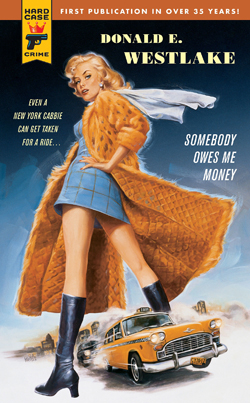
FRIDAY'S FORGOTTEN BOOK: Somebody Owes Me Money

Talk about prodigious outputs! Donald E. Westlake is a legend. Over a hundred novels, many under pseudonyms, mostly in crime but also in other genres as well. He was in the back of mind from some conversation this past week, so when I went to the library this week to return books I checked to see if they had any Westlake and sure enough, they did (not that my shiny shiny iPad Rook isn't groaning with books to be read >_<). This one looked like fun.

First published in 1969, Somebody Owes Me Money got this shiny new edition from Hard Case Crime in 2008. The main character is the hapless Chet Conway, cab driver and inveterate gambler. Not the sharpest tool in the shed, but he generally catches on eventually. There's something fun about writing a character that's going to be less swift than the reader and Chet fills the bill. The brilliant opening line plays with the gradual reveal: "I bet none of it would have happened if I wasn't so eloquent."

What happens is that Chet gets the tip of a lifetime, scores big, goes round to his bookie Tony and finds him dead. And then Tony's wife arrives and eventually the police and things don't look so good. Chet manages to get the police to believe he didn't kill Tony, but the next thing you know the bookie's sister Abbie arrives with a gun in hand, sure he did murder her brother and ready to get revenge.

Chet and Abbie make a winning pair, bickering and working at cross-purposes; she's way out of his league and Chet's constantly surprised to find her in the vicinity. If it weren't for Abbie, he'd have bought it in the first few chapters, which brings out his chivalrous desire to protect her, though as even he realises, "Abbie McKay was no helpless damsel in distress. She could take care of herself, that girl, I was sure of it."

Fun stuff: suspense, twists and turns as well as laugh out loud moments. Full of those nice little touches that give a richness to the story and fill in its world, like everyone arriving out of breath from the long walk up to Jerry's fifth floor apartment or the insane insurance calculations that obsess Chet's dad. Well worth a ride.

See all the FFB recommendations over at Patti Abbott's blog.

Friday, March 16, 2012

Friday's Forgotten Books: Angelica Lost and Found

When Russell Hoban died, I was among those who went first to Riddley Walker in mourning his passing. Somewhat neglected in the encomia was his latest book at the time, Angelica Lost and Found (though now Soonchild is out, too).

Angelica finds its inspiration from Ariosto's Orlando Furioso and from a painting of a key scene from the epic poem. Angelica is the woman chained to the rocks on the beach. The hero Ruggerio flies down on a hippogriff to rescue her from the sea monster, Orca. Girolamo da Carpi captured the scene in oils, now hanging in the Museum of Art in El Paso, Texas.

In Hoban's novel, our hero is the hippogriff who names himself Volatore and seeks out Angelica with whom he has fallen in love. How can an imaginary animal love a woman from a poem? He makes himself real, but finds she has become real, too, far away in San Francisco. Even when they find each other, their joy is momentary because reality just can't bear such dreams being made real. Some bon mots:

"Everything is real, Angelica. Reality is a house of many rooms, and sometimes we can enter more than one. Ariosto's words put real wind under my wings, made me fly. It was not only words on paper--I remember the air rushing past me, remember looking down on plains and forests, mountains and oceans. I lived, I flew over the sea in a painting by Girolamo da Carpi in a time long past."

"Why are you in my dream of reality?" 
"I don't know. Reality is a mystery to me and that's how I like it; an understood reality can only be an illusion." 

"Ok, Liv. If I told you I've had sex with an imaginary animal, what would your reaction be?"
"An imaginary animal?"
"That's right."
"What kind of imaginary animal?"
"A hippogriff."
"A hippogriff!"
"Named Volatore."
"Volatore!"
"Does repeating everything I say in italics help you to take it in?"

What can I say? It's Hoban-esque: playful, intelligent, sexy, irrational, thoughtful, sad, happy and fun. If you like that, you'll like this.

Look for the full list of overlooked books over at Patti Abbott's blog. er, Todd's blog.


Friday, January 20, 2012

Friday's Forgotten Books: If You Want to Write

As I get ready to teach another Creative Writing course, I think about books to recommend at the end and here's a perennial recommendation. I'd also recommend Lynda Barry's What It Is as well, especially if you yearn to write but haven't quite figured out how to get the inchoate thoughts in your head out onto paper( and yes, Barry wants you to use paper). Like Barry's book Ueland's classic will give you confidence in your words. I chose this image because that's the edition I first had: it's been through many since then.

Ueland gets to the heart of the matter with her concise assertion: "everybody is talented, original and has something important to say." Everybody: that's an important underpinning of all that she writes here. You don't have to go out and live adventures or make yourself 'interesting' (a most films about writers suggest) in order to write. She's about the process -- the work of writing -- as the way to discover what you have to say. "I learned...that inspiration does not come like a bolt, nor is it kinetic, energetic striving, but it comes into us slowly and quietly and all the time, though we must regularly and every day give it a little chance to start flowing, prime it with a little solitude and idleness."

One of her "ah ha!" moments comes from reading one of Van Gogh's letters in which he begins by talking about how beautiful the scene outside his window is, then decides to try to sketch it. "And then on his cheap ruled note paper, he made the most beautiful, tender, little drawing of it," Ueland writes, and "the moment I read Van Gogh's letter I knew what art was, and the creative impulse. It is a feeling of love and enthusiasm for something, and in a direct, simple, passionate and true way, you try to show this beauty in things to others, by drawing it." That's the key: recognising something that matters to you and conveying it as accurately as possible.

Never ask yourself if your ideas are important. Don't worry about being profound: "I learned that you should feel when writing, not like Lord Byron on a mountain top, but like a child stringing beads in kindergarten - happy, absorbed and quietly putting one bead on after another." Remember, "...writing is not a performance but a generosity."

Obviously she and I agree about Blake, but there's a key there, too. "Don't always be appraising yourself, wondering if you are better or worse than other writers. 'I will not Reason and Compare,' said Blake; 'my business is to Create.' Besides, since you are like no other being ever created since the beginning of Time, you are incomparable."

I like to have her reminders. Ueland nourishes the soul and reinvigorates the heart

As always, check Patti's blog for a roundup of overlooked tomes.


Friday, December 23, 2011

Friday's Forgotten Books: Riddley Walker

Russell Hoban was a singular writer; when asked what kind of a writing I do, I have generally offered up Hoban as the "genre" in which I write. Sadly, his name didn't always resonate with people -- and that includes NY Times obit writers; though most memorials mentioned Riddley Walker, too many seemed to be speaking of his masterpiece second hand. While many of Hoban's works deserve the accolade of 'masterpiece' this is the one that resonated most deeply for me. I read Riddley first in high school around the time I also read A Clockwork Orange: these books cemented my love of languages in a fictional context, though when I re-read Riddley as an adult, it was as if I had never read it before. Becoming a medievalist brought a further level of amazement, and visiting Canterbury Cathedral to see the St. Eustace painting was the ultimate pilgrimage for me.

Along with the art of "being friends with your head" Hoban's books taught me to trust in my muse and just write the stories I had to tell and trust that somewhere out there might be readers who would find resonance with them (and that they wouldn't do so if I didn't write them). Fans of Hoban might not be as numerous as those of more popular writers, but my experiences with the Kraken show me they are extraordinary and devoted.

My obsessions with storytelling and ritual feature here. The essay originally appeared in Puppetry International back in 2006, one of the first academic essays of mine to appear in a  non-academic publication that I nonetheless listed on my CV. At the time it seemed a bit radical (is it peer reviewed?!) however since then  I have continued my slide into publishing with abandon wherever my words might be of interest. No regrets there. I suppose I could blame tenure, but I only got that last year, so I suppose it's just my lax attitude. (>_<) I recommend picking up the issue of PI  if you have any interest in puppetry: fascinating publication. I think there's more I have to write about puppets, even more about Punch, but things leak out of my brain at their own pace.

Here's the opening: I've put the rest up on Scribd (restoring my original title which I prefer). Be sure to see Todd's round-up of this week's Forgotten Books (Pattii's taking a break for the holidays).


Future Medieval Space: Performing “Punch” in Riddley Walker

Although he sets his novel Riddley Walker (published in 1980) in a post-apocalyptic future, Russell Hoban makes use of the medieval world to mark this future as a site of the “primitive.” For this stunted society, the most apparent aspect of the Middle Ages is the explicitly medieval legend and wall painting of St. Eustace, which still exists faintly on the wall of Canterbury Cathedral. Perhaps more important is his appropriation of the medieval mystery plays, which illuminate bibilical narratives and are traditionally performed on mobile wagons. As performed in Riddley Walker, the “Eusa Show” (a garbled version of the St. Eustace story) takes on many of the mystery plays’ aspects, transmitting the truths of the culture and entertaining people with education. This modified Punch and Judy show conveys the only narrative that remains after the apocalyptic devastation of English society. The ritual of the puppet show picks up the religious meaning of the mystery plays, but it also takes on a social and governmental function that medieval dramas typically lacked. Just as various dissenters from Lollards to Pelagians threatened the orthodoxy of Christianity in the middle ages, the young protagonist’s discovery of a real Punch puppet sets off a chain of events that destroys the carefully scripted Eusa show. Hoban’s use of Punch history gives this superb novel its authority, while the familiar art of puppetry provides a vivid connection to this bizarre future world for the modern reader...

Friday, December 16, 2011

Forgotten Books

Normally, I'd try to have an offering for Patti Abbott's blog but as I am writing this from the comfort of Dundee where I am relaxing, I will just reiterate my birthday wish to request your help in keeping my books from being forgotten by liking, rating and reviewing them on Amazon, Goodreads, Shelfari and so forth. I would be most grateful!

Do it in the name of today's birthday kids, Jane Austen and Philip K. Dick, both of whom have been an influence on me.

This is the first blog post I've written on my phone. Let's see how it goes! 


Friday, December 09, 2011

Friday's Forgotten Books: Young Men in Spats

"I never want to see anyone, and I never want to go anywhere or do anything. I just want to write." 
-- P. G. Wodehouse

There's some kind of fundamental perversity in my nature that made me choose at the library this week a 5 CD unabridged set of Beckett's Malone Dies as well as P. G. Wodehouse's Young Men in Spats, but I'll leave you to sort out what that means.

Wodehouse's prose delights. A simple yet profound pleasure, one that most Americans in particular seem immune to -- a phenomenon I cannot comprehend. I suppose I can grasp there are those who dislike spending time with the (mostly) rich young things idling their time in (mostly) frivolous ways, as does Wodehouse's most well-known creation Bertie Wooster. More folks became enamored of them when Bertie and the inimitably shimmering Jeeves were brought to vivid life by Hugh Laurie and Stephen Fry (who seemed born to take the roles). But it's also true that Wodehouse has never received the acclaim more dour writers regularly do, because he makes everything seem so effortless. The key word there is seem: as Oscar Wilde could tell you, there's nothing that takes more effort than creating prose that feels effortless.

Wodehouse is a genius. While his topics may be nothing earth-shattering, his prose captures a crystalline brightness that seems impossible to replicate. It's so deft. So I will just share some of the delights from this volume detailing the exploits of some of the young men of "a little group of Eggs and Beans and Crumpets" who often regard women as a separate species:

"It saddened him, he tells me, when he opened his illustrated tabloid of a morning, to have to try to eat eggs and bacon while gazing at a photograph of Mae Belle McGinnis, taken when she was not looking her best because Mr. McGinnis had just settled some domestic dispute with the meat-axe."

"The foundation of the beverage manufactured by Mr. Silvers seemed to be neat vitriol, but, once you had got used to the top of your head going up and down like the lid of a kettle with boiling water in it, the effects were far from unpleasant."

"And on the morning of which I speak they had strolled into into the Thorpe and Widgery emporium to lay in a few little odds and ends, and there, putting in a bid for five pounds of streaky bacon, was a girl so lovely that they congealed in their tracks."

"The first intimation Barmy had that the binge was going to be run on lines other than those which he had anticipated was when a very stout Mother in a pink bonnet and a dress covered with bugles suddenly picked off a passing cyclist with a well-directed tomato, causing him to skid into a ditch, Upon which, all sixteen mothers laughed like fiends in hell, and it was plain that they considered the proceedings had now been formally opened."

"Already the barmaid's ears had begun to work loose at the roots as she pricked them up."

"Well, Freddie, as you know, has never been the dreamy meditative type. I would describe him as essentially the man of action. And he acted now as never before. He tells me he doubts if a chamois of the Alps, unless at the end of a most intensive spell of training, could have got down the stairs quicker than he did."

"He had studied Woman, and he knew that when Woman gets into a tight place her first act is to shovel the blame off on to the nearest male."


See the rest of the overlooked books at Patti Abbott's blog.

Monday, November 07, 2011

Know-vember: Todd Mason

Todd, of course, shows up here frequently whether as a fellow participant and sometime host of Friday's Forgotten Books and the host of Tuesday's Overlooked A/V or just as one of the regular kibitzers. He's on the left in this picture from a family wedding.


1. What's the first thing you do upon waking in the morning?

Pat/skritch the dominant, female cat in the house, Niki, who has probably awakened me so I can pat her and then feed the entire trio of household cats. 

2. What's a song you might be persuaded to dance to?

Some of the music I've actually danced to: THE MAIDEN IN THE TOWER performed by the Brubeck Quartet (a ballet suite that Brubeck didn't complete, but on the album COUNTDOWN the quartet recorded four pieces DB had finished); "She Said Yeah" as recorded by the Rolling Stones; "She's Not There" by the Zombies (introduced a party full of fellow high-schoolers, including eventual pro musician Deb Fox, to them at that time); THE FREEDOM NOW SUITE by Max Roach, et al.; Jawbox’s “Twister” and The Specials’ “Ghost Town.”

3. Where in the world do you live?

A house in Collingswood, NJ, though I also rent an apartment in Media, PA...but entirely too much time is spent in a gray cubicle in Radnor, PA. 

4. What's a great night out for you?

Good conversation, a good meal, perhaps a performance and a good bookstore (a/v materials also good). 

5. What's a great night in?

Conversation, meal, sex, perhaps other performance, and good literature (a/v materials also good). 

6. If you were offered an all expenses paid trip anywhere in the world, where would you go?

Tough call. I so rarely enjoy travel, having had entirely too much of the bad sort in my youth. There are all sorts of places I'd be interested in seeing, but getting there is less than half the fun. If it isn't a round-the-world journey, with many destinations (with rest breaks between), I'd be torn between, say, Italy and Australia, Guyana and Japan... 

7. What book do you wish everyone would read so you could talk about it?

I've spent several years citing those weekly, but among the very best ones are THE EXILE by William Kotzwinkle, LIVING MY LIFE by Emma Goldman, CONJURE WIFE by Fritz Leiber, THE FEMALE MAN by Joanna Russ, THE ENQUIRIES OF DR. ESZTERHAZY by Avram Davidson, THE ALEPH AND OTHER STORIES, 1933-1969 by Jorge Luis Borges, GOING OUT OF OUR MINDS by Sonia Johnson, TROPHIES AND DEAD THINGS by Marcia Muller. Dozens of others. 

8. What movie makes you cry?

In reverse chronological order, among those I recall causing some tears to well: SHAME (the Bergman sf film); PONETTE (who doesn't love a good setpiece of an recently-orphaned child of about six being tormented for her status by schoolmates?); PATHS OF GLORY (with the laughter); THE 400 BLOWS; SNOOPY COME HOME; "The Last of the Curlews" (the first ABC AFTERSCHOOL SPECIAL...they were trying, then). 

9. What makes you laugh?

Unexpected jokes, and well-executed expected ones. Humor that is not about others getting hurt (chided is OK). 

10. Are there fairies at the bottom of your garden?

David Campton's "At the Bottom of the Garden" convinced me at a young age to have them ruthlessly extirpated. 

Thank you!

You're welcome.

Friday, October 28, 2011

Friday's Forgotten Books: The Best of Myles

After the harrowing process of moving and desperately trying to unload many of my books, I have sworn to buy no more books and to adapt wholeheartedly to my gypsy life. Of course that lasted until I visited Charlie Byrne's Bookshop, a Galway institution. I was there for a reading, but I couldn't quite resist this book. So far, it's the only one I bought there. Let's hope I can keep to that.

Most people will know Flann O'Brien [true name Brian O'Nolan] from At Swim-Two-Birds or The Third Policeman, acknowledged comic classics. The Best of Myles collects the "Cruiskeen Lawn" columns he wrote as Myles na gCopaleen in the Irish Times. Yes, a lot of pseudonyms, eh? No wonder I love him.

I was reading this on the bus to Shannon airport last week and giggling in my seat, doubtless disturbing the poor woman next to me who thought I was some kind of lunatic. Ahem.

O'Brien maintains a tone of daft reasonableness whether he's plotting to take over the Irish Writers, Actors, Artists and Musicians Association (rebuffed in his offer to take charge, he first finds fault with all they do, then decides to form a rival splinter group), suggesting dialogue at the Abbey Theatre be printed as banners and hung above the stage so audience members can read ahead to catch their buses on time, or developing get-rich-quick schemes like his Beard Food (accompanied with appropriate sketches of the wonders it will provoke). He relates many adventures of "the brother" -- a schemer of the first order who nonetheless seems to garner a grudging respect from many despite his high-handed ways.

He addresses "the Plain People of Ireland" often -- and offers their suspicious views of his meanderings. No surprise as he invents business schemes of dubious execution: artisans who will give wealthy stupid people's books the impression of having been read, with increasing fees depending on the amount of wear and the addition of pithy ripostes or citations annotated on the pages, or ventriloquist dates to accompany the not very bright and provide their half of the sparkling conversations. The Plain people are inclined to interrupt with corrections of his spelling or signs of impatience when his self-glorifying goes on too long.

Among his vaunted skills are the accompanying drawings illustrating various points. The drawings are wonderful as well, offering valuable visual advice such as how to carry your drunken friend who has collapsed or how to cross a river without getting your top hat wet. Valuable advice indeed.

See the full list of books over at Patti Abbott's blog.

I did go to the reading last night and read my new poem because Kevin was soft-hearted enough to squeeze me in at the end. It seemed to go over well. I tagged along to the pub afterward and it was great to have a chance to get to know people a little more. Quite a community of writers here.

Friday, October 14, 2011

Friday's Forgotten Books: Three Plays by Mae West

You think you know Mae West, don't you? The slightly risqué performer with the voluptuous curves: who asked Cary Grant to come up and see her, told Beulah to peel her a grape? What you may not know is how much she cleaned up her act for the movies. Three Plays includes Sex, The Drag and The Pleasure Man. West's plays are hilarious, full of street cant and scorching satires on the sexual and gender mores of her time. The first of the three landed her in jail for "corrupting the morals of youth" where she dined with the warden and his wife, and told reporters she only wore silk underwear. The press loved her and she got a lot of attention, but her next play which dealt frankly with homosexuality got tryouts in the provinces (Connecticut and New Jersey) but was kept off Broadway by the "Society for the Prevention of Vice" (an early morality group). Her next play The Pleasure Man, about the backstage shenanigans of vaudevillian Lothario featured an enormous cast of actors, acrobats, female impersonators and dancers -- all of whom were arrested on two of the three performances that took place. West and her cohorts were acquitted after the jury split their decision. One suspects it might have gone something like this wonderful scene from I'm No Angel:


See the full round up of overlooked books at Patti Abbott's blog.

Friday, October 07, 2011

Friday's Forgotten Books: Werewolf of Paris

Yeah, I seem to have wolves on the brain of late. I'm not the only one as this window display in an Eyre Square shop shows. I can't explain -- oh, wait. Yes, I can. One reason is that I've got a story coming out soon: It's a Curse which will be the seventh installment in Paul D. Brazill's Drunk on the Moon series. If you haven't checked out Mr B's series, you are in for a treat. I had a lot of fun playing in his world with PI-turned-werewolf Roman Dalton. More as the time approaches, but I promise mayhem and humour in equal parts.

But on to the Forgotten:

Werewolf of Paris by Guy Endore (1933)

I think that this is one of the books I gave away while jettisoning my library for the move to Ireland, which I probably regret (but surely I can get an ebook). It was the primary source for Hammer's Curse of the Werewolf with its cursed child born out of wedlock on Christmas day, his mother violated by a priest. The young child Bertrand discovers strange hungers as he grows up, dreaming that he has changed into a wolf (oops, the dreams are real) and his uncle finds it difficult to cover up the increasingly nasty shenanigans of his nephew. After an explosion of assault, incest and murder, Bertrand runs off to Paris. He tries to find ways to manage his affliction and joins the Guard to fight in the Franco-Prussian war. He falls in love with an innocent girl. They try to cope with his hungers by letting him drink her blood. But eventually Bertrand fears he will hurt Sophie and ventures once more out into the city to satisfy his dark desires, exposing his secret and resurrecting danger for them both. The rest of the story is suitably gothic and tragic against the historic backdrop of the Paris Commune.

This is a fine gem and one that horror and Gothic fans will enjoy. For more overlooked treasures, drop by Patti Abbott's blog for a full round-up.

Friday, September 23, 2011

Friday's Forgotten Books: Saint Patrick's Confessio

People ask me what this "digital humanities" business is that I'm supposed to be engaged in for the coming academic year; the answer is long and complicated (but if you bring me a cuppa, I'll tell it to you). Among the kinds of activities that very big umbrella covers is one of the projects developed here at the Moore Institute: the Confessio of Saint Patrick.

You can look at digital renderings of the eight surviving manuscripts; you can read the text in English, Latin, Gaeilege, Italian, German or Portuguese; you can read a lot of essays that tell you about the context of Patrick's time, the manuscripts, the world he lived in and get a full bibliography of the sources. All from the comfort of your computer!

This is the sort of thing that shows you why medievalists, despite our reputation as people only to be found in musty libraries among handwritten tomes, tend to be geeks of the first order and interested in the latest technologies (okay, this does not apply to Fred Biggs ;-). The most plenteous text from the Middle Ages, The Prick of Conscience (not as racy as it sounds), boasts just over a hundred copies. Many exist in a single copy (e.g. Beowulf). Digital copies are so helpful!

For more FFB, drop by Patti Abbott's blog.

Friday, September 16, 2011

Friday's Forgotten Books: The Way We Live Now

I have a great love for nineteenth century novels. Their leisurely nature and broad scope allows readers to inhabit their worlds entirely. It makes them perfect for long afternoons reading, but I've found, too, that they suit perfectly for piecemeal ebook reading as well, which may at first seem unlikely. The truth is that depth and leisure make it very easy to pick up a book days or weeks later and fall back into the adventures without hesitation. I have read Trollope's The Way We Live Now over a matter of months, whenever I might be idle for a moment and have my iPod to hand.

Barchester Towers has generally been acknowledged as Trollope's masterpiece and I can't recommend it enough, but there's something timely about The Way We Live Now with its financial shenanigans—bounders, bubbles bursting and fortunes ruined—that fits our time perfectly. That it begins with a writer struggling to make ends meet likewise endears the book to me. The depiction of Americans in London—with their wild and brash ways including a woman who wields pistols—made me laugh, but by the end Trollope has characters acknowledging that while "They do tell bad things about them Americans," as the owner of a boarding house put it, some might be quite good to know.

The good characters nearly break your heart and the bad characters prove so fascinating that you almost understand their motivations even if you can't quite forgive their horrible behaviours. Let me offer some bon mots from the book to demonstrate Trollope's style such as his description of the Evening Pulpit, one of the papers Lady Carbury (the struggling writer) implores for a good review. The paper was meant to record events of the day and predict those of the morrow. "This was effected with an air of wonderful omniscience, and not infrequently with an ignorance hardly surpassed by its arrogance. But the writing was clever. The facts, if not true, were well invented; the arguments, if not logical, were seductive… A newspaper that wishes to make its fortune should never waste its columns and weary its readers by praising anything."

Of course her pleas were vain, and she appealed to her publisher to defend her. "Mr Leadham did not care a straw for facts or figures—had no opinion of his own whether the lady or the reviewer were right; but he knew very well that the Evening Pulpit would surely get the better of any mere author in such a contention. 'Never fight the newspapers, Lady Carbury. Who ever got any satisfaction by that kind of thing?'"

I think Trollope felt the sting of the situation sharply. It's hard to believe he might get such cutting reviews with his wonderful sense of nuance. Of the American woman he writes: "Mrs. Hurtle got up to receive him with her sweetest smile—and her smile could be very sweet. She was a witch of a woman, and, as like most witches she could be terrible, so like most witches she could charm."

Of the swindler Melmotte who ends up winning the seat for Westminster despite rumours of his financial misdeeds: "The more arrogant he became the more vulgar he was, till even Lord Alfred would almost be tempted to rush away to impecuniosity and freedom. Perhaps there were some with whom this conduct had a salutary effect. No doubt arrogance will produce submission; and there are men who take other men at the price those other men put upon themselves. Such persons could not refrain from thinking Melmotte to be mighty because he swaggered; and gave their hinder parts to be kicked merely because he put up his toe."

At a low point, Lady Carbury repeats to herself "those well known lines from the satirist — Oh, Amos Cottle, for a moment think / what meager profits spread from pen and ink." She plunges on anyway: if our characters were not to make so many errors of judgment, we would not enjoy their lives quite so much. Lady Carbury finds much to console her in the writing of her novel: "One becomes so absorbed in one's plot and one's characters! One loves the loveable so intensely, and hates with such fixed aversion those who are intended to be hated." However, on the bad days, "on a sudden everything becomes flat, tedious, and unnatural. The heroine who was yesterday alive with the celestial spark is found to-day to be a lump of motionless clay."

Trollope's gentle affection and even gentler derision invites the reader to think generously of characters despite their many faults. He says of the good, if unimaginative man Roger Carbury: "To a man not accustomed to thinking there is nothing in the world so difficult as to think."

Enjoy.

Friday, July 08, 2011

FFB: The Fallen

For the full list of Friday's Forgotten (or neglected or insufficiently trumpeted) Books, see Patti Abbott's blog. If you're in need of reading material, there are always wonderful suggestions.

I remember when Marko asked if I had got The Fallen yet and I said, "Nah, I'm really only interested in MES, don't think I'll be interested." But then my editor Simon at the Spectator sent me a copy of the updated edition and suggested I follow the author Dave Simpson on Twitter and, well, they were right. This is an amazing book about a singular band and the obsession it provokes -- which really is all about Smith. Shot through the main narrative is also Simpson's account of the unraveling of his own relationship as his obsession with tracking down the dozens of former Fall members grows. He finally realises he has hit bottom when he finds himself listening to -- and liking -- Phil Collins songs:

What greater slur can a man carry than admitting to listening to Phil Collins?


The tale begins and ends and really never travels too far from the enigmatic frontman (whose autobiographical tome I have also written about for FFB). Many of the Fallen have gone on to success on their own -- Brix Smith is a fashionista, Mark Riley a popular DJ, Julia [Nagle] Adamson head of Invisible Girl Records -- but so many expressed a willingness to return to the fold should the boss ever ask them to do so, despite the acrimony that often accompanied their departure. Smith's philosophy gets likened to a football coach, an intimidating schoolmaster and an experimental psychologist, who thinks, "routine is 'the enemy of music'" and that regular shake-ups help keep the team on their toes (as does fiddling with their instruments and equipment on stage in the midst of a show.

While people like to celebrate groups like the Rolling Stones that have been together since the Pleistocene era (yawn) because they don't want their favourite things to change, Smith has managed a musical sleight of hand by means of constant if unpredictable change. He's famously claimed that even if it's "me and your granny on bongos" it's still the Fall and he's right. A Simpson realises,

...for all the hiring and firing in the group, the person most feeling the pressure of carrying the legend like The Fall is Smith -- because, after all, it's his reputation on the line.

By the end of the book, there's a distorted collage of the genius behind the band. Smith seems to grow and change, to be all things to all people, a "God" to some and "the boss" to others, a trusted friend and an unruly psychopath. But singular -- and indeed genius. The Fall are musical Marmite, but I think anyone who loves the music scene will find this book riveting as it delves into the 70s, 80s, 90s and noughties. It's an amazing tale well told by Simpson. Highly recommended.


Friday, April 08, 2011

Carnival & FFB: Skeem Life

Tonight! The Saint Rose Camerata plays Camille Saint-Saëns' Carnival of the Animals. I will read some Ogden Nash poems between the songs. Unfortunately not among them is one of the tiny number of poems I can recite by heart (which includes Lewis Carroll's Jabberwocky and Dorothy Parker's Résumé):

The wombat lives across the seas
Among the far Antipodes.
He may exist on nuts and berries
Or then again, on missionaries.
His distant habitat precludes
Conclusive knowledge of his moods,
But I would not engage the wombat
In any form of mortal combat.


Wise words!


Get the full round up of Friday's Forgotten Books over at Patti Abbot's blog. I'm stretching the definition of FFB to cover a book that hasn't had much exposure and should: SKEEM LIFE by Gary Robertson. I met Gary on Twitter, first because of his band The Cundeez -- probably because I was touting the Punk Rock Juke Box with Marko (every Thu 12-3 and Fri 11-2 Eastern). Good stuff! As we got to talking, we discovered we both wrote and chatted about plays and books. Gary sent me a lovely package with Skeem Life and his book of poetry, Pure Dundee, and his historical study Gangs of Dundee. You're sensing a theme, eh? He also sent me The Cundeez CDs and a DVD of a performance of his play The Berries.

Well, you know that I'm usually quite good with languages and accents, but I have to admit while I had little trouble reading Dundeez, I have had to listen very closely while watching the play! I'm going to have to watch it again after reading and assimilating the books, but it's a very funny and often rather touching account of a day's work picking berries. Apparently buses would take people out from the city to pick berries during the height of the season, a welcome addition to their often meagre incomes during the tough times, but also a kind of break from the usual routine.

As Robertson puts it in "McGonagall's Disciples" (a reference to the legendary Scottish poet),

We are thi Dundee lihterahti
Ejicated on thi streetz an a but bren scatty

and they speak

Wi language az rough az a rhino's erse
Oary Dundonian in poetic verse
Itz oor tongue, oor dialect, itz how wi converse

You get acclimated quickly. And the stories in Skeem Life are often hilarious though also often relating dangerous events and somewhat scandalous situations, but the matter-of-fact spirit and unflagging sense of fun triumph. It's a hard life, but there's never any self-pity. Great stuff.

Check out the music, poetry and books, and be sure to keep it oary!


Friday, April 01, 2011

Friday's Forgotten Books: The Pillow Book of Eleanor Bron

I'm glad to put the March madness behind me, but as it's April Fools' Day, I'll not trust that things are any less insane. No column yesterday because as I discovered last night, I forgot to send it -- d'oh! Maybe it'll be up later today. That's just how it's been. Some of the madness is good: keep your fingers crossed.

Publication: Check out my faux Lear in the April issue of Asinine Poetry and "like" it if so inclined. See also my "hack" bio. The editor writes:

Ms. K.A. Laity is capable as few poets are of a nubile, incessant verse that wears its pants lightly. Her poetics do not hold to some center, but instead bounce around the space in a vain effort to catch the laser point of reason.

High praise, eh -- er, something...

Don't forget to peruse the other offerings of overlooked books at Patti Abbott's blog.

FFB: THE PILLOW BOOK OF ELEANOR BRON

First, massive thanks to Todd for getting me this. We had nearly given up on it arriving and then at last it did. It's a hard to find book, which is a travesty. You doubtless know Bron if only from my mentions of her with my idol Peter Cook or in the Beatles' Help! or of course as Patsy's mother in AbFab.

What you may not know is that she is a crisply intelligent observer and witty self-deflating writer. Working with lionized men like Cook, Moore, Miller and Bennett in Beyond the Fringe and of course, The Beatles, Bron often finds herself on the fringes of the excitement and ignored. Yet she never seems resentful although frequently amused and always sharply observant. Here she is on flying to Nassau with the Fab Four to film the tropical sections of Help!:

I was not prepared for the noise when we walked out onto the tarmac. It was Trafalgar Square with the volume up, beyond imagination -- the sound of millions of starlings startled into the air, But the starlings were girls, when I looked back, very very young ones, who covered the airport buildings. Wherever you could see, wherever they could see, wherever they were allowed, and elsewhere, oozing and easing themselves in where they were not; waving banners and arms, pushing and heaving, in great danger I imagine of falling over edges, wriggling and ceaselessly squealing -- a high sighing hopeless poignant sound, unrequitable.

She reprints a letter from EM Forster who says he's looking forward to seeing her in the dramatic adaptation of Howard's End. Bron makes little lists, "poignant things" or "disappointing things" or "remarkable things":

-- my mother's total lack of vanity
-- my father's sense of fairness

The glamourous world of show business, which she seems nonplussed to find herself immersed in, gets treated with an explorer's eye of discovery and sometimes a dazzled look of amazement. The whole of this book is delightful and I long to sit down to tea with Bron and just talk for hours. Sigh.