Showing posts with label opera. Show all posts

Friday, July 29, 2011

Friday's Forgotten Books: Between the Angels and the Apes

Not so much "forgotten" as -- what? Aborted? Headed off at the pass? The initial news was wonderful: Alan Moore writing an opera on John Dee with Gorillaz! What's not to love? It sounded like a match made in an alchemical lab somewhere with the potential of turning into gold. There was just one problem: Gorillaz couldn't be bothered to come up with some artwork for Moore's magazine Dodgem Logic despite having the issue held for them several times.

Really? Is it so hard to give a little quid pro quo? Apparently, so that was that.

Well, if you're Alan Moore, you just get on with the billion other projects you have going and publish what you have in Strange Attractor, and if you're Damon Albarn, you make your own opera on Dee anyway.

The lovely thing about Between the Angels and the Apes is how the notes reveal (once again) Moore's structural approach to composition. Consider the opening section of the outline:

If we're to create an approximately ninety-minute piece on the subject of Greatest Dead Englishman John Dee, then a solid and conventional place to start structurally would be a classic three-act construction with sections of a half-hour each. This also seems to fit nicely with the triangular Greek delta symbol (which is how Dee identifies himself in the facsimile notes presented in A True and Faithful Relation of What Passed for Many Yeers between Dr John Dee and Some Spirits [Meric Casaubon, 1659] and is also the elemental symbol for fire, which is in turn the element that represents the highest spiritual component of the magician or, indeed, the ordinary human being).

Moore further breaks down each section into subsections with flashbacks and the opening and closing scene of the dying Dee in Mortlake with his daughter. It almost seems as if Moore comes up with the idea of breaking the fourth wall as he writes, suggesting that the magician can sense the audience as "spirits of futurity" watching him from the time to come. His take on Queen Elizabeth is that she's a kind of Faerie Queen and he suspects "that Dee's devotion to Elizabeth was at least partly erotically inspired" so imagines her  as more "otherworldly and erotic" than traditionally envisioned. It's a fascinating look at a show that will doubtless never be. Yes, it includes some of the text as well as the notes for the piece, although it remains unfinished.

You can buy this issue of the journal, which also includes Moore Bumper Book of Magic collaborator Steve Moore, no relation, but subject of his performance piece, Unearthing.

Find this week's round up of Forgotten Books over at Sweet Freedom, next week back at Patti's.

Last week's FFB included Todd's write up of our comic Jane Quiet for which he's given me and Elena the best pull quote ever:

Laity might be the literary child of Angela Carter and Peter Cook and Italo Calvino, and Steier the artistic child of Trina Robbins and Gahan Wilson and Jules Feiffer, and not a little dash of Joan Aiken.

Yes, I plan to employ that one.

Tuesday, June 14, 2011

Review: Terry Gilliam's The Damnation of Faust

I had a lot of trepidation about the ENO production of Berlioz's The Damnation of Faust; not because Gilliam hadn't done opera before, which seemed to put some people off—after all what better to do with an over-sized imagination than put it to use in the heightened spectacle of opera?—but because of the trailer and the thought, "Oh, not Nazis again." The ultimate banality of evil is that it can be used without controversy or effect. Apart from bizarre extremists of various stripes, most people are are board with the whole Nazis=bad, so I imagined some ham-handed club about to be wielded over the audience.

But yeah, I got my ticket anyway. It was bound to be spectacle, right?

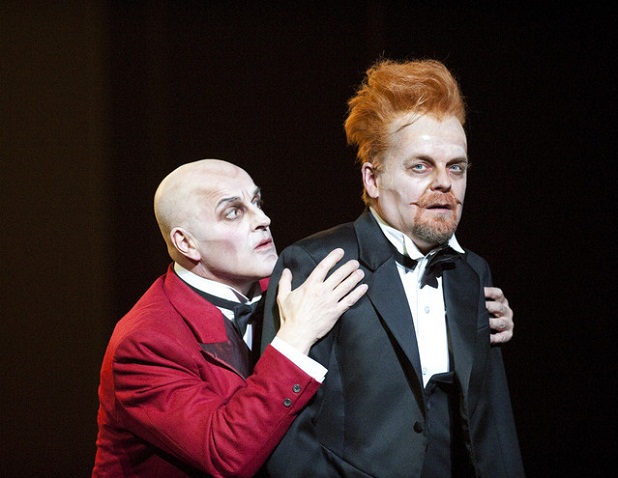
Gilliam did not disappoint. The production literally starts with a bang that clearly startled many in the audience. Enter Christopher Purves as Mephistopheles with a few of his lost souls, announcing himself as our infernal compere for the evening. His hellfires seem to always be ready to lick at the feet of the players, ever present. As our shock-headed Faust, Peter Hoare enters the pastoral opening his work literally on his back as he ignores the courting couples in the forest in search of solitude to return to his calculations and contemplation, but the spirit of the spring invades, including a Krampus and Holda as if it were almost a mythic spring. How can he resist?

Mephistopheles persuades Faust out of his cell at last; the cell looks not like a monkish scholar's room, but a holding cell in an asylum. Coupled with Faust's later appearance in a straight-jacket, it may be a way to cast doubt on the veracity of all that occurs, but it's not really important.

I have to admit, the Nazi motif worked perfectly; after all, Berlioz's opera unfolds against a backdrop of war. The slight relocation in time suits. We see the rise of the fascist movement gradually as Faust's own story unspools. In the tavern scene a few brown shirts stand out, but as the scene unfolds we see them gradually muscle through the crowd and gradually more chorus members remove their jackets to reveal brown shirts and uniforms underneath, until the majority of the tavern crowd has joined up. It works.

It works too that Marguerite is a Jew that Faust first sees singing the role of Brunhilde in the Ring wearing a blonde wig. Mephistopheles' careful maneuvering of Faust into her room occurs on a setting that I knew at once would turn into Kristallnacht, but Gilliam kept the audience waiting for it then in the midst of the scene, rolls back time restoring all the broken windows and returning people to their homes to replay the scenes slightly differently with more direct interference from the demon. You begin to suspect that all the mayhem in the land has been his doing.

I find Berlioz's opera a lugubrious affair and I much prefer Marlowe's Faust to Goethe's sappy romantic, but Gilliam had the story cracking along with the most amazing visuals that combined good old fashioned stage craft, projections, puppetry and a good bit of flash and explosion. The mad race to "save" Marguerite was a fantastic hell journey, the final damnation an incredible glorious release of the hellfire, and so many moments were simply cleverly apt and nimble. It was a great way to employ Gilliam's tendency to excess without the impression that anything was superfluous.

Of course the cast was superb: Purves' Mephisto had the right combination of oiliness and menacing bombast. Hoare's Faust managed to convey the emotional wrenching of his character without ever tipping over into bathos. Christine Rice's Marguerite offered up a silky heroine with a voice anyone might fall for. The role is so small yet so important; Marguerite really has to knock your socks off in her opening song and then break your heart soon after. Rice was amazing; when Marguerite sang her breaking heart on the way to the gas chambers, there were a lot of wet cheeks in the audience. The whole orchestra and chorus were superb of course; the practically filled the stage at the curtain.

The good news is that there was a crew from the BBC (and a huge group of folk attending as well) so perhaps there will be the opportunity to see some of this even if you couldn't be there for the final performance. Gilliam looked giddy as he joined the cast on stage for the final bows. And why not? Well done, indeed.

Tuesday, April 14, 2009

Publication: Heofen rece swealg

My essay about the Grendel opera, "Heofen rece swealg: Neomedievalism and Spectacle in Grendel: Transcendence of the Great Big Bad" appears in the latest issue of This Year's Work in Medievalism.

This was the paper I gave at the conference in London, Ontario in October 2007, where Terry Jones of the Pythons was the keynote speaker and all around bon vivant. Great conference and hey, a publication *and* a Python out of it. Who could ask for more?

Friday, August 08, 2008

Publications

I always forget about so many of the things I've written until I have something jog my memory. This week my faulty memory was jogged by reminders about revisions. I had completely forgotten about one of the essays (yeah, that's just how absent-minded I am) and that I was supposed to be revising it. Hee hee -- I have a book review due at the end of the month, too, that I have not forgotten about (I swear, John).

The first is "Heofen rece swealg: Neomedievalism and Spectacle in Grendel: Transcendence of The Great Big Bad" which will appear in an upcoming issue of Studies in Medievalism. It's developed from the paper I gave at the conference in London last November -- the one that also featured Terry Jones. It's about the Grendel opera directed by the fabulous Julie Taymor.

The other essay is "Medieval Community: Lessons from The Black Knight" which will appear in the inaugural issue of LATCH: A journal for the study of the Literary Artifact in Theory, Culture, or History, which I believe will come out in November. I originally presented that as conference paper, too, at Kalamazoo.

Yes, folks -- that's the way to accumulate academic publications less painfully. Commit to a conference (a fairly innocuous thing to do, usually only requires a one page abstract of what you might write); once you've been accepted, think about that ten page conference paper and finally write it (depending on your working habits and Powerpoint needs) a month before the conference (or a week, or on the plane, or -- if you're the really edgy [Miss Wendy*] type, in the bathroom of the hotel the night before you give it while your suite-mates slumber). Once you have the conference paper, someone will possibly ask you to submit it for publication, which you agree to do, then panic once the deadline looms. So you mash it out haphazardly and send it, apologetically reminding the editor that it's just "a draft" of course. Disparaging reader comments help you fix it into something less embarrassing. Then, just when you've forgotten you ever wrote the thing, you find out it's about to be in print.

*in the interest of fairness, I think I ought to mention that she was just finishing her paper, not writing the whole thing...

Monday, March 03, 2008

The Doctor will be In

Thanks to Crispinus, I just found out that Jonathan Miller is going to be at Skidmore next month. Whoo hoo! He's like a rock star of British comedy, theatre and performance. I remember being riveted to the tv every time he was on Dick Cavett back in the 70s and 80s. Of course, the fact that he was one of the stars of Beyond the Fringe has no effect on me whatsoever (gaah, goggle, drool!).

Maybe they'll get Alan Bennett next year (well, a gal can dream). Here's the schedule (the first event might not be open to the public, but I'll be in SF anyway):

Date: Thursday, March 20th
Time: 7:00 p.m. to 12:00 midnight
Location: Emerson Auditorium, Palamountain Hall
Film Titles: (viewed in this order)
Jonathan Miller Interview w/ Dick Cavett on directing Shakespeare (The Taming of the Shrew); Jonathan Miller Interview w/ Charlie Rose on directing Shakespeare (King Lear); Jonathan Miller Lecture at Museum of Fine Art Boston (topic - Vision in Relationship to Art); and Jonathan Miller staring in the comedy Beyond the Fringe.

There are three public events scheduled during the Residency. Each is noted below.

Date: Thursday, April 3rd
Time: 8:00 p.m.
Location: Davis Auditorium, Palamountain Hall
Event: Jonathan Miller Lecture - Laughing Matters: Humor & Comedy

Date: Monday, April 7th
Time: 7:30 p.m.
Location: Davis Auditorium, Palamountain Hall
Event: Panel Discussion - Film & The Imagination

Date: Tuesday, April 8th
Time: 4:30 p.m.
Location: Payne Room, Tang Museum
Event: A Conversation with Jonathan Miller